Upadhyayula Lakshman Rao
In the resonant cadences of the Jagatī and Triṣṭubh metres of the Rigveda, the sage Agastya lifts his consciousness toward the Maruts, the radiant storm deities who move between heaven and earth as mediators of both energy and intention. They are invoked as impartial participants in every yajña, not bound by preference but aligned with the cosmic rhythm that sustains all sacred acts. In this vision, the Maruts become the subtle transmitters of human aspiration, carrying the essence of ritual offerings to the divine realms, much like natural forces carry signals across space. Their presence affirms that no act of sincere invocation is lost in the vastness of existence.
The Maruts are portrayed as guardians of both terrestrial and celestial domains, embodying the dynamic forces that regulate balance within nature. They are not merely mythic figures but representations of atmospheric energies—winds, pressure systems, and electrical phenomena—that sustain life on Earth. Their “self-proclaimed” strength reflects the autonomous power of nature itself, which operates without human command yet responds to human awareness. In calling upon them through disciplined prayer, the sage acknowledges a profound truth: that harmony with nature arises not from control, but from attunement.
Clad in the luminous robes of the heavens, the Maruts are likened to nurturing cows that yield life-sustaining milk, a metaphor deeply rooted in Vedic symbolism. Here, nourishment is both physical and spiritual, echoing the cycles of rainfall and fertility that sustain agriculture and life. The waters they release are not random but measured, sustaining ecosystems with precision. This imagery mirrors the hydrological cycle, where evaporation, condensation, and precipitation function as a continuous offering of life to the Earth, revealing an ancient intuition of environmental balance embedded within poetic expression.
The hymn speaks of the sanctified soma, a refined elixir that works subtly upon the heart and mind, suggesting an early understanding of altered states of consciousness achieved through ritual and meditation. As the devotee contemplates the Maruts, their presence is felt not externally alone but within the depths of the heart, indicating a psychological dimension where divine forces correspond to inner states of awareness. This union of outer nature and inner experience reflects a sophisticated integration of spirituality and proto-scientific observation.
The Maruts are further described as warriors adorned with radiant weapons, their strength both protective and transformative. Their weapons, gleaming like finely forged swords, symbolize the forces that cut through inertia and ignorance, much like lightning cleaves the sky. The imagery of weapons embracing their sinews as a beloved consort suggests an intimate unity between power and purpose, where energy is guided with precision rather than chaos. This can be seen as an early metaphor for controlled energy—forces that, when harnessed, sustain rather than destroy.
Their collective nature is emphasized: they move as a host, inseparable and harmonious, reflecting the coordinated behavior of natural systems. They are immortal, untouched by sin, not in a moralistic sense but as embodiments of processes beyond human error. Their manifestation across many yajñas signifies their universality; wherever there is transformation, movement, or exchange, the Maruts are present. Their luminosity evokes the brilliance of lightning and the charged atmosphere before rain, phenomena that inspire both awe and understanding.
The hymn vividly captures their capacity to shake even mountains, a poetic reflection of the immense forces within nature, such as storms and seismic energies. Yet they arrive with ease, their motion swift and unimpeded, bringing vitality to the environment. Their “sweet words” can be interpreted as the gentle sounds of wind and rain, which, though powerful, also soothe and sustain. This dual nature—fierce yet nurturing—reveals a nuanced perception of natural forces as neither wholly benevolent nor destructive, but inherently balanced.
The Maruts are richly adorned, their brilliance enhanced by their ornaments and weapons, symbolizing abundance and potency. The imagery of the tongue between their jaws becoming prevalent suggests the articulation of power through sound—perhaps an allusion to thunder, the voice of the storm. Their prevalence is compared to rain spreading through clouds, emphasizing their self-manifesting nature. Just as clouds naturally yield rain, the Maruts naturally express their शक्ति, their intrinsic force, without external prompting.
The inquiry into the origin and destination of waters reflects a philosophical curiosity that borders on scientific inquiry. Where does the rain arise, and where does it go? The Maruts, in breaking the waters like straw, symbolize the release of stored energy within clouds, while the light that divides them evokes lightning, a phenomenon that precedes rainfall. This passage reveals an early attempt to understand atmospheric processes through symbolic language, blending observation with reverence.
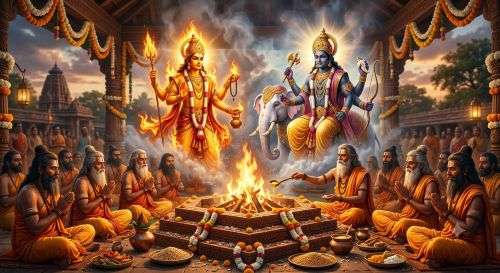
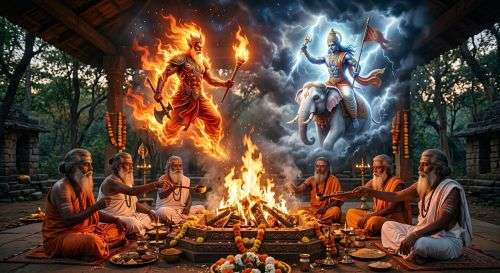
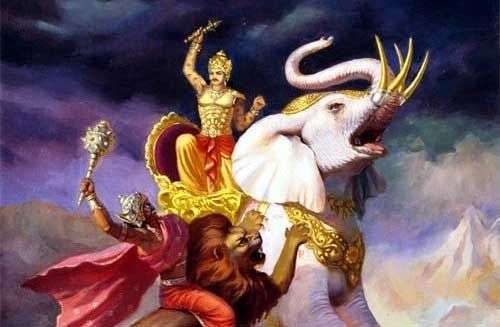
In companionship with Indra, the Maruts participate in the distribution of wealth and vitality. Indra’s thunderbolt, the vajra, shatters the clouds, releasing life-giving waters upon the Earth. This interplay between Indra and the Maruts reflects the coordination of different natural forces—pressure, الكهرباء, and precipitation—working together to sustain life. The resulting rains nourish the भूमि, bringing fertility and abundance, and affirming the interconnectedness of all elements within the cosmos.
The hymn recalls the primal act of creation, where the Maruts, in their luminous and vigorous form, generated the waters that made life possible. From this act emerged food, nourishment, and the continuity of existence. Their association with Prishni, the cosmic mother, further reinforces their role in the generative processes of the universe, where energy and matter converge to produce life.
Finally, the sage Mandhata offers this hymn as a living current of devotion, carried by its own intrinsic शक्ति toward the Maruts. It is not merely a composition but a vehicle of intention, designed to reach the divine through the harmony of sound and meaning. In closing, the prayer seeks blessings of well-being, nourishment, and longevity, reflecting the timeless human aspiration to live in alignment with the forces that sustain the cosmos.