



The decision to confer the Padma Shri on former Union Home Ministry official R.V.S. Mani is much more than recognition of a diligent civil servant. It is an acknowledgment of bureaucratic integrity under political pressure. More importantly, it exposes one of the most controversial political narratives manufactured during the Congress-led UPA era—the attempt to coin and institutionalise the phrase “Hindu terror.” For years, the Congress leadership sought to create a false equivalence between isolated criminal acts allegedly involving some individuals of Hindu background and the globally documented phenomenon of Islamist terrorism. The political objective appeared obvious: neutralise the charge of Islamist radicalisation by suggesting that terrorism had no religious identity and that Hindus, too, had their own organised terror ecosystem. This narrative conveniently suited the Congress’s electoral calculations but inflicted enormous damage on Bharat’s social fabric. The phrase “Hindu terror” or “saffron terror” was repeatedly invoked by senior Congress leaders during the UPA years. It found mention in political speeches, investigative narratives and public discourse, despite the absence of any judicial finding establishing the existence of a nationwide organised Hindu terrorist movement comparable to organisations such as Lashkar-e-Taiba, Jaish-e-Mohammed, Al-Qaeda or ISIS. History has not been kind to that narrative. One of the defining episodes was the Ishrat Jahan encounter case. According to former Home Secretary G.K. Pillai and former Under Secretary R.V.S. Mani, the second affidavit filed by the Union Government in 2009 was altered at the political level to remove references to intelligence inputs linking Ishrat Jahan with Lashkar-e-Taiba. Both officials have publicly maintained that they resisted pressure to endorse changes they believed distorted the original intelligence assessment. Mani has also alleged that he faced coercion and harassment during subsequent investigations for refusing to support what he considered a politically motivated narrative. These allegations have consistently been denied by the Congress party, which maintains that they are politically motivated.
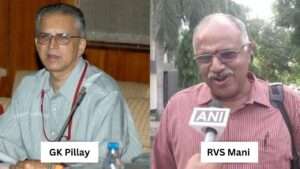
Whether every allegation ultimately withstands judicial scrutiny is a separate matter. What cannot be ignored is that two senior bureaucrats, with impeccable service records, independently narrated remarkably similar accounts of political interference in matters involving national security and intelligence. Their refusal to become instruments of political convenience deserves recognition. Civil servants are expected to serve the Constitution—not the ruling party of the day. When bureaucrats choose professional integrity over career advancement, they strengthen democratic institutions. Had officers like Mani and Pillai simply signed whatever was placed before them, the consequences could have permanently altered public perception, not merely of individuals, but of an entire community. The larger issue extends well beyond the Ishrat Jahan case. The Congress’s repeated flirtation with the “Hindu terror” narrative inflicted lasting damage by unfairly casting suspicion upon Bharat’s overwhelming Hindu majority. It sought to create a moral equivalence between a civilisation that has historically been among the principal victims of terrorism and globally recognised jihadist organisations responsible for thousands of attacks across continents. Bharat has suffered decades of cross-border terrorism—from the Parliament attack and the Mumbai carnage to countless assaults in Jammu & Kashmir. The perpetrators of these attacks belonged to internationally designated terrorist organisations motivated by radical Islamist ideology. Equating those networks with an alleged ideological construct called “Hindu terror” was not merely politically reckless; it trivialised the real nature of the terror threat confronting the nation. Individuals from any religion who commit acts of terrorism must undoubtedly face the full force of law. Criminal culpability is individual, not communal. But branding an entire civilisation or attempting to create a false ideological equivalence without credible institutional evidence is both intellectually dishonest and socially dangerous. That is precisely why the honour bestowed upon R.V.S. Mani carries significance beyond one individual. It symbolises respect for officials who refused to compromise intelligence records or bureaucratic propriety for political expediency. G.K. Pillai deserves equal appreciation for standing by the same principles. Their courage reminds future civil servants that loyalty belongs first to truth, institutional integrity and the Constitution—not to transient political masters. The Padma Shri is a fitting beginning. But history may well judge that what these officers protected was far greater than a government file. They helped prevent a political narrative from permanently branding millions of innocent Hindus with the stain of terrorism. For that, the nation owes them far more than a medal. Well, governments come and go. Political narratives rise and collapse. But institutions endure only when honest civil servants refuse to bend facts to suit those in power. Democracies are protected not merely by elections, but by men and women who choose truth over convenience. R.V.S. Mani and G.K. Pillai did precisely that. Their legacy is not just about one case or one government; it is about preserving the credibility of Bharat’s institutions. That is why the honour bestowed upon them resonates far beyond a Padma award.

