



At the tender break of dawn, when the first light of day spread its pale gold across the trembling earth, the vast hosts of the Kauravas and the Pandavas emerged from their encampments, each adorned with splendour, discipline, and martial pride. Their ranks moved with deliberate majesty, fortified by carefully devised strategies, expanding and contracting like living organisms, eager for engagement. Standards fluttered, armour gleamed, and the air itself seemed charged with the anticipation of a decisive clash.
When both forces advanced to confront one another, Dronacharya, the venerable preceptor, burdened with a heart divided between duty and remorse, addressed Duryodhana with a voice tinged by shame and sorrow. He confessed that he had already declared the impossibility of capturing Dharmaraja so long as Arjuna stood guard upon the field. Yet, he proposed that if some daring warrior could, by cunning stratagem, draw Arjuna away, he would assuredly seize Dharmaraja. Even if surrounded by multitudes, he vowed to unleash such force as would bring ruin upon all opposition. Should Dharmaraja be found without Arjuna’s protection and fail to withdraw, his capture would become a glory adorning Duryodhana’s crown.
Hearing this, Susarma rose with burning indignation, recalling the repeated humiliations inflicted upon him by Arjuna. The memory of those defeats smouldered within him like an unquenched fire. He declared before Duryodhana that the time for vengeance had arrived, and that he had long pledged to confront Arjuna in a battle where only one would survive—the king of Trigartha or Arjuna himself. With fervent resolve, he proposed to draw Arjuna into a fierce and deceitful engagement, thereby removing him from the field. This plan found eager support among the princes of Trigartha—Satyavratha, Satyakarma, and Satyavarma—and was praised by their charioteers and commanders alike. Thus, ten thousand warriors assembled under Susarma’s command, strengthened by allied kings of Kerala, Malava, Sileendra, Magadha, and Machillika, forming a formidable host dedicated to executing this dark design conceived under Drona’s guidance.
Before setting forth, these warriors performed solemn rites, invoking the sacred fire as witness to their terrible oath. With uplifted weapons and fierce determination, they swore that they would either slay Arjuna or fall in the attempt. Should they fail, they invoked upon themselves the grievous sins of slaying cows, murdering Brahmins, violating women, stealing sacred wealth, abandoning the helpless, deceiving the innocent, indulging in vice, and committing acts that would cast them into the deepest misery. Bound by this dreadful vow, the elite force marched forward with pride and dreadful splendour, delighting Duryodhana as he beheld their readiness.
Meanwhile, Dronacharya arranged the Kaurava army into the formidable Garuda Vyuha, the great eagle formation, symbolising predatory precision and sweeping power. He himself stood at the beak, the striking point of attack, while Duryodhana and his brothers occupied the head. Kripacharya and Kritavarma formed the vigilant eyes; warriors of Sinhalese, Abheera, Surasena, and Kekaya constituted the neck; Bahilika, Salya, Bhurisrava, Somadatta, and Sala extended as the right wing; Aswathama, Sudakshina, Vinda, and Anuvinda spread as the left. The spine was held by Sakuni and the kings of Poundra, Kalinga, Ambasta, and Magadha, while Karna, accompanied by vast forces, stood as the tail. Saindhava and other kings formed a reserve guard, ever ready to reinforce any faltering segment. Each warrior was placed with careful consideration of strength and intellect, revealing the calculated depth of Drona’s design, which, though brilliant, was shadowed by an underlying moral darkness.
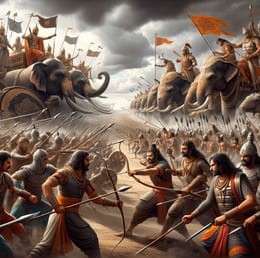
The formation itself moved like a storm-tossed ocean, its divisions rising and falling in rhythmic ferocity. Among its mightiest elements stood the formidable Bhagadatta, towering upon his war elephant, radiant as the sun upon a mountain peak, a spectacle both awe-inspiring and fearsome. At the appointed moment, Susarma and his sworn band advanced southward, boldly challenging Arjuna. Hearing their call, Arjuna addressed Dharmaraja with respectful urgency, declaring that to refuse such a challenge would be a stain upon his honour. He assured his brother of safety and vowed to annihilate the challengers with valour. Dharmaraja, though aware of Drona’s prowess and intent upon foiling his pledge, hesitated, yet Arjuna stood firm in his resolve. He entrusted Dharmaraja’s protection to Satyajit, a warrior of proven strength and skill, cautioning that if Satyajit were to fall, it would be wise to withdraw from the battlefield.
With blessings received, Arjuna departed, saluting his brother with devotion and advancing with blazing energy toward the enemy. As he moved far from Dharmaraja, the Kaurava ranks rejoiced, perceiving the unfolding success of their design. Observing the Garuda formation, Dharmaraja instructed Drustadyumna to arrange the Pandava forces in a half-circle to counter it. Soon both armies stood prepared, their formations locked in silent tension before the storm. Conches roared, drums thundered, and the battlefield resounded like the confluence of the Ganga and Yamuna in flood.
Dharmaraja then appealed to Drustadyumna to employ his mastery and shield him from Drona’s designs. With confident assurance, Drustadyumna declared that Drona would never reach him while he stood guard. Mounting his chariot drawn by brown steeds, he advanced toward Drona. At the sight of his destined slayer, Drona’s visage momentarily faltered, yet he quickly recovered and unleashed a relentless storm of arrows upon the Panchala forces, breaking into their ranks with devastating force.
Elsewhere, Arjuna, having reached the field of his engagement, descended upon the assembled warriors like a ravenous lion among helpless deer. The enemy, emboldened by their oath, formed a half-circle and shouted with fierce excitement. Arjuna, smiling calmly, remarked to Krishna upon their ignorance, noting that their very joy invited their destruction, and that their fearless stance would at least secure them a place among the brave who fall in battle. Then he sounded his divine conch Devadatta, whose thunderous reverberation shook the hearts of all who heard it, momentarily stripping the enemy of their arrogance.
Regaining composure, they attacked together, but Arjuna moved with unmatched speed and precision, cutting down fifteen thousand charioteers from afar. Though they showered him with arrows, he countered effortlessly, striking with deadly shafts. Subahu struck Arjuna’s crown, but Arjuna swiftly retaliated—shattering banners, slaying steeds, and leaping amidst his foes. With a single decisive stroke, he severed Subahu’s head. Chariots fell shattered in thousands, and the enemy ranks were torn apart like fragile cloth before a tempest. Panic seized them, and many fled toward Duryodhana for refuge.
Yet Susarma rallied them with fierce words, urging them not to abandon their vow or their honour. Thus, the battle raged on, as Sanjaya faithfully recounted these events, each moment bearing witness to courage, cunning, and the inexorable march of fate upon the field of war.

