



After composing the great epic Mahabharata, the sage Vedavyasa entrusted the sacred duty of revealing its history to the people of the earth to his devoted disciple Vaishampayana. At that time the noble king Janamejaya, eager to learn the deeds of his forefathers, humbly prayed to the sage for the narration of their ancient history. Vyasa, pleased with the king’s devotion, directed Vaishampayana to recount the entire story before him. By the grace of the sage, Vaishampayana attained the dignity of the sacred narrator, while Janamejaya assumed the reverent role of the listener.
The king then inquired, “O venerable sage, when the mighty grandsire Bhishma, commander of the Kauravas, withdrew from the battlefield and fell upon the bed of arrows, what did the blind monarch Dhritarashtra do after hearing the report of Sanjaya?” In reply, Vaishampayana began his narration.
When Bhishma departed from the field of war, the heart of Duryodhana burned with a restless desire for victory. Meanwhile the grief-stricken king sent Sanjaya to observe the events among his sons. Through the divine vision granted by Vyasa, Sanjaya beheld the happenings in both camps and soon returned to Hastinapura. Dhritarashtra received him with solemn honour and anxiously asked who had been appointed to command the Kaurava army after the fall of the grandsire and how the scattered forces had regained courage against the unmatched might of the Pandavas.
Sanjaya answered with gravity, recalling how Bhishma still lay upon his bed of arrows while warriors from both sides gathered around him. By releasing the celestial Parjanya weapon, Arjuna brought forth sacred waters from the earth to quench the thirst of the venerable hero. Yet the wise counsel of Bhishma was disregarded by the Kauravas, who departed from that place in silent frustration.
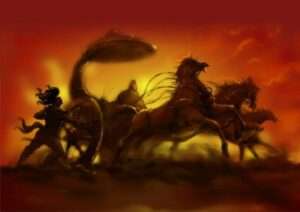
On the following morning, when Sanjaya entered the Kaurava camp, the air trembled with the mingled sounds of drums, trumpets, and conches. These solemn notes signified both mourning and preparation for renewed battle. The fourfold army assembled in uneasy order, and the absence of the towering Bhishma cast a shadow of fear across the ranks.
The assembled kings approached Duryodhana and declared that the warrior Karna could now enter the battlefield, since Bhishma had fallen. Without the grandsire, they lamented, the army resembled a household without its master, a herd without its shepherd, a barren field without harvest, or a cavern devoid of its lion. Fear gripped the warriors as they beheld the steadfast courage of the Pandavas.
Amid cries of despair the kings called aloud for Karna to rescue them from their helpless condition. Duryodhana then proclaimed before the gathered warriors that Karna, a hero of immense strength and valour, must be summoned without delay to join the struggle.
In earlier days, Bhishma had classified Karna as only a half-chariot warrior, and wounded pride had kept him from the field while the grandsire commanded the army. Now, however, the necessity of his presence was deeply felt by all the Kaurava leaders.
When these words reached Karna, his heart overflowed with emotion and tears welled in his eyes. Yet mastering his sorrow with swift resolve, he addressed the shaken army. He declared that though Bhishma, the pillar of the Kuru race, had fallen like the lofty Mount Meru to the glory of Arjuna, he would restore their courage and stand firm beside them with all the strength of his sinews.
Karna vowed that he would follow the illustrious path of Bhishma and oppose the Pandavas with unwavering determination. Thus, Sanjaya reported to Dhritarashtra that the turning of fate had opened the path for Karna’s entry into the great war, and that he now sought to revive confidence within the trembling ranks of the Kaurava host.

