


Sanjaya said to Dhrutarastra: “At that moment, your ten sons advanced against Bhīmasena with the confidence of seasoned warriors. Yet their assault was short-lived. With ten irresistible shafts released in swift succession, Bhīma severed their heads and cast them lifeless upon the earth. Vṛkadhara, the brother of Karṇa, then challenged him with great audacity, but he too was slain by Bhīma’s mighty hand. Thereafter, the twelve brothers of Śakuni, renowned among warriors, rushed together against the son of Vāyu. Bhīmasena consumed them as Death himself devours beings at the appointed hour, leaving none to escape his fury.
Exulting in victory and blazing with martial pride, Bhīma moved through the hostile ranks like a raging tempest. His relentless strength and merciless assault shattered all resistance before him. Then the princes of the Sūrasenas, Vāsatis, Mālavas, Trigartas, and Bāhlikas, supported by their fourfold armies, united to restrain his advance. Seeing his brother encircled by vast multitudes, Dharmarāja Yudhiṣṭhira leapt forward like a lion descending upon a herd of frightened beasts. Striking the enemy with irresistible force, he carved a path through their ranks and spread destruction wherever he moved.
The Kaurava forces, overwhelmed by the sudden fury of the Pāṇḍavas, fell into confusion. Some perished beneath the storm of weapons, while others retreated in terror and disbelief. One portion stood paralyzed by fear; another gazed in astonishment at the swift unfolding of events. Many, stripped of pride and courage, looked helplessly in every direction, seeking guidance and protection. Perceiving this disorder, Duryodhana urged Droṇācārya to turn his attention toward Bhīma and Yudhiṣṭhira, whose prowess was steadily breaking the spirit of the Kaurava host.
With renewed enthusiasm, Droṇa confronted Dharmarāja and discharged celestial weapons of formidable power. Yet Yudhiṣṭhira countered each missile with equal mastery. When Droṇa invoked the mighty Indrāstra, Dharmarāja rendered it ineffective. The preceptor then launched the Brahmāstra itself, but even that divine weapon was neutralized by an equally fitting response. Meanwhile, Dhṛṣṭadyumna advanced to challenge Droṇa, but the venerable warrior ignored him and instead turned his wrath upon King Drupada and his forces, scattering them in all directions.
As the battle grew increasingly severe, Bhīma and Arjuna came together against Droṇācārya. Showering him with countless arrows, they wounded and harassed him from every side. Simultaneously, the Kekaya and Matsya warriors pressed hard upon the Kaurava army, humbling its pride and diminishing its confidence. The Pāṇḍava and Pāñcāla forces drove their enemies before them as shepherds drive scattered sheep. Witnessing the disappointment and despair spreading through your army, I, Sañjaya, beheld the Kaurava ranks losing heart beneath the relentless pressure of their foes.
Seeing his forces shaken and their confidence drained, Duryodhana turned to Karṇa and said, “The time has come for you to rescue the Kaurava army. The enemy grows stronger with every passing moment, and our warriors are losing courage before their fierce resistance.” Karṇa replied with unshaken confidence: “O King, I alone am sufficient to slay Arjuna. To overcome Bhīmasena is no difficult task. My foremost duty is to preserve your royal glory and secure your kingdom. While I stand upon this field, the enemy shall never triumph. Witness now the courage and might with which I shall assail them.”
These words were heard by Kṛpācārya, who smiled gently and addressed Karṇa in a spirit of frank wisdom. “Indeed, your speech is noble, and Duryodhana may well dream of ruling the earth through your strength and bravery. Yet can excessive boasts conquer the Pāṇḍavas? Who among us is unaware of your prowess? The world remembers the encounters at the Ghoṣa-yātrā and the cattle raid of Virāṭa. Why then these repeated proclamations? Enough has been spoken. You speak as though none had witnessed your previous battles with the sons of Pāṇḍu. Empty words win no victories. We have all experienced defeat at Arjuna’s hands on different occasions. Today he stands supported by Yudhiṣṭhira, Bhīmasena, Ghaṭotkaca, and countless allied kings. How then do you expect to overcome him so easily?”
Stung by these words, Karṇa answered in anger. “He who possesses the power to accomplish what he declares has every right to speak boldly. Why should he concern himself with idle criticism? There is no fault in announcing one’s intentions. Do not the rain clouds thunder before they pour down their showers? O Brāhmaṇa, I have tolerated your words only out of respect for your sacred status. Speak further in this manner, and I shall sever your tongue. You continually praise Arjuna and his companions while weakening the spirit of our warriors. You diminish not only my strength but also that of Droṇa, Aśvatthāman, Śalya, and others. Why do you belittle our valor and courage?”
Karṇa’s disrespect toward Kṛpācārya ignited the wrath of Aśvatthāman. Unable to endure the insult directed at his maternal uncle, he seized his sword and rushed toward Karṇa like a blazing firestorm. Duryodhana immediately intervened, while Kṛpa himself restrained his furious nephew, whose anger surged like the uncontrollable waves of a tempestuous ocean. Karṇa, still inflamed with pride, exclaimed, “Why restrain him, O King? If Aśvatthāman comes forward in arrogance, let him come. Such pride is not subdued by gentle words but by the strength of the arm. Do not hold him back.”
Duryodhana then addressed the son of Droṇa with conciliatory words. “O Aśvatthāman, your father, Droṇācārya, you yourself, Karṇa, Śalya, Kṛpācārya, and even Śakuni have all labored for a single purpose—that I may obtain sovereignty over the earth. Your desire and mine are one. At this critical hour, unity alone can secure success. If we turn our weapons against one another, disaster will surely follow. Therefore forgive Karṇa and preserve harmony among us.” Hearing these words, Aśvatthāman gradually calmed his anger. Karṇa too regained composure and, tightening the string of his bow, prepared once more for battle.
The allied kings of the Pāṇḍavas, seeing Karṇa advance with renewed determination, spoke among themselves: “This Karṇa has long been the source of suffering to the sons of Pāṇḍu. Why should we delay? Let us surround him, cast him down, and leave him no avenue of escape.” Raising a great cry, they rushed upon him from all directions. Karṇa answered with ruthless ferocity. His arrows drenched the battlefield in blood, and many princes and warriors fell beneath his deadly shafts. He cut down renowned fighters and scattered entire formations before him.
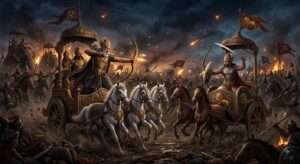
Observing Karṇa’s devastation, Arjuna advanced to confront his lifelong rival. Karṇa struck first, piercing him with three sharp arrows. In response, Arjuna released thirty swift shafts that penetrated Karṇa’s armor, sinews, and head, causing him great pain. So rapid was Arjuna’s attack that Karṇa’s bow slipped from his right hand. Yet, to the astonishment of all, Karṇa immediately seized another bow and resumed the fight, sending forth a fierce volley of arrows.
Then, O Dhṛtarāṣṭra, Arjuna’s right eye reddened with wrath, and his form became terrible to behold. In an instant he shattered Karṇa’s bow, slew his charioteer, and cut down his horses so that they collapsed upon the battlefield. Bereft of support and overcome by fear, Karṇa lost all sense of direction. Unable to withstand Arjuna’s fury, he abandoned the field and fled. Seeing their foremost champion retreat, the Kaurava warriors lost heart. Some ran in panic, while others concealed themselves wherever refuge could be found. Thus did the mighty Arjuna scatter the Kaurava host, and thus, O King, did I witness and report these events to you.”

