



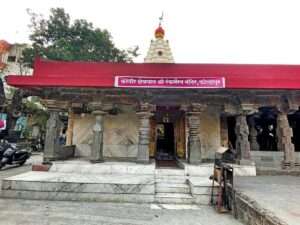
Rankabhairav Temple is situated in Mangalwar Peth near the famous Mahalaxmi Temple in Kolhapur. The temple stands close to the historic Rankala Lake and is one of the ancient guardian shrines of the sacred Karvir region.
The presiding deity is Lord Rankabhairav, a fierce and protective manifestation of Lord Shiva as Bhairava. He is revered as the Kshetrapala (guardian deity) and “Kotwal of Karvir,” the divine protector of Kolhapur and its devotees. The deity is popularly known among locals as Rankoba.
The temple is believed to be around 900 years old and is built in the Hemadpanti style. It consists of a Sabha Mandapa and Garbhagriha supported by carved stone pillars displaying Chalukyan influences. The sanctum houses a rare standing stone idol of Rankabhairav adorned with a traditional Maratha turban and protected by a five-hooded serpent canopy.
Rankala was one of the six ancient settlements that existed in the Karvir region before Kolhapur developed into a major religious center. Historical records suggest that stone from the Rankala area was extensively used during the Shilahara period for constructing temples, including the renowned Mahalaxmi Temple.
Over time, quarrying activities and a subsequent earthquake transformed the area into what is now Rankala Lake. The temple remained an important spiritual center throughout these changes and continues to be one of the oldest surviving shrines of Kolhapur.
According to the sacred traditions of Karvir Kshetra (Kolhapur), Goddess Mahalaxmi established her divine abode in the region after destroying evil forces and blessing the land with prosperity and spiritual power. In ancient times, a severe drought affected many surrounding areas, causing rivers and lakes to dry up. However, Karvir remained blessed with abundant water sources due to the grace of the Goddess.
To protect these precious water resources and safeguard the sacred city, Goddess Mahalaxmi appointed eight Bhairavas as guardians in the eight directions around Karvir. Among them, Rankabhairav was entrusted with protecting the area around present-day Rankala. He performed his duty with great devotion, guarding the sacred waters and ensuring the welfare of the people.
Pleased with his unwavering service, Goddess Mahalaxmi bestowed upon him the honor of becoming the Kshetrapala (guardian deity) of Karvir. Since then, Rankabhairav has been worshipped as the “Kotwal of Karvir,” the divine protector of Kolhapur and the guardian of Goddess Mahalaxmi’s sacred domain.
Another local tradition states that Rankabhairav received a boon from the Goddess to remain eternally near the waters he protected. As a result, devotees believe that his divine presence exists both in the waters of Rankala Lake and in the temple on its banks. Even today, pilgrims seek his blessings for protection, courage, and the removal of obstacles before or after visiting Goddess Mahalaxmi in Kolhapur.
The temple occupies a special place in Kolhapur’s religious tradition because Rankabhairav is considered the official guardian deity of the city. Many devotees visit the shrine before or after worshipping Goddess Mahalaxmi.
The standing idol wearing a Maratha-style turban is a rare feature not commonly seen in Bhairava temples. Local folklore also speaks of a submerged golden temple of Rankabhairav beneath the waters of Rankala Lake.
Devotees believe that worshipping Rankabhairav grants protection from negative influences, courage during difficulties, success in important endeavors, and divine guardianship over family and property.
Mahashivaratri, Kalabhairava Jayanti, and Vijayadashami are the principal festivals celebrated here. During Vijayadashami, the ceremonial procession of Goddess Mahalaxmi and Rankabhairav is a major religious event in Kolhapur, drawing large numbers of devotees who seek the blessings of the guardian deity of Karvir.


