



Family, greed, and the tragedy of a changing society
The land of Haryana has long been known for its familial love, brotherhood, and the culture of joint families. The warmth of relationships was evident in village Chaupals. Family was not merely a blood relationship, but was considered the foundation of life’s greatest security and respect. Grandparents, uncles, aunts, and brothers and sisters together formed a social structure where individuals were never left alone. Family joys were shared, and sorrows were shared together. From labor in the fields to household decisions, everything was done with a spirit of sharing. At that time, it was difficult to imagine that someone could become an enemy of a family member for property.
But with changing times, the landscape of society has rapidly changed. Economic competition, urbanization, growing material desires, and consumerist thinking have gradually weakened the intimacy of relationships. Now, families that once epitomized love and cooperation are being torn apart by property and financial disputes. A small piece of land, a share of inheritance, or monetary transactions are often fueling conflicts that culminate in violence and murder.
Today, not only in Haryana but across the country, news of a brother killing another brother, a son attacking a father, or an uncle-nephew relationship being marred by bloodshed, is constantly emerging. These incidents are not merely crimes but a sign of the growing moral decay within society. This increasing violence within families suggests that wealth and property are now considered more important than relationships.
In states like Haryana, land is no longer merely a means of farming. Urbanization and industrial expansion have led to rapid increases in land prices. Farms that were once modest in value have now become assets worth crores of rupees. This economic transformation is causing tension within many families. Brothers are now fighting in the courts over the division of land that was once cultivated jointly by the family. In many cases, these disputes transcend legal boundaries and escalate into violence.
The breakdown of joint families has also exacerbated this problem. In the past, elders served as mediators. If there was a dispute, respected family members would sit together and find a solution. Their word was considered final. But now, the trend of nuclear families has increased. Families have become smaller, and communication has decreased. As family members began living separately, the emotional distance between them also increased. This distance often gives rise to distrust and selfishness.
In modern society, a person’s success is measured by their financial status. A large house, an expensive car, and abundant wealth have become symbols of social prestige. Social media and market-driven culture have further reinforced this mindset. Everyone seems to be engaged in the race to earn as much money as possible. In this race, the sensitivity of relationships is being left behind. People are beginning to view their families as partners and competitors rather than collaborators.
From a psychological perspective, property disputes aren’t just financial struggles. They also stem from insecurity, ego, comparison, and a sense of entitlement. Often, individuals feel wronged, have received a smaller share, or are neglected within the family. These feelings gradually escalate into anger and violence. Tensions pent up for years within a family can explode over a minor dispute.
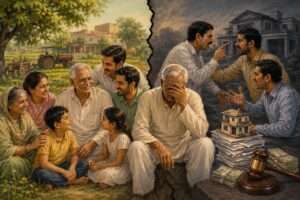
The patriarchal mindset in Indian society also plays a role in fueling these disputes. Competition among sons over property is increasingly evident. Parents often unwittingly discriminate between their children. Giving more importance to one son or disparity in property distribution lays the foundation for future conflicts. This tension can build up over the years, eventually leading to major disputes.
Today, millions of property dispute cases are pending in the courts. Families remain embroiled in legal battles for years. Litigation consumes time, money, and peace of mind. The court cycle can sour relationships to the point where any possibility of reconciliation is virtually eliminated. Sometimes, even subsequent generations carry this animosity as a legacy.
The irony is that the very possessions for which people destroy their relationships ultimately fail to bring them peace of mind. Wealth can provide comfort, but it cannot provide intimacy and trust. Brothers who spent their childhoods playing together become enemies. Parents who have devoted their entire lives to raising their children find themselves feeling insecure among their own children in old age. This situation is not just a family crisis, but a social tragedy.
This problem is further complicated in rural society because land is not only a property but also a symbol of social prestige. Families with more land are considered more influential. This is why people struggle for years even for small parcels of land. Panchayats often fail to resolve these disputes, leading to violence and murder.
The situation is different in urban areas. Legal battles between siblings over their parents’ property, homes, and businesses have become common in metropolitan areas. Elderly parents often suffer from loneliness and insecurity. In some cases, children pressure their parents to transfer the property to their names. This situation raises serious questions about the values of the Indian family system.
Money and wealth are not inherently bad things. Problems arise when a person places wealth above morality and human sensibilities. Greed gradually erodes a person’s sensitivity. They begin to view relationships from a financial perspective, not an emotional one. When human values weaken within a person, the avenues open for violence and crime.
Solving the problem isn’t possible through legislation alone. Serious efforts are needed at the social and moral levels. First, we must strengthen the culture of dialogue within families. When family members express themselves openly and understand each other’s feelings, disputes will be less likely. Often, small misunderstandings can escalate into major conflicts due to a lack of communication.
The role of elders remains crucial even today. They should not only be guardians of property but also guides of family values. Children must be taught from childhood that relationships are more valuable than any land or wealth. If love and trust prevail within the family, property division will be smoother.
The education system also needs to give greater importance to moral education and family values. Today’s education is making people successful, but it’s failing to make them sensitive. It’s important to teach children that true success in life isn’t just about financial achievement, but also about preserving humanity and relationships.
Society must also change its mindset. The tendency to honor only financial success is dangerous. When society prioritizes wealth over character, behavior, and sensitivity, the mad pursuit of wealth intensifies. Society needs role models that inspire sacrifice, cooperation, and family unity.
The media and entertainment industry also have a major responsibility. If films, serials, and digital platforms consistently portray wealth and prosperity as symbols of success, the new generation will adopt that mindset. Society needs cultural examples that strengthen the dignity of family, sensitivity, and relationships.
The government and administration should also take initiatives in this direction. Family counseling centers, mediation committees, and community resolution mechanisms can be developed at the Panchayat level. If disputes are resolved through dialogue at an early stage, many families can be prevented from breaking up and violence.
The most important thing is to look within oneself. Life is fleeting. Wealth and land remain here, but the memories of relationships endure for generations. No possessions can match the love that comes from family. If a person learns to control their selfishness and ego, many conflicts can be prevented.
The greatest strength of Indian society has always been its family. If these families begin to disintegrate, the moral foundation of society will also weaken. Modernity and economic development are necessary, but they are meaningful only when the preservation of human values accompanies them. Development means not only economic prosperity, but also social and emotional balance.
Ultimately, we must understand that while wealth may be a necessity, it is not the ultimate truth. The ultimate truth is love, trust, and the sense of belonging that sustains a person in difficult times. If the pursuit of wealth begins to consume relationships, it will be a defeat not just for the family but for society as a whole. Large buildings and vast properties do not define civilization; it is the respect people give to their relationships. Therefore, the greatest need of the hour is to learn to value relationships more than wealth, because ultimately, it is not land but our people who provide the support for a person’s survival.


