Upadhyayula Lakshman Rao
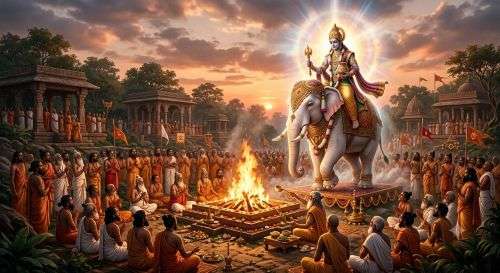
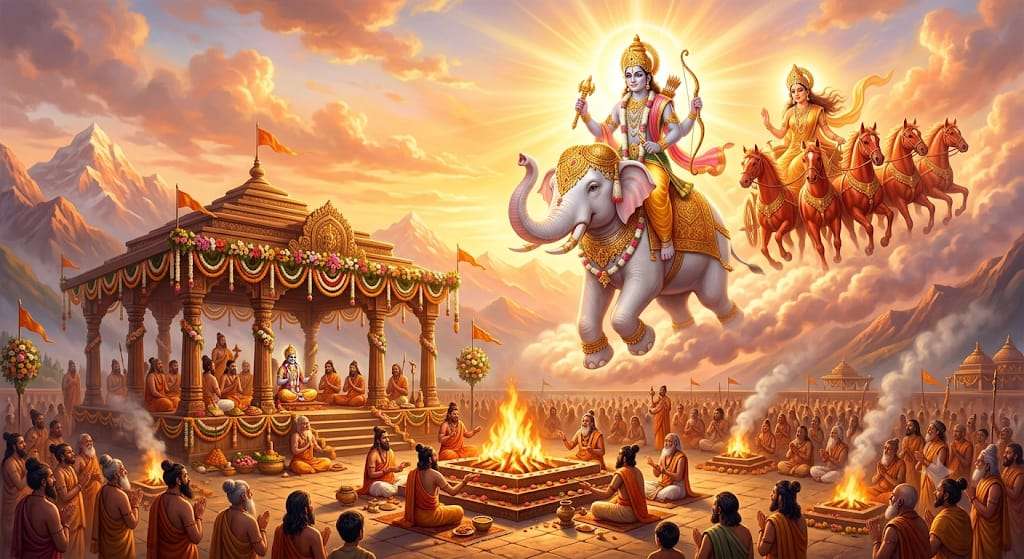
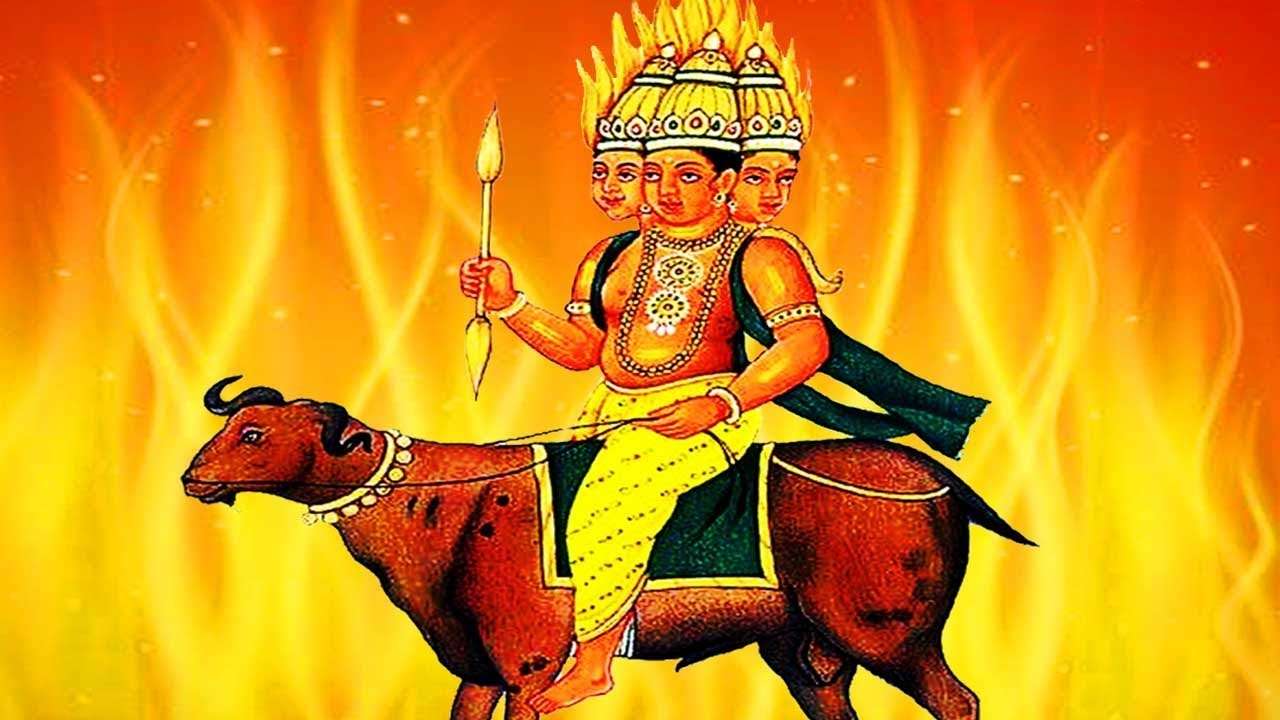
The sage Puruchhepa, immersed in the sacred cadence of the Atyashti Chandas of the Rigveda, raises his contemplative voice in adoration of Agni, the divine flame who stands at the center of all sacrificial order. In this exalted vision, Agni is not merely the physical fire kindled upon the altar, but the grand आयोजक—the supreme organizer of the yajña, who harmonizes the cosmic and human realms. As the priest among gods and the worshipper on behalf of humanity, he bridges the visible and invisible, carrying offerings upward while bringing blessings downward. His presence is invoked with reverence, for he is दक्ष, supremely efficient, who kindles himself with the very oblations offered into him, transforming matter into subtle essence.
Agni is celebrated as the मूल कारण—the fundamental source of life’s continuity among human beings. Born of strength and sustained by it, he is the पुत्र of power, ever capable and unassailable. Endowed with the discerning intelligence of a Brahmin, he embodies wisdom that perceives the hidden laws of existence. As the divine messenger who invites the gods to partake in the yajña, he assumes a central role in sustaining ṛta, the cosmic order. The hymns thus extol him as self-luminous, all-pervading, and radiant like the sun, yet intimate and accessible to the human heart.
In his flaming singularity, Agni appears as one, yet manifests in countless forms—within the hearth, the lightning, the sun, and the vital warmth of life itself. He is the generous bestower of gifts, fulfilling the aspirations of patrons and sustaining the sacred reciprocity between giver and receiver. The priests, with disciplined devotion, invoke him through hymns, seeking his grace to fulfill the desires of those who uphold the sacred rites. Union with Agni is no trivial attainment; it demands purity and steadfastness, for his force is such that even mountains yield and dissolve before his blazing intensity.
Agni’s brilliance is likened to the sharp strike of an axe, cleaving through obstacles and enemies alike. Like a vigilant hunter, he subdues adversaries with silent precision, advancing unhindered and never retreating. His dynamic energy reflects not only physical combustion but also the relentless movement of transformation inherent in nature. Those who understand the ultimate truth, aligned with his essence, are rewarded with abundance, for Agni becomes the medium through which prosperity flows. Patrons offer rich oblations into his flames, recognizing him as the gateway to higher realms, the मार्गदर्शक who grants access to heavenly existence.
Moving through forests and woods, Agni consumes and reduces all to ash, yet this destruction is but a prelude to renewal. In a profound scientific sense, he represents the principle of energy transformation, where matter is neither lost nor diminished but altered in form. He purifies without residue, removing sin as fire removes impurity from gold. In the stillness of night, his radiance becomes even more pronounced, symbolizing the light of knowledge that shines brightest amid ignorance. Eternal and ever-renewing, he accepts oblations offered in sacred spaces, inheriting them as a son inherits the legacy of his father, thus preserving continuity across generations.
The threefold manifestation of Agni—the Āhavanīya, Gārhapatya, and Dakṣiṇāgni—forms the sacred triad that protects and sustains those who honor them. Having received offerings, Agni remains ever youthful, and in turn, he bestows vitality and vigor upon his patrons. His flames, sharp and resonant like the spears of the Maruts, echo with a vibrant force that inspires both awe and devotion. Worthy of worship in times of peace and in the triumph of battle, his nature remains constant: to receive, to transform, and to illuminate.
The sages of the Bhrigu lineage, well-versed in the mysteries of existence, worshipped Agni for both material prosperity and spiritual ascent. Through the churning of the arani—the sacred wooden implements—they generated fire, symbolizing the awakening of latent energy through disciplined effort. Agni, adorned with ritual sanctity, emerges as the bestower of treasures, both earthly and divine. As the primordial deity of yajña, he is worshipped with clarified ghee, the essence of nourishment, offered with reverence and precision.
Agni stands as the lord of the human race, venerable and sovereign, deserving of the highest devotion. Just as children approach their father for sustenance, so do the gods themselves approach Agni to receive their share of offerings. Priests, in their sacred duty, place oblations into him, recognizing his centrality among all deities. Strong, invincible, and ever-victorious, Agni embodies radiant शक्ति. Born from the friction of aranis, his origin itself symbolizes effort giving rise to illumination, and his actions are ever glorious.
Patrons, understanding his importance, serve him with dedication, as loyal attendants serve a revered master. The priests, endowed with inner strength, invoke him at dawn, seeking his protection and blessings of wealth, cattle, and vitality. Agni’s presence sanctifies the yajña, and his arrival is celebrated as the foremost among divine guests. Just as poets praise the wealthy with eloquence, so must priests praise Agni with hymns rich in devotion and insight.
In this profound relationship, Agni is regarded as equal among visible gods, accessible yet supreme. The devotee, pure in heart, seeks his grace, trusting in his benevolence to bestow prosperity and righteousness. Mighty and generous, Agni nourishes both priests and patrons, granting food, wealth, progeny, and continuity of lineage. As the strongest force eliminates opposition, so does Agni remove all obstacles with his शक्ति, guiding humanity toward harmony, prosperity, and ultimate truth.