


Beholding his ten beloved sons fall lifeless beneath the relentless prowess of Bhurisrava, the valiant Satyaki was seized by a tempest of wrath and grief, each striving to master his noble mind. Gathering his scattered resolve, he burned with fierce determination and drove his chariot toward the foe. Like two mountains crashing in a storm, Satyaki and Bhurisrava encountered one another in dreadful combat. With unerring shafts Satyaki slew the steeds and struck down the charioteer of his adversary; their chariots collided and were shattered, leaving both warriors stranded upon the earth. Drawing their swords, they fought hand to hand—one impelled by vengeance, the other by allegiance to royal authority. Then the mighty Bheema swiftly bore Satyaki away upon his own chariot, while Kripacharya rescued Bhurisrava and conveyed him to the Kaurava ranks.
As the sun declined toward the western horizon and twilight spread her dusky veil, Arjuna, in the final moments of the day, released sanctified arrows that tore through the Kaurava divisions. Witnessing the vast slaughter of his forces, the grandsire Bheeshma blazed with indignation and commanded twenty-five thousand charioteers to assail Arjuna. Yet with celestial astras Arjuna reduced that proud array to ashes, silencing the swelling arrogance of the Kaurava host. The fading rays of the sun shimmered upon streams of blood that flowed from men and beasts alike, and Bheeshma, surveying the field strewn with flesh and crimson pools, judged that the hour demanded cessation. He instructed Drona to halt the armies. Wearied warriors from both camps withdrew under the wavering glow of torches, seeking fragile solace in music and tale, as narrated by Sanjaya to the blind monarch Dhritarashtra. Thus passed the seventh night upon the sacred plain of Kurukshetra.
At dawn the Pandavas formed the crocodile array, devised with subtle intelligence. Arjuna and King Drupada stood at its head; Nakula and Sahadeva at the eyes; Bheema at the gaping mouth; Ghatotkacha at the cheeks; Satyaki and Yudhishthira at the neck; Dhrishtadyumna and King Virata along the spine; the Kekaya and Karusha princes upon the flanks; Kuntibhoja and Sataneeka at the navel; and Sikhandi with Iravan at the tail. In answer, Bheeshma marshalled the heron formation: he and Drona at the beak; Kripa and Ashwaddhama as the eyes; Kruthavarma, the Kamboja chiefs, and Bahlika at the head; Duryodhana with the king of Surasena at the neck; Bhagadatta and the ruler of Sauveera at the breast; Anuvinda at the rear; Susarma upon the left; the Yavana king upon the right; and at the tail Srutayu with Bhurisrava. Conches, kettle-drums, trumpets, and horns resounded, and the air trembled with war-cries as both hosts advanced.
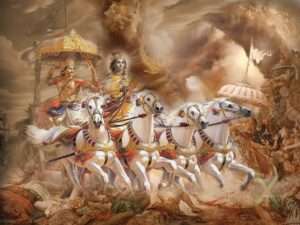
Bheema, desiring to quell the pecking fury of Drona stationed at the beak, rushed against him, for the nature of the crocodile’s mouth is to devour what the heron’s beak seeks to pierce. At Bheema’s onset, Drona’s supporting ranks recoiled. The preceptor struck Bheema with seven sharp shafts; Bheema in turn slew Drona’s charioteer with a spear. Though moral reflection may question the slaying of an unarmed guide, the harsh code of war esteems such an act as a lawful strategy, for the fall of steeds and charioteer unmans even the mightiest warrior. Guiding his chariot himself, Drona renewed his assault until Bheeshma advanced and scattered the Kekayas who encircled him, dispersing them like clouds before a tempest. Fear touched the Pandava ranks, yet that momentary setback only inflamed Bheema, who surged like wildfire through the Kaurava host.
Encouraged by Yudhishthira and Duryodhana alike, the armies fought with redoubled zeal. Then Dhritarashtra, troubled in spirit, questioned why his seasoned warriors could not subdue the sons of Pandu. Sanjaya replied that destiny, long foreseen by Vidura, was unfolding; that the king’s former silence at injustice, especially during the fateful dice game, had sown the seeds of this calamity; and that lamentation at such an hour could not alter ordained consequence.
Meanwhile Bheema, cleaving through hostile ranks, encountered the sons of Dhritarashtra—Dussasana, Durmada, Dussaha, Jaya, Jayatsena, Vikarna, Chitrasena, Sudarsana, Charuchitra, Suvarma, and Dushkarna—standing armed together. Delighted at the prospect of solitary combat, they resolved to surround and slay him. Like meteors encircling the sky at doomsday, they besieged him with the fourfold army. Perceiving that his chariot might become a prison amid encircling foes, Bheema leapt to the ground and commanded his charioteer to withdraw to safety. Moving with dreadful swiftness, he crushed elephants, severed trunks, shattered chariots, and felled horse and foot alike. The earth seemed to quake beneath his tread; heaps of slain warriors rose like crimson hills; and his solitary combat upon the field struck awe and terror into every heart. Thus, O King, did Bheema stand amid thy sons like Death incarnate, and the fate of the day trembled upon the edge of his wrath.

