BG Srinivas
The Ministry of Finance notification of 14 September 2026 has triggered a familiar cycle: alarm on social media, talk of a “UPI tax”, and a flood of AI-generated explainers dressed up as government releases. Some of what is circulating is accurate, some is not, and the actual picture deserves a sober reading.
What has actually changed
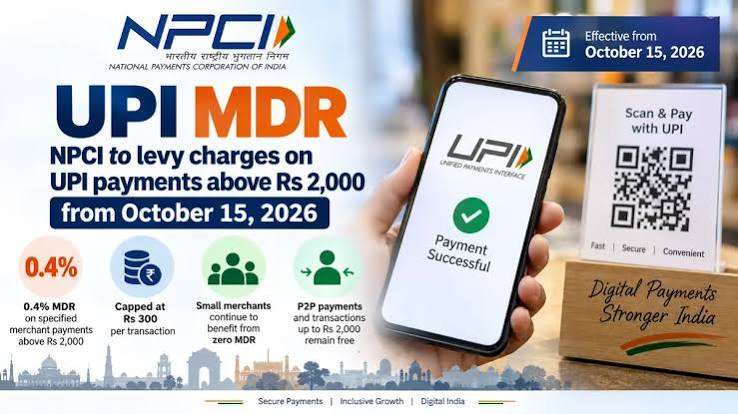
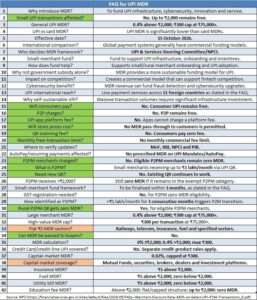
Under Section 10A of the Payment and Settlement Systems Act, the government has specified RuPay debit cards and UPI transactions up to ₹2,000 as modes on which no bank or system provider may impose any charge on either the payer or the payee. Anything above that threshold is now open to a Merchant Discount Rate. The Ministry and NPCI have since clarified the framework that takes effect on 15 October 2026: a 0.4% MDR on specified person-to-merchant transactions above ₹2,000, with a cap per transaction. P2P transfers stay free at any amount. Payments to merchants up to ₹2,000 stay free. Small merchants under the existing zero MDR framework stay free. By the government’s own estimate, roughly 96% of P2M transactions are untouched.
Who pays
MDR is paid by the merchant receiving the payment, not deducted from the customer. This is how card payments have always worked. Debit card MDR is capped by the RBI at 0.4% for small merchants and 0.9% for others; credit cards typically run 1.5% to 3%, and merchants have absorbed those costs for years without anyone calling them a tax. At 0.4%, UPI remains the cheapest acceptance rail in the country by a wide margin.
Calling this a burden on the common man is not a serious claim.
Why the charge exists
Banks, payment aggregators and technology providers carry real costs: infrastructure, fraud management, settlement, customer service. A committee report earlier this year noted that the absence of MDR was making the UPI ecosystem financially difficult to sustain. The current government incentive covers only 0.15% on sub-₹2,000 payments to small merchants, budgeted at about ₹2,000 crore for FY27, and does not touch large merchants at all. The ecosystem has been running high-value merchant volumes at zero revenue.
Our view
The notification is not what it is being made out to be. It is a narrow, capped, merchant-borne charge on a small slice of high-value transactions, at a rate well below every alternative rail.
That said, we would still urge the government to consider funding this cost rather than shifting it. UPI has done more to formalise the Indian economy, create a digital trail and displace cash than any tax measure in a generation. Cash is not free either; it carries printing, handling, leakage and enforcement costs that the state bears silently.
Transparent subsidy for the digital rail is a defensible use of public money, and the benefits of near-universal frictionless acceptance likely exceed its fiscal cost. But that argument should be made on the numbers, not by mislabelling a merchant fee as a tax on the public.
Will some of that 0.4% find its way into prices? In a competitive market, a fraction of it might, diffusely and over time. But on a ₹5,000 purchase, the fee is ₹20, split across a merchant’s entire cost base.
In fact, the introduction of MDR on UPI would materially change the narrative around fintechs. The sector has long been viewed as one where scale has been built without a clear path to monetisation. A sustainable revenue model for UPI would alter that perception, improve investor sentiment and give the fintech ecosystem a significant boost.