



The Supreme Court is undoubtedly one of the most important institutions in a democracy. Its responsibility extends beyond interpreting laws; it also has to strike a delicate balance between individual rights, institutional accountability and the larger requirement of maintaining public order. In my view, that balance becomes particularly important when legitimate grievances spill over into unlawful protests.
The Supreme Court’s reported September 1, 2026 ruling, in which a three-judge Bench headed by Chief Justice Surya Kant invoked its extraordinary powers under Article 142 to quash FIRs against Gen Z protesters involved in the nationwide NEET-UG 2026 paper-leak agitation, has therefore triggered an important debate. The larger question is not whether young people have the right to protest. They unquestionably do. The question is where the line should be drawn when a legitimate protest crosses into rioting, destruction of property or serious public disruption.
There is a compelling argument in favour of judicial empathy. Thousands of students preparing for competitive examinations can hardly be equated with hardened criminals. Examination leaks can destroy years of hard work, create enormous uncertainty and understandably provoke anger among young aspirants. If the agitation was substantially driven by a genuine demand for transparency and justice, the circumstances surrounding the protests cannot simply be ignored.
The Supreme Court’s reasoning, as reported, appears to have proceeded from precisely this consideration: that the future prospects and livelihoods of young students should not be permanently damaged merely because they participated in an agitation arising out of systemic failures. That is a humane and understandable approach.
But compassion, in my view, cannot become a substitute for accountability.
The right to protest is a fundamental democratic freedom, but it is not an unrestricted licence to break the law. The moment a peaceful demonstration turns into violence, destruction of public or private property, intimidation or unlawful assembly, the State has a legitimate obligation to intervene. A democracy cannot function on the principle that the cause of a protest automatically determines the legality of the conduct of its participants.
This is where the Supreme Court’s intervention deserves closer scrutiny.
If FIRs involving acts of violence or serious public disorder are withdrawn wholesale merely because the accused are students or because the underlying grievance is considered legitimate, what message does that send to future protesters? Generation Z today could be followed by Generation Alpha and Generation Beta tomorrow. Every generation may have genuine grievances. But genuine grievances cannot be allowed to become a justification for unlawful conduct.
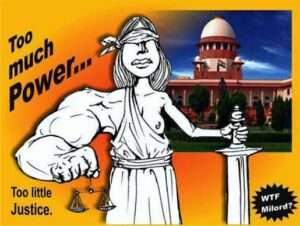
There is also a larger institutional concern. The judiciary must remain an impartial arbiter of law and constitutional rights. It should certainly protect citizens against arbitrary or excessive State action. At the same time, it must be careful not to create the impression that the State can be compelled to retreat whenever sustained protests threaten to escalate.
In my view, that would be an unhealthy precedent.
There is a difference between protecting the right to dissent and protecting every act committed in the course of dissent. The former strengthens democracy; the latter can undermine it.
The government must certainly be held accountable for examination irregularities, paper leaks and administrative failures. If officials are responsible, they must face appropriate investigation and action. Students whose careers have been jeopardised deserve justice and, where warranted, institutional remedies. But accountability cannot operate selectively.
The same principle must apply to protesters. If an individual participated peacefully, there is little justification for allowing a criminal case to destroy his or her future. But where there is credible evidence of violence, vandalism or deliberate destruction, due process should take its course.
The judiciary, therefore, need not choose between compassion and the rule of law. It can uphold both.
The Supreme Court’s constitutional powers are extraordinary precisely because they must be exercised with extraordinary care. Article 142 is intended to ensure complete justice; it should not inadvertently create the perception that public disorder can secure judicial indulgence.
At a time when democratic institutions are already under enormous pressure, the judiciary has an even greater responsibility to be pragmatic. It must protect legitimate dissent, check governmental excesses and safeguard citizens’ rights—but simultaneously ensure that its interventions do not contribute, however unintentionally, to an environment where lawlessness begins to appear politically or socially acceptable.
Justice must be compassionate, but it must also be consistent. Democracy needs dissent, but it needs discipline too. The judiciary’s greatest challenge is to ensure that one does not come at the cost of the other.


The article couldn’t have been more balanced. Couched in right words to critique a critical issue it concludes with acknowledgement of dissent and discipline as integral to democracy. How true that state cannot be compelled to retreat when protests threaten to escalate.
That would tantamount to invitation to anarchy.
I am in conformity with the views expressed in the article