



Arjuna, his heart torn between reason and anguish, spoke with a voice that trembled under the weight of unbearable grief. “When such mighty warriors as you—strong, skilled, and consummate in the science of war—stood guard, how could my son, unconquerable even to Indra, fall in battle? From no angle does my mind discern the cause of such a catastrophe.” Thus, as his intellect struggled to assert order amidst chaos, his thoughts multiplied like waves upon a storm-driven ocean. Each question gave rise to another, and in answering himself he found no solace, only deeper unrest. Turning toward Yudhishthira, he declared in rising bitterness that his trust had betrayed him. “O king, it was my faith in you and in the host of Drupada that has yielded this grievous end. Had I known your prowess would falter, I would have guarded my son myself and spared him this untimely death.”
His sorrow sharpened into accusation, and his words, like arrows, struck without restraint. “Where was your strength, your divine power of arms? How could you endure such disgrace, failing to protect a mere youth? Are these weapons but ornaments to you, devoid of honor and purpose?” Yet even as he reproached others, his anguish turned inward. “What blindness possessed me,” he lamented, “that I left my son unguarded? My own folly stands revealed in this calamity.” His breath grew heavy, his face contorted, eyes reddened with tears and fury, until none dared meet his gaze. The very air seemed burdened by his grief.
Then Krishna, with words of gentle wisdom, sought to soothe the tempest within him, while Dharmaraja, steady yet sorrowful, spoke with humility and truth. “O peerless Arjuna,” he began, “when you departed to confront the assembled foes, we faced Dronacharya, who had arranged his forces in an impregnable formation. His arrows rained like fire, denying us even the space to advance or raise our heads. In that dire moment, I remembered your son, Abhimanyu, trained in your art and endowed with youthful valor. I asked him to breach the formation, promising that we would follow.”
“Like a mighty elephant plunging into the ocean, he entered the formation and shattered its front. But before we could reach him, Jayadratha stood as an immovable barrier. Empowered by the boon of Shiva, he held us at bay, rendering us helpless. Within, your son stood alone against a host—Drona, Kripa, Ashwatthama, Kritavarma, and Karna. Yet he faltered not. He drove them back, slew princes such as Lakshmana Kumara and Brihadbala, and scattered kings like leaves before a storm. At last, bereft of chariot, he fought on foot with a mace, clashing fiercely with the son of Dushasana, until both fell in that terrible combat. Thus did Abhimanyu attain immortal glory, ascending to the heavens through valor unmatched.”
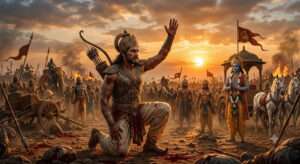
Hearing this full account for the first time, Arjuna’s strength deserted him. His limbs trembled, his mind reeled, and torrents of tears flowed unchecked. Overcome, he collapsed, senseless with grief, while his kin stood silent, stunned by the enormity of his sorrow. Krishna and Dharmaraja raised him, restoring him slowly to awareness. Yet as consciousness returned, so too did a burning resolve. His lips quivered, his brows knit in fierce determination, and with a voice edged like thunder he spoke again.
“O son of Dharma, hear now my vow, and let all kings bear witness. Tomorrow, before the sun sets in the western sky, I shall slay Jayadratha upon the battlefield. If he flees, seeks refuge in you or in Krishna, or casts aside his pride and surrenders, he may yet be spared; otherwise, he is doomed. He is the cause of my son’s death, and any who stand beside him shall be consumed by the fire of my arrows. Should I fail in this vow, may I incur the gravest of sins—betrayal of my teacher, the slaying of a Brahmin, indulgence in vice, and abandonment of duty. Nay, more: I shall cast myself, along with my Gandiva, into the blazing fire.”
With that, he roared like a lion awakened to wrath, and drawing his mighty bow Gandiva, he twanged its string, the sound echoing across the heavens. Krishna, in solemn accord, sounded the conch Panchajanya, while Arjuna’s own Devadatta resounded in answer. The warriors, stirred by this fierce resolve, raised their voices in renewed confidence, as though victory itself had taken form. The Gandiva seemed to dance with the shadow of death, and the very atmosphere throbbed with the strategy and purpose of Krishna and Arjuna united.
Thus, as the night deepened, Sanjaya recounted these events to Dhritarashtra, revealing how grief had transformed into a vow that would shape the destiny of the coming day, and how, in the hearts of men, despair had given way to a fire that none could easily extinguish.

