Lakshmanrao Upadhyayula
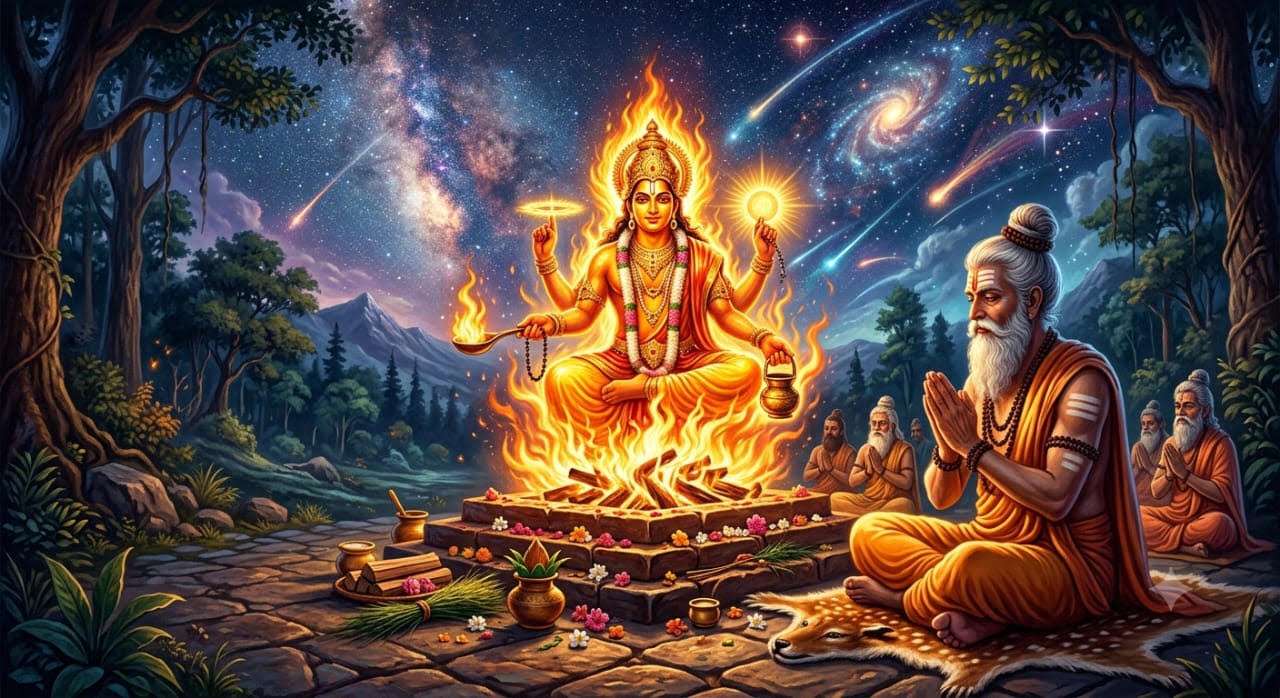
The sage Gr̥tsamada, immersed in the profound cadence of the Jagatī metre, raises a luminous invocation to Agni, the eternal flame who stands at the heart of Vedic consciousness. Agni is not merely fire in its physical manifestation but the very embodiment of divine radiance, the sustainer of life, and the purifier of all sacred action. He is described as rich in nourishment, for through him flows the subtle energy that sustains both the visible and invisible worlds. As the knower of all beings, Agni penetrates the essence of existence, linking the mortal and the divine. The priests, understanding this cosmic function, continually nourish him through yajña, recognizing that every offering made into his flames becomes a bridge to higher realms.
In the rhythmic unfolding of Vedic ritual, Agni assumes the role of both messenger and witness. Just as a cow instinctively nurtures its calf during the day, so does Agni, ever vigilant, sustain the aspirations of humanity both by day and by night. His presence is invoked continuously, for he spreads across the heavens and dwells within every sacred act performed by human hands. In the darkness, he becomes light; in uncertainty, clarity; and in ritual, sanctity. Thus, Agni is seen as auspicious, a sovereign presence governing both earth and heaven, embodying the totality of wealth—not merely material abundance, but the fullness of spiritual prosperity.
Agni’s brilliance is not confined to mere illumination; it is dynamic, transformative, and purposeful. In the form of blazing fire, he acts as the task master of cosmic order, ensuring that the principles of ṛta, the universal law, are upheld. Installed by the gods themselves in their original and unchanging form across all worlds, Agni becomes the axis of interaction between realms. Scientifically, this reflects an intuitive understanding of energy transformation: fire converts matter into subtle forms, just as yajña transforms physical offerings into spiritual merit. In this sense, Agni can be seen as an early conceptualization of energy exchange, where nothing is lost but only transmuted.
The hymn further elevates Agni as the giver of rain, linking him to the hydrological cycle. From the heavens, he returns as water, nourishing the earth and sustaining life. This reveals a remarkable scientific temperament embedded within Vedic thought, recognizing the cyclical interplay between fire, atmosphere, and water. Agni is also likened to the moon in his gentle illumination and is revered as the protector of waters and even as a divine mother, nurturing existence. Through his expansive power, he upholds both earth and heaven, and even in desolate places, when invoked, he restores vitality and sacred presence.
As the performer and sustainer of yajña, Agni permeates all rituals, receiving oblations and carrying them faithfully to the gods. Among herbs and plants, he manifests as the latent heat of life, and when kindled, he rises like a guiding star between earth and heaven. This imagery reflects both spiritual symbolism and ecological awareness, recognizing fire as an integral force within nature’s cycles. When Agni is invoked to shine forth, he is also invoked to bestow auspicious and steadily growing wealth—wealth that includes health, vitality, knowledge, and harmony with the cosmos.
Through Agni, the offerings of humanity transcend their material form and reach the divine. In return, he grants prosperity in the form of cattle, horses, progeny, and enduring nourishment. The hymn expresses a deep yearning for abundance that is not selfish but aligned with cosmic harmony. Agni is asked to open the gates of flourishing food, symbolizing both agricultural fertility and the opening of pathways to sustenance and well-being. The unique power of yajña, guided by Agni, softens both earth and heaven, drawing their grace toward the devoted.
At the arrival of Uṣas, the dawn, Agni is rekindled with renewed brilliance. As the first light of day spreads across the horizon, Agni’s flames rise in harmony with the sun’s rays, symbolizing the unity of terrestrial and celestial fire. He becomes the foremost practitioner of yajña, the lord of people, and the most honored guest in every sacred space. This daily rekindling reflects a profound psychological and spiritual insight: renewal is constant, and through disciplined practice, the human spirit can align itself anew with cosmic forces.
Agni is praised as the predecessor of the gods, the one who prepares the path for divine presence. The hymns chanted by humanity are not mere words but vibrations that resonate with Agni’s essence, pleasing him and invoking his grace. The rewards sought are vast—food, strength, capability, and excellence that surpasses limitations. The reference to the five categories, or pañcajana—gods, ancestors, humans, animals, and birds—reveals an inclusive vision of existence, where the light of Agni, like that of the sun, nourishes all forms of life without distinction.
In its deeper philosophical layer, the hymn acknowledges variations in interpretation, such as those found in Nirukta, where beings like Gandharvas, Asuras, and Rakshasas are included. This reflects an evolving intellectual tradition that seeks to understand the diversity of existence within a unified framework. Agni, as the light that comforts all, transcends these classifications, offering illumination to every realm of being.
Finally, the hymn culminates in a heartfelt prayer. Agni, the conqueror of obstacles and the worthy recipient of praise, is invoked by priests of noble lineage and sincere intent. He is asked to flourish in the sacred halls of yajña, bringing wealth, progeny, and well-being to the patron and the community. As the knower of all that exists, Agni stands as both witness and benefactor. The priest and the patron together seek his blessings, aspiring for dwellings filled with joy, generations enriched with virtue, and lives guided toward higher purpose.
In this grand vision, Agni becomes more than a deity; he is the principle of transformation, the bridge between matter and spirit, and the guiding force that leads humanity toward enlightenment. Through courage, devotion, and the chanting of sacred hymns, seekers align themselves with this eternal flame, moving steadily toward the highest goal of existence.