Upadhyayula Lakshman Rao
In the ancient vision of the Rigveda, the sage Deerghatama raises his contemplative voice in hymns composed in the measured cadences of Jagatī and Triṣṭubh, invoking the divine principle of Ashva. The horse is not merely an earthly creature but a radiant manifestation of cosmic vitality, born of divine grace and sustained by the nourishment of the universe itself. Its vigor, courage, and ceaseless motion symbolize the dynamic forces that uphold existence. Through ritual, these forces are harmonized with human intention, aligning earthly action with celestial rhythm.
The invocation extends to the guardians of cosmic order—Mitra, Varuna, Aryaman, Vayu, Indra, the Maruts, and the divine artisans Ribhus—that no fault be found in the ritual. Each deity represents a law of nature or a principle of balance, and the sacrifice is thus a profound dialogue between humanity and the cosmos. The presence of the goat, sacred to Pushan, signifies guidance, nourishment, and the bridging of realms; it moves ahead as a herald, symbolically carrying the intent of the sacrifice to the divine plane.
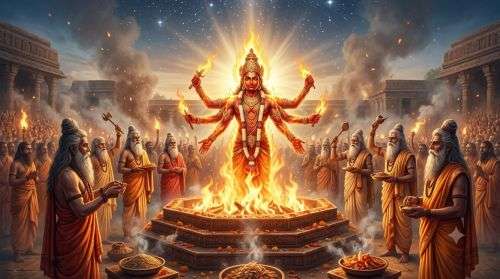
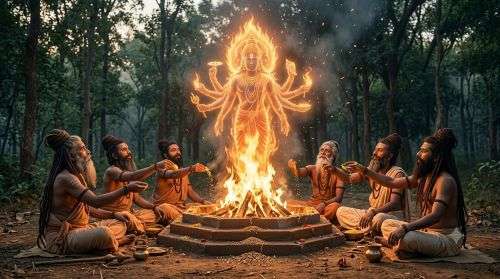
The ritual unfolds with meticulous order, reflecting both spiritual devotion and proto-scientific precision. The priests, including the Hotṛ, Adhvaryu, and the overseeing Brahman, act as custodians of sacred knowledge, each role defined with clarity and discipline. Fire, embodied as Agni, becomes the transformative medium through which material offerings are transmuted into subtle essence. The preparation of the altar, the cutting of wood, the crafting of implements, and the arrangement of vessels all reveal an early understanding of process, structure, and intentional design—an integration of ritual with empirical awareness.
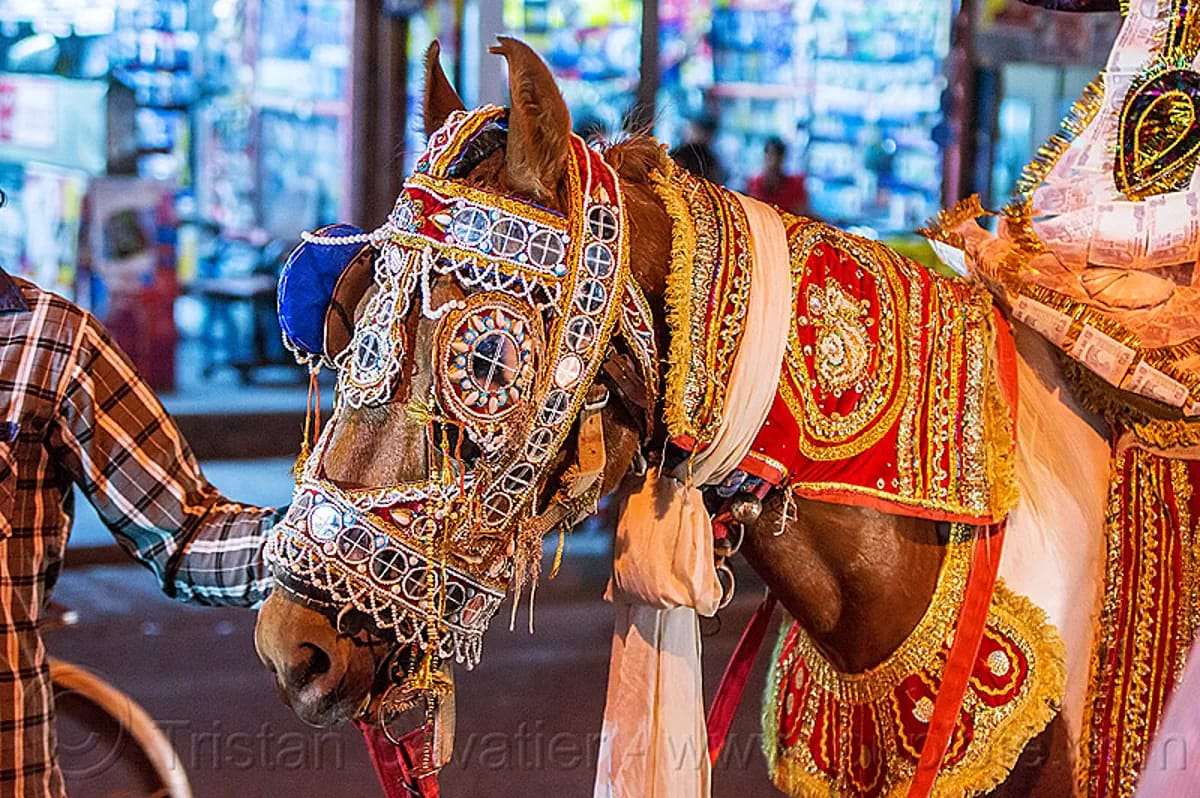
The horse, chosen for its strength and flawless form, is adorned with gold and sacred ornaments, elevating it from the mundane to the divine. Its binding, though described in physical terms, symbolizes the containment of cosmic energy within the framework of ritual order. The act is not one of cruelty but of transformation, where the individual form is offered back to the universal source. The careful separation of parts, the preservation of purity, and the insistence that no fragment be defiled or wasted reflect a deep reverence for matter and its sacred potential.
Even the smallest details—the prevention of contamination, the safeguarding of juices, the sanctification of tools—demonstrate a disciplined awareness akin to scientific hygiene and controlled experimentation. The ritual insists that nothing impure reach the offering, echoing a principle of systemic integrity. The presence of observers awaiting the sacred food underscores the communal dimension, where divine grace is redistributed among participants, reinforcing social cohesion and shared belief.
The horse’s journey is ultimately metaphysical. It is declared not dead, but transformed, ascending through the flames of Agni into the realm of the gods. Time itself, composed of day and night, becomes the field in which this transformation occurs. The horse is identified with cosmic motion, with the chariot of Indra and the pathways of the Ashvins, linking terrestrial sacrifice to celestial travel. Its essence merges with the eternal, affirming the Vedic insight that life is not extinguished but transmuted.
Thus, the ritual of the sacred horse stands as a grand synthesis of spirituality and early scientific temperament. It encodes observation, classification, and procedural rigor within a framework of symbolic meaning. The universe is perceived as an interconnected system, where energy, matter, and consciousness interact through lawful processes. In this vision, sacrifice is not destruction but reconfiguration, not loss but continuity, and through it, humanity seeks alignment with the eternal order, aspiring for strength, prosperity, and liberation from all impurity.