Upadhyayula Lakshman Rao
In the sacred cadence of the Rigveda, composed in the dignified movement of the Trishtubh metre, the sage Kakshivantha raises a profound hymn to the divine principle of dāna, the eternal law of charity. His vision does not merely praise the act of giving but unfolds its deeper spiritual and cosmic significance. Charity, in this hymn, is not an isolated virtue but a sustaining force that harmonizes human life with the universal order. The king Swanayu is exalted as an embodiment of this principle, one who, at the break of dawn, bestows wealth gracefully upon those who approach him, thus aligning himself with the rhythm of nature, where the morning itself symbolizes renewal, generosity, and awakening.
Kakshivantha recounts how the wealth received from the king was not hoarded but transmitted through filial reverence to his father, thereby preserving the continuity of tradition and duty. That wealth, sanctified by rightful use, expanded in its purpose and bore fruit across generations. It sustained life, nurtured progeny, and ensured the flourishing of sons and grandsons, reflecting the Vedic understanding that prosperity is not merely material accumulation but the extension of life’s vitality and dharma across time. The sage addresses his son with both affection and insight, declaring that by arriving first at dawn, he became the foremost recipient of royal grace. Yet, he also observes with subtle wisdom that wealth, like a tether, binds the recipient just as ropes bind animals and birds, suggesting that material gain carries both responsibility and restraint.
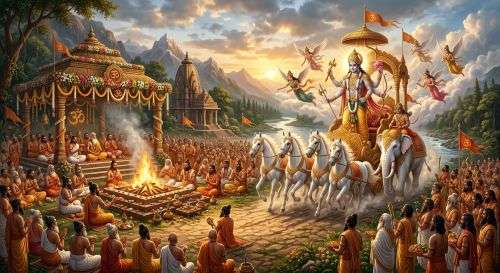
The king, thus praised, is invoked to flourish abundantly with cows, horses, and manifold riches, symbols of sustenance, strength, and societal well-being in Vedic culture. The divine power of Indra is called upon to further bless him, affirming that righteous generosity attracts celestial favor. The sage reflects on his own journey, arriving at the sacred grounds of yajña, guided by adherence to tradition and ritual order. With the wealth received, he prepares the sacred Soma, offering it to the gods, thereby transforming material charity into spiritual communion. This act illustrates the Vedic cycle where wealth, when purified through sacrifice, returns to the cosmic order as divine nourishment.
The hymn then expands into a vivid portrayal of cosmic harmony. Cows, revered as sources of nourishment and abundance, flow with milk, granting comfort and protection to those engaged in sacred rites. They symbolize not only physical sustenance but also the gentle generosity of nature itself. The forces described as invincible protect those who bring happiness to others, suggesting a moral law embedded within the universe where benevolence attracts protection. The blazing sacrificial fire, fed with clarified butter, stands as the root cause of growth, representing transformation, energy, and the scientific insight that life thrives through the conversion and circulation of elements.
The narrative deepens as it describes the destiny of those who worship with sincerity and offer oblations with devotion. Such individuals attain a place among the gods, moving in higher realms of existence. For them, the waters become rich with nutrients, the earth yields abundant produce, and life unfolds in continuous harmony and joy. These descriptions, while poetic, reflect an intuitive understanding of ecological balance, where righteous living aligns human activity with the cycles of nature, ensuring sustainability and prosperity.
Charity is further exalted as the source of beautiful possessions and higher attainment. Those who give selflessly are elevated to luminous realms by the grace of Surya, attaining a form of immortality through their deeds. Longevity, freedom from sorrow, and release from sin are described as natural consequences of a life devoted to pleasing the divine through righteous action. The hymn emphasizes that those who chant sacred hymns, uphold ritual vows, and live in accordance with dharma transcend decay and the diminishing effects of time.
In contrast, those who neglect these sacred duties, who neither give nor perform rituals, are said to descend into darkness and hardship. This is not merely a moral warning but a reflection of the Vedic worldview, where disconnection from the cosmic order leads to imbalance and suffering. The seer’s mind, transcending ordinary human limitations, culminates in a profound declaration: charity itself is divine, and giving is a manifestation of the sacred. Through this insight, Kakshivantha elevates the concept of dāna from a social virtue to a universal principle, revealing it as a bridge between the human and the divine, between material existence and spiritual realization.