



At the break of dawn, a strange and terrible enthusiasm seized the Kaurava hosts. Adorned with glittering ornaments, clad in shining armour, bearing shields and keen-edged weapons, they advanced under the supreme command of Bhishma. Their movement resembled the surging of oceanic waves, vast and unrestrained, rolling toward inevitable collision. So splendid was their ordered march that, for a fleeting moment, they seemed like warriors proceeding in a royal wedding procession rather than toward a field of slaughter. Their army was arranged in the formidable Makara, the Crocodile formation, devised with deliberate strategic skill.
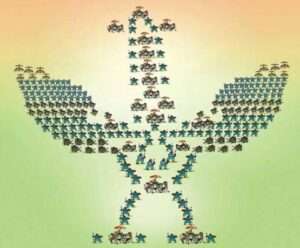
In response, the Pandava forces formed the swift and vigilant Hawk formation. Bhima was stationed at the forefront, the fierce beak of that living formation. Shikhandi and Dhrishtadyumna stood like its two penetrating eyes. Satyaki took position at the head, while Arjuna guarded the vital neck. King Virata and King Drupada held the left wing, supported by the valiant Kekayas. At the rear stood the sons of Draupadi and the youthful Abhimanyu. Yudhishthira, with Nakula and Sahadeva, secured the tail of the formation. Thus arrayed in dreadful symmetry, both armies stood poised for war.
Suddenly the silence shattered. War drums thundered, conches roared, trumpets and bugles blared, and their vibrations seemed to tremble between earth and sky. Then spoke Sanjaya to Dhritarashtra: “O King, Bhimasena has boldly crashed into the Crocodile formation, like a mighty sea-creature cleaving through the ocean of the Kurus.” With irresistible fury Bhima broke into the enemy ranks, scattering the Kaurava divisions. From within their own strategic depths he showered arrows upon Bhishma.
The grandsire Bhishma shone resplendent, like sacred fire fed with clarified butter. His arrows blazed like flames, and for a moment the Pandava forces trembled beneath his onslaught. Then Arjuna entered the field, restraining Bhishma with celestial weapons. The divine astras he unleashed were fierce and devastating, forcing the Kaurava warriors to recoil from their scorching power.
At that perilous hour, Duryodhana approached his preceptor Drona and spoke with bitterness: “O revered master, you and Bhishma together can repel even celestial forces, yet you seem to ignore the growing dominance of the Pandavas. Why do you behold this havoc in silence?” Drona, troubled by the accusation, replied with measured gravity: “None has yet withstood the might of the Pandavas. I never vowed to conquer them. When a small urn is dipped into the ocean, it can hold only what its measure allows. So too is our strength limited by destiny. Why speak words that wound without wisdom?”
Having thus spoken, Drona advanced fiercely, loosing volleys of arrows that scattered the Pandava ranks. Satyaki rushed upon him with the force of wind. The preceptor smiled at his audacity and struck him with a powerful shaft, yet could not quell his spirited assault. Bhima hastened to support Satyaki, raining arrows upon Drona. Bhishma and Shalya came to Drona’s aid, while the sons of Draupadi and Abhimanyu joined the fray, directing relentless shafts against Drona and his allies.
Then Shikhandi surged forward like blazing fire, the twang of his bowstring echoing across the heavens. With firm resolve he attacked Bhishma. Yet Bhishma, unwilling to combat one whom he regarded as having changed gender, withdrew from that encounter. Observing this, Duryodhana again provoked Drona, who drenched Shikhandi with celestial weapons and forced him back.
The battle soon dissolved into dreadful chaos. Warriors no longer knew whom they struck. Weapons clashed, releasing showers of sparks like lightning flashes. The twanging of bows resounded like rolling thunder. Blood fell in torrents, staining earth and sky. Horses collapsed in heaps; elephants fell like shattered mountains. White garments turned crimson. The bodies of warriors rose in ghastly mounds, and the battlefield trembled as though seized by an earthquake.
The celestial beings applauded the valor displayed by both hosts. Bhima and Bhishma led their respective armies with relentless vigor, while Arjuna supported Bhima and Drona stood beside Bhishma. They fought with immeasurable strength, face to face, in ferocity beyond telling. In the midst of this fury, Duryodhana attacked Bhimasena, and the Kaurava princes, united like a herd of enraged elephants, charged upon him. Their chariots surged forward in support of their brother.
Arjuna, drawing his bow with resounding twang, released a storm of arrows against the Kaurava princes. Like clouds dashed against a mountain peak, they faltered and retreated. Fear-stricken, they rallied behind Bhishma. Duryodhana, regaining composure, waved his hand and encouraged them to renew the fight. The forces of Shakuni, the Sindhu, Gandhara, Trigarta, and Kalinga stood by him under the leadership of Dushasana, and together they pressed against Bhima and Arjuna.
Elsewhere, countless duels unfolded: Vinda and Anuvinda faced the King of Kasi; the Saindhava engaged Bhimasena; Vikarna fought Sahadeva; Chitrasena confronted Shikhandi; Duryodhana battled Virata; the Trigarta king opposed Nakula; Drona encountered Chekitana and Satyaki; Kripa engaged Hardikya; Abhimanyu fought Salva; the Kekayas contended with Dhrishtaketu; Ghatotkacha assailed the Kaurava princes; and Yudhishthira met Shalya in grim determination, resolved either to conquer or to die.
The combat raged fiercely until midday. The blaze of clashing astras and shastras seemed to challenge the very sun. Its rays grew scorching, mingling with the heat of battle. Broken chariots, shattered weapons, and lifeless bodies of horses, elephants, and warriors floated in streams of blood thick with bones and severed limbs. The field appeared as though overturned by a catastrophic convulsion of the earth, everything shattered and borne along by the residue of wrath.
At last the war reached a state devoid of emotion. Kinship was forgotten. Mercy perished. Each warrior sought only the ruthless destruction of his foe. Thus was the dreadful spectacle at Kurukshetra, as Sanjaya faithfully narrated to the blind king Dhritarashtra—the tale of a day when valor and vengeance eclipsed all bonds of humanity.

