Upadhyayula Lakshman Rao
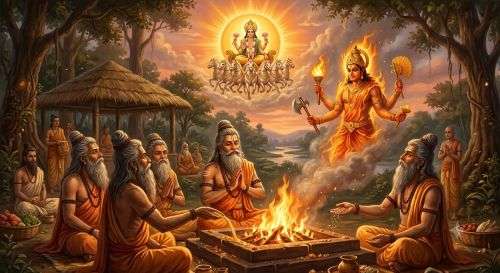
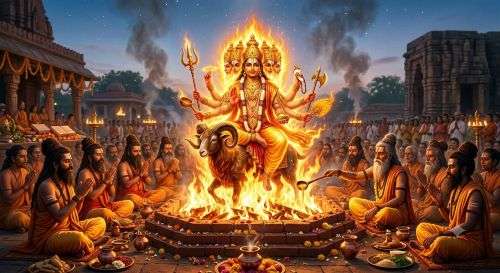
In the contemplative vision of the sage Deerghatama, a subtle and profound inquiry arises concerning Agni, the eternal mediator between the mortal and the divine. Is Agni superior to mankind, or is he akin to them? Does he stand as an elder guide, or has he emerged later among beings? Is he merely the sacrificial fire kindled by human hands, or the transcendent divine principle itself? These questions are not expressions of doubt alone, but the doorway to higher understanding. The sage, in reverence, addresses Agni as an elder brother, cautioning him not to partake unworthily of the sacred vessel, for it has arisen from a noble and sanctified origin. Thus begins the unfolding of a mystery that bridges ritual, craftsmanship, and divine evolution.
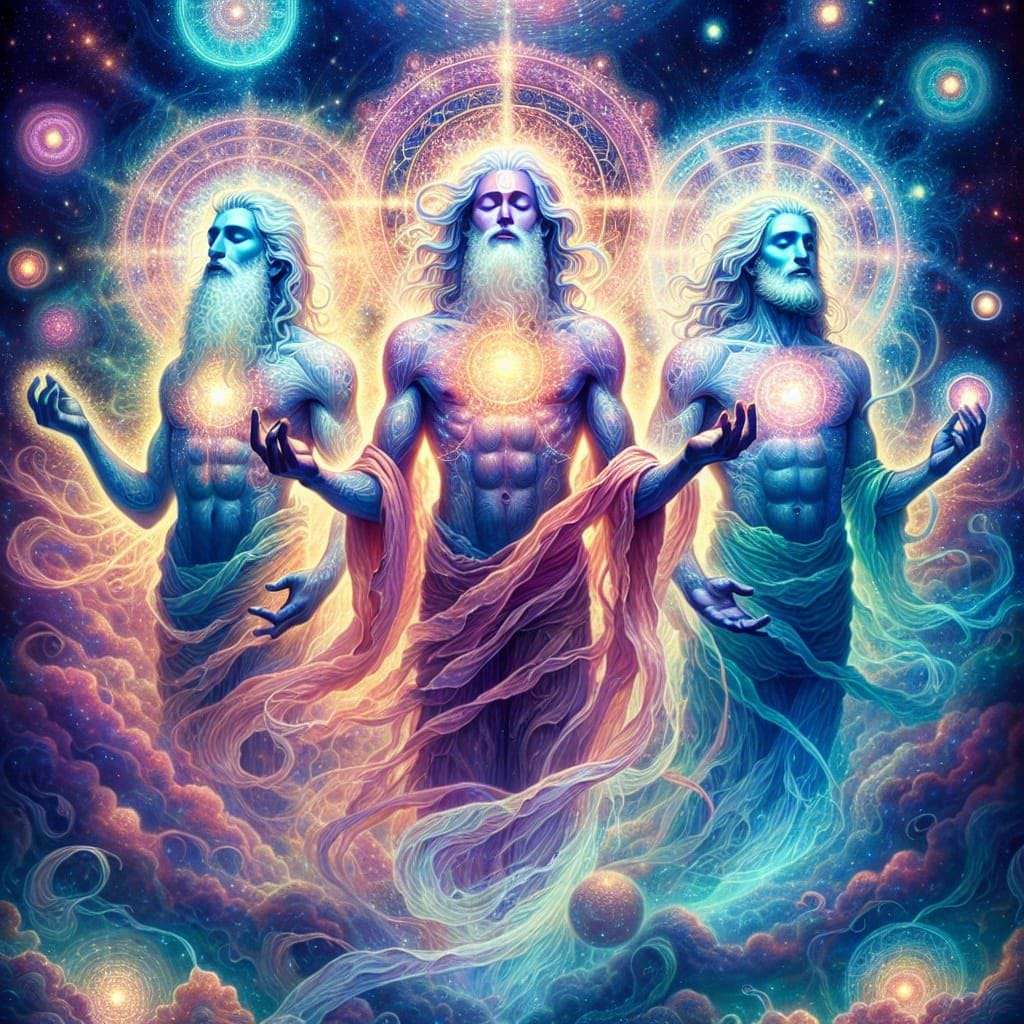
The narrative then turns to the origin of the sacred wooden vessel, a symbol of transformation and divine participation. The Rubhavas, the three sons of Sudhanva—Rubha, Vibhva, and Vaja—were not born as gods but attained divinity through the excellence of their skill, intellect, and disciplined effort. They entered the consecrated halls of yajna, drawn by the call of Soma, the elixir of immortality. Agni himself stands as the fourth among them, not merely as fire, but as the conscious witness and messenger of divine will. The gods, recognizing the latent brilliance within these artisans, set before them a task both simple and profound: to transform a single wooden vessel into four, thereby multiplying utility without diminishing essence. This was not merely a test of craftsmanship, but of perception, innovation, and alignment with cosmic order.
The Rubhavas, with humility and confidence, responded to Agni, acknowledging him as the divine envoy. They declared their intent to go beyond mere replication—to create a horse from a horse, a chariot from a chariot, and to bring forth life itself in the form of a living cow. These declarations were not boastful, but reflections of their deep understanding of transformation and regeneration. Upon completing their task, they sought the presence of the divine messenger, eager for recognition not of pride, but of fulfillment. When the divine artisan Twasta beheld the fourfold vessel, he was struck with astonishment and a trace of shame, for his singular creation had been surpassed in both scope and ingenuity. His reaction, though born of attachment, reveals the tension between creation and innovation, between origin and evolution.
From that moment, a subtle shift occurred in human conduct. The fear of invoking the wrath of Twasta led to the use of alternate names, giving rise to the tradition of epithets and functional titles such as Athvaryu, Hota, Udgata, and Brahma. These were not mere names, but roles defined by action and responsibility. Even in domestic life, mothers began to call their children by affectionate names, a gentle echo of a deeper cultural transformation rooted in reverence and caution.
The creations of the Rubhavas were distributed among the gods, each recognizing the value of their work. The twin horses, radiant and swift, were taken by Indra and came to be known as Hari. The chariot was claimed by the Ashwins, the divine physicians and travelers of the skies. Brihaspati received the multi-hued cows, symbols of abundance and knowledge. The Rubhavas, having demonstrated their mastery, humbly requested a share in the Soma, the divine nectar. The gods, acknowledging their achievements, invited them to partake, offering even variations of Soma suited to their taste and preference, thus honoring both their individuality and their unity.
Their accomplishments extended beyond objects into the realm of life itself. They rejuvenated their aged parents, restoring youth where time had taken its toll. They created a living cow from an existing one, not merely replicating form but instilling vitality. Their work reflected an advanced understanding of structure and function—one shaping the life-blood, another the flesh and bone, and the third the internal systems that sustain existence. This division of labor and integration of knowledge mirrors the principles of biological science and systemic design, revealing a proto-scientific temperament embedded within Vedic thought.
The Rubhavas also contributed to the harmony of nature and human survival. They directed rains to higher regions, enabling the flow of water across varied terrains. They taught the principles of agriculture, transforming the land into a source of sustenance. They stored waters in lower regions, ensuring conservation and continuity. Their vision was not limited to creation, but extended to sustainability and ecological balance. Their residence in the realm of the sun symbolizes not only their elevated status but their alignment with the source of light and life.
Yet, even in their divine repose, questions arise—who shall awaken the world in their absence? It is Surya who proclaims the continuity of order, and Vayu who stirs the stillness, reminding that the cycle of activity and rest is eternal. The Maruts, Agni, Vayu, and Varuna converge in reverence, acknowledging the stature of the Rubhavas. Their presence transcends boundaries, uniting space, earth, sky, and ocean in a single continuum of respect.
The deeper insight offered by the sage is that divinity is not confined by birth, form, or lineage. The gods themselves are not bound by any singular identity or origin. They rise through righteous action, through service to both humanity and the natural world. Agni, Vayu, and Indra attained their divine stature not by inheritance, but by their contributions and alignment with cosmic purpose. The sages followed this path, transcending ordinary perception through discipline and vision, becoming creators in their own right.
The Rubhavas stand as exemplars of this truth. They were not born divine, but became so through intelligence, perseverance, and dedication. Their work reflects the spirit of engineering, scientific inquiry, and innovation. They improved upon existing creations, even surpassing the original artisan. Their ability to transform, regenerate, and sustain speaks of a profound understanding of both material and life sciences. Their achievements are not merely symbolic, but indicative of a culture that valued knowledge, experimentation, and the betterment of life.
Their journey affirms that excellence, when guided by purpose and humility, leads to recognition and elevation. Though their brilliance may at times be obscured, like the sun behind clouds, it cannot be extinguished. The gods themselves acknowledged their worth, granting them a place equal to the solar realm. This was not a gift, but a recognition of merit. The Rubhavas, through their extraordinary faculties, bridged the human and the divine, leaving behind a legacy that continues to inspire the pursuit of knowledge, the refinement of skill, and the realization of higher truth.