
This is an article series. Please read all previous articles before reading this article. The URLs for all previous articles are located in the SPECIAL THOUGHTS section.
Let’s continue pondering over Shiva, a very prominent Devata in Level 5.
Shiva Linga
Recently, a member of the parliament from West Bengal posted a very offensive and objectionable meme on social media, showing a contraceptive put on what appears to be a Shiva Linga. And the MP is supposedly a Hindu. Have you ever wondered why do people do such grossly offensive things? If you think that it is merely “vote bank politics”, then I disagree. Mere “vote bank politics” is not enough reason to create such an offensive meme. I argue that this is because Hindus themselves have grossly misunderstood the meaning of the word “Linga”.
For example, the word “Stand” takes several meanings based on context, such as “Bus Stand is nearby” or “Put the Guitar back on its Stand”, or “I cannot stand this noise” or “We request everybody to Stand,” and so on. Similarly, the word “Linga” can take several meanings… and, at a shallow level, one of those meanings happens to be “Phalus” or the male genital. But, like how each word has a root, the root of the word “Linga” is what is relevant. Etymologically, the word “Linga” is explained as “leenam gamayati iti linga:”. The word “Leena” refers to something that is concealed, dissolved, merged, absorbed, or immersed. For example, when we add sugar to water, it dissolves pretty soon. Once dissolved, it has become “Leena” in water. And something that has the ability to reveal to us what has become “Leena” is referred to as “Linga”. With that elaboration on the etymology of the term “Linga”, let’s now revisit the word “Linga”
1) In the context of “Jeevaatma”, and
2) In the context of “Shiva Linga”.
Jeevaatma and the Gender
Tongue reveals the presence of sugar dissolved in the water. The nose reveals the presence of a certain fragrance in the air. A force of attraction to ferrite material and the absence of such attraction with non-ferrite materials reveal that a certain object is actually a magnet. Thus, in a way, each of our Indriya-s is a Linga because it reveals to us what is hidden/dissolved/concealed in the Pancha Bhoota-s. So, all these Indriya-s are wrapped around the Jeevaatma as external attachments. Very early in this series, we learnt about the 3 Shareera-s that wrap the Jeevaatma. The innermost wrapper is called Linga Shareera. That begs the question: “Why is it called Linga Shareera?”. My take is… at the beginning of the creation of this universe, all Jeevaatma-s that fall within the created space (called Bhootaakaasha) are wrapped with the first Shareera. With this, the Jeevaatma can experience the 5 Tanmaatra-s through the 5 Indriya-s and thus, since the Indriya is revealing something concealed in the Pancha Bhoota-s outside, the 5 Indriya-s can also be referred to as 5 Linga-s. In other words, just like how Indriya is a generic term, Linga is also a generic term and is basically synonymous with the term “Indriya”.
You may be thinking, “What about the Karmendriya? They don’t reveal anything concealed to us. Do they? Then can we refer to them too as Linga?”. My take is… Yes, we can. For example, Vaak Indriya reveals to a Jeevaatma that it has the ability to talk. Paani Indriya reveals to a Jeevaatma that it can create so many wonderful things that were all concealed until the Jeevaatma was able to manifest fully. Similar arguments can be presented about each of the remaining Karmendriya-s, too. As we know, there are specific terms for each Indriya… such as Karna Indriya (ears), Twag Indriya (skin) and so on. The specific term used to refer to the genital organ is Upastha, and there in… the specific term used to refer to female genitalia is Yoni, and the specific term used to refer to male genitalia (especially the Phallus) is Shishna. But the linguistically popular term for Shishna is the generic term “Linga”. But why is that only the male genital specifically referred to as Linga? Why is the female genital is specifically referred to as Yoni and NOT referred to as Linga? Well… you’ll have to read further.
What is very important to note here is that the gender does not merely pertain to the genital on the external body, but it is in fact an intrinsic characteristic of the Jeevaatma itself. Let’s ponder it. Our Shareera is made of Pancha Bhoota-s (Pruthvi, Aapa, Teja, Vaayu and Aakaasha) and each of them is a Jada (insentient) and therefore genderless. So, something that is made of five genderless insentient things can’t have a gender. Thus, logically speaking, Gender is an intrinsic characteristic of the Jeevaatma and its external Abhivyakti (manifestation) is what we see as genitals in our Shareera (external gross body). But there is a caveat to this.
In conclusion from the above, a Jeevaatma has a gender. In other words, a Jeevaatma is either male or female. A Jeevaatma of female gender will always adorn a female body and have female genitalia in its external body. A female Jeevaatma will never adorn a male body. But, a Jeevaatma of male gender can adorn either a male body or a female body. What it means is that when we see a woman or any female animal, we cannot say for sure that the gender of the Jeevaatma inside that Shareera is also female. It can also be a male Jeevaatma adorning a female body. But, on the other hand, if we see a man or any male animal, we CAN say FOR SURE that the Gender of the Jeevaatma inside that Shareera is absolutely male. Thus, as a corollary, the male genital alone is referred to as Linga because it clearly reveals the Gender of the Jeevaatma that’s concealed inside that Shareera. And, as a second corollary, the female genital is NOT referred to as Linga because it does NOT clearly reveal the Gender of the Jeevaatma that’s concealed inside that Shareera.
There is evidence for this too in nature. We hear about a school of fish that are minnows. Bigger fish hunt them and sometimes eat up all the males in the school. And when this happens, one of the females turns itself into a male so that procreation is possible. We also hear about crocodiles laying eggs, but the gender of the crocodiles that hatch depends of the temperature of incubation. Logically, how can these happen unless the above is true about the gender of a Jeevaatma and its external Abhivyakti?
Finally, why is the female genital is referred to as Yoni? The Sanskrit word “Yoni” is synonymous with “Kaarana,” which means “cause” or “a point of origination/birth”. Thus, though we can’t deduce the Gender of the Jeevaatma in a female Shareera, we can decisively say that the female genital is the point of birth for all species that reproduce through the union of male and female. Therefore, logically, the use of the term “Yoni” to refer to the female genital makes sense.
Hopefully, the above explanation gives some clarity to the confusion created by the use of the term “Linga”. With that, let’s now get to the second topic, which is Shiva Linga.
Shiva Linga
As we learnt earlier, while elaborating on the Devata-s in level 15, Bhrugu Muni wanted to evaluate and determine who among the Trimoorti-s is the supreme. Puranic anecdotes summarize that when he visited Shiva’s abode in Kailaasa, Shiva was deeply engrossed with his eternal consort Paarvati. When his patience ran out, Bhrugu Muni cursed Shiva that from that point onwards, people in Bhooloka would worship Shiva in Linga form. These are stories that we tell our children. But the problem is that we continue to say the same stories as adults. Worse yet, the internet is so full of these primary school level interpretations that even search engines and AI summaries give us the same old accounts, which sound almost nonsensical to adults.
First of all, Bhrugu Muni is a very highly exalted Rushi, so exalted that Shree Krishna likens himself to Bhrugu Maharshi in the Bhagavad Gita. Bhrugu Rishi can be trusted to have a far, far better understanding of Shiva and Paarvati than we. My take is that… to Bhrugu Maharshi, Shiva and Paarvati being “Leena” (fully engrossed) in each other means they were really focused on their Niyata Karma. Therefore, going by “leenam gamayati iti linga:”, Bhrugu Maharshi decreed that Shiva and Paarvati be worshipped in this Leena form itself as they are fully engrossed in each other. Therefore, this is not to be taken as a curse, but a request coming in the form of a decree filled with confidence that Shiva and Paarvati will greatly appreciate and admire a great devotee such as Bhrugu Maharshi. Also, Bhrugu Maharshi knows fully well that both Shiva and Paarvati are far above him in the hierarchy. So, merely a self-centred curse, sprouting from a hurt ego caused by a long wait, would be a highly unwise move by Bhrugu Maharshi. Also, since Shiva and Paarvati are both far higher in the hierarchy of Devata-s, an unwise curse from anyone hierarchically below need not affect them at all. Worse yet, if Bhrugu Maharshi’s words were coming from his anger due to a long wait and hurt ego, then it might have even invoked a counter curse from Shiva and Paarvati. Bhrugu Maharshi is not to be thought of as so unwise that he doesn’t realize any of this. Therefore, logically, it is to be taken as a decree by an ardent devotee in admiration of Shiva and Paarvati, fully engrossed in the Karma they both were meant to do.
Let’s think about it this way. Suppose I am interested in earning the Anugraha (grace) of Shiva and Paarvati? Can I earn it by admiring Shiva and Paarvati as Devata-s who are fully focused and engrossed in their destined Karma, and expressing my gratitude to them? Or, can I earn it by thinking that Bhrugu Maharshi, a very highly exalted Rushi, had no control over his ego and got angry when he had to wait too long and decided to curse someone superior to him without knowing who he was cursing? The answer is quite obvious.
This is also a good point to introduce the readers to a key aspect of Puranic writings, which is Bhaashaa Traya-s. There are 3 times of Bhaasha-s in Purana-s, namely: Samaadhi Bhaashaa, Darshana Bhaashaa, and Guhya Bhaashaa. Simply put, Samaadhi Bhaasha is conveying something “as is”. Darshana Bhaashaa is conveying “as seen”, not exactly “as is”. And, Guhya Bhaashaa is conveyed in the form of a riddle, in a coded way which is not very straightforward nor easily understood. There is a reason for these different types of communication. Perhaps an example will help. Most of the Bhagavad Gita is in Samaadhi Bhaasha, as it is meant to convey the realities about the creator and his creation precisely. The above incident about Bhrugu Maharshi cursing is, in my opinion, is conveyed in Darshana Bhaashaa. It looks like Bhrugu Maharshi cursed Shiva, but realities can be understood only when the basics of Adhyaatma are somewhat clear. A good example for Guhya Bhaashaa is the particular incident in Mahaabhaarata where Vidura has to convey to Yudhishtira about the danger of Lakshaa Gruha right in front of Duryodhana. It was necessary to convey in such a way that only Yudhishtira got the message, while making sure that Duryodhana continues to think that Yudhishtira does not know anything about Duryodhana’s evil designs at the Laakshaa Gruha.
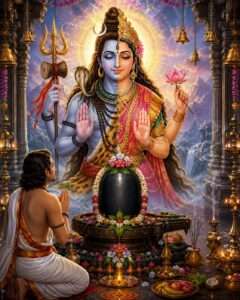
In summary, the so-called “Shaapa” by Bhrugu Maharshi became a “Vara” for the entire humanity. By accepting this “Shaapa”, Shiva and Paarvati, who are “Leena” in each other, decided to invoke their presence in Shilaa-s available only in the Narmada River, just like how Paramaatma accepted Vrunda’s “curse” and decided to invoke himself into the Saalagraama Shila. The Shilaa from the Narmada River is what we refer to as the Shiva Linga. Like in the case of Saalagraama Shilaa, we don’t invoke the presence of Shiva in a Shiva Linga because he has already invoked his presence into them. The presence of a Devata in the Shilaa is referred to as Sannidhaana. In other words, Saalagraama Shilaa has Sannidhaana of Paramaatma, and Shiva Linga has Sannidhaana of Shiva and Paarvati in a “Leena” form.
Ardha Naareeshvara
We already pondered over Jeevaatma, its gender and its external Abhivyakti (manifestation) in our Shareera. However, Gender is not just what we see externally in our Shareera. In other words, males and females are not simply physically different. They are different in their line of thought, in their mental faculties and their very intrinsic characteristics too. Overall, masculine characteristics are dominant in a male Jeevaatmaa and feminine characteristics are dominant in a female Jeevaatmaa. But Shiva is unique in the sense that he has all the masculine characteristics and all the feminine characteristics too. And therefore, he is referred to as Ardha Naareeshvara. In fact, all the Devata-s in Level 5 and above are Ardha Nareeshvara-s.
The Ardha Naareeshvara form of Shiva is usually depicted as the right half of Shiva being masculine and the left half being feminine. This is symbolic, and there is a reason behind this as well. The human body has Naadi-s. While there is no specific term in English for the Sanskrit word “Naadi”, I’ve often heard the wise ones use the term “Channels of Energy”. The Naadi-s on the right side of the body are referred to as Pingalaa Naadi-s. The energy conveyed through these Naadi-s is masculine. And, the Naadi-s on the left side of the body are called Idaa Naadi-s. The energy conveyed through these Naadi-s is feminine. And finally, there is a Naadi, which is where all the 7 Chakra-s are present. This central channel of energy is called Sushumnaa Naadi.
When the Jeevaatma exits the body, it can exit through any of the exit points.
Scenario 1: Jeevaatma can exit through one of the nine orifices (2 ears, 2 eyes, 2 nostrils, 1 mouth, 2 excretion orifices). Exiting through the lower orifices is not helpful vis-à-vis spiritual progress in successive Janma-s. Exiting through the other orifices is least helpful among all the scenarios. My take is that a Jeevaatma exiting through any of these paths will end up being a Preta (ghost). Unfortunately, this is the most common scenario.
Scenario 2: The best-case scenario is the Jeevaatma exiting through the central Sushumnaa Naadi. A Jeevaatma exiting via this path will reach Brahma Loka and will not return to the cycle of birth/death.
Scenario 3: Next best scenario is the Jeevaatma exiting the body through the Pingalaa Naadi. This is called Deva Yaana. It is to be noted that a miniature of every Deva Loka is actually located on this path. These Deva Loka-s are filled with bright light and light is for precise/resourceful knowledge. This Yaana (travel) ultimately leads to Brahma Loka and a Jeevaatma does not return from there. It attains a state called Jeevan Mukti.
Scenario 4: The least of the best scenarios is the Jeevaatma exiting through the Idaa Naadi, which are to the left side of the body. This path is filled with darkness. A miniature of all Pitru Loka-s is located on this path. It only leads to Swarga Loka. Staying at Swarga Loka can be long, but yet temporary. One has to return to the earth once the duration of stay in Swarga Loka lapses. Return to earth invariably means re-entry into Maatru Garbha, which has no light. Since this path is filled with darkness and eventually leads to darkness in Maatru Garbha, these channels are referred to as feminine Naadi-s.
This is why the Ardha Naareeshvara form of Shiva is depicted with masculine traits on the right half and feminine traits on the left side.
Next, we’ll learn more about the symbolism of Shiva Parivaara.