



Sri Anantha Padmanabha Temple at Hebri in Udupi district is a serene shrine nestled at the foothills of the Agumbe Ghats, beside the River Sita. Surrounded by fertile fields and plantations, the temple preserves the tradition of worshipping Lord Vishnu in his Anantha Padmanabha form, the Lord associated with Ananta, the eternal serpent.
The exact foundation date is not firmly established, but inscriptions and traditions confirm that the temple has stood for centuries. By the 18th century, worship was well established, and a Brahmin family was brought to Hebri to perform rituals. The Beedina Ballala family continues hereditary management to this day.
The presiding deity is Sri Anantha Padmanabha. The main idol is a three‑foot black granite figure in standing posture, revered as Anantha Devaru. Inscriptions identify the deity clearly, though some scholars once noted a resemblance to Lord Srinivasa.
The temple reflects the traditional style of coastal Karnataka. It does not have towering gopurams but instead a simple, intimate structure suited to the region. The complex also houses shrines for Kshetrapala, Khadga Ravana, and Dhoomavathi, showing how Vaishnava worship coexists with guardian‑deity traditions of Tulu Nadu.
The temple has received royal patronage, with inscriptions recording donations from kings. A devastating fire in the early 20th century destroyed half of Hebri town and the temple’s chariot, but devotees rebuilt it with renewed devotion. The temple is also spiritually linked with the Anantha Padmanabha shrines of Perdoor and Iruvathur, believed to have been consecrated during the same period.
The sthalapurana tells a sacred story of divine manifestation. Long ago, sages prayed for Lord Vishnu to remain eternally present in the region. In response, three idols of Anantha Padmanabha were consecrated simultaneously at Hebri, Perdoor, and Iruvathur. This act symbolized that the Lord’s presence is infinite and spread across the land, guarding devotees everywhere.
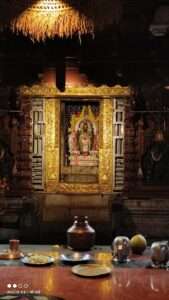
At Hebri, the Lord chose the banks of the River Sita, surrounded by forests and fertile fields, as his abode. The idol, carved in black stone, became the living presence of Ananta Padmanabha. Kings offered gifts, and devotees believed that worship here granted health, wealth, courage, fame, and relief from planetary afflictions.
The story also speaks of divine protection. When a great fire destroyed Hebri town and the temple’s chariot, the idol remained untouched. Devotees saw this as proof of the Lord’s eternal guardianship. They rebuilt the ratha, believing that Anantha Padmanabha had safeguarded the shrine.
Thus, the sthalapurana of Hebri is a tale of divine manifestation, resilience, and community faith. On Anantha Chaturdashi, the story takes on special meaning, as devotees remember the Lord who embodies infinity and continues to bless generations with his boundless grace.
The principal annual celebration is Gounothsava, observed for five days beginning with Kumbha Sankramana in February. Rituals and offerings during this time draw devotees seeking prosperity and well‑being.
Anantha Chaturdashi is a festival dedicated to Lord Vishnu in his Ananta form, symbolizing the eternal and infinite principle. On this day, devotees observe the Ananta Vrata, offering prayers for protection, prosperity, and spiritual well‑being. A sacred thread called the Ananta Sutra, tied with fourteen knots, is worn to represent the fourteen worlds and the Lord’s boundless presence.
The significance of Anantha Chaturdashi lies in remembering that Ananta means infinity, while Padmanabha refers to Vishnu from whose navel the cosmic lotus emerges. Together, they express the eternal nature of the universe and the Lord’s role as its sustainer. Observing this day is believed to bring blessings of health, wealth, courage, and harmony, while reinforcing the faith that the Lord’s grace is limitless and everlasting.

