
This is an article series. Please read all previous articles before reading this article. The URLs for all previous articles are located in the SPECIAL THOUGHTS section.
Last time, we learnt about Shiva’s Khatvaanga and we noted that it is an Aayudha made of the human skull and the human femur bone. Doesn’t that remind you of something we’ve all seen at some point, somewhere in our vicinity? I’m referring to the “Danger” sign, like the one here. It is meant to scare people away and keep them out of a dangerous area, whether because of high voltage, toxicity, or another hazard. The only difference between this “Danger” sign and Khatvaanta is that Khatvaanga has only 1 femur bone, but this sign has 2 in the form of “X”.
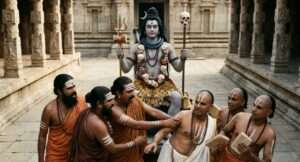
 Picture generated through AI by Karthik Dinesh
Not just Khatvaanga… there are a few more things which are actually scary. Let’s list them all.
- Khatvaanga – Skull and Femur bone
- Runda Maalaa (garland made of severed heads).
- Third Eye – No other Devata has a third eye distinctly showing. And it is this eye which Shiva opened to burn Manmatha (a.k.a. Kaama). So, it is awkward looking and scary.
- Ash – Smearing of ash from cremated dead bodies. Again, this isn’t something one would normally do.
- Naagaabharana – A snake worn as a garland in the neck
So, that begs a question: Why does Shiva, a Devata, wield an Aayudha which looks gross and scary? Why a garland of bleeding heads? Why this scary appearance? There are stories and anecdotes in the Puraana-s regarding the above. One such anecdote comes from Shreemad Bhaagavata Puraana, where Paramaatma himself instructs Shiva to hide Paramaatma’s presence in this universe. Why? Because, only the deserving should be able to experience Paramaatma’s presence. Thus, Shiva’s appearance works as decoy.
Among the undeserving, the Asura-s are always attracted towards anything that looks scary, gory, gross and disgusting. If we scan the Puraana-s, we come across a common factor among Asura-s. They never do any great Tapasyaa in pursuit of Paramaatma. But they always go to great lengths to please either Brahma or Shiva to seek boons. For example, Hiranya Kashipu was an Asura. He observed great penance to please Shiva and later on another penance to please Brahma. Similarly, Raavana and Kumbha Karna both did great penance to please Shiva and later on another penance to please Brahma. Similarly, Mahishaasura, Narakaasura, Tripuraasura, Taarakaasura… the list is literally endless. They all do penance to please either Brahma or Shiva or both to acquire boons and then take undue advantage of the boon to create havoc in the world.
Therefore, it is important for a devotee to learn about Shiva Upaasana so that he/she can look beyond the gross/scary appearance with a Saatvik mindset. We all have to be extremely grateful to the Guru Paramparaa (lineage of Guru-s) that I am one of the adherents of, for having taught us the correct way of Shiva Upaasanaa. I hope to be able to write more about this Guru Parampara in future. I consider myself extremely fortunate for having received this through my Guru because otherwise, the popular options available to choose from for Hindus are just completely irrational. What are those options? Let’s look at them:
Veera Vaishnava philosophy
I’ve briefly mentioned this philosophy a few times in the past. One of the most popular schools of philosophy today among Hindu-s is the Shree Vaishnava philosophy. Its popularity spans from Tamil Nadu in the south to Nepal in the north. The originator of this philosophy was Shree Raamaanuja Achaarya, who is considered an Avataara of Shesha. In short, his philosophy propounds that Vishnu is the highest among all those we worship. He was born in present-day Tamil Nadu. His philosophy challenged the other popular schools of philosophy at that time, and he was severely persecuted for this reason. He escaped to the neighbouring state of Karnataka, where he lived for most of his life, which spanned a total of 120 years. His body is entombed in Shreerangam, Tamil Nadu.
What is popularly known is Shree Raamanuja Achaarya’s statement about Shivaalaya (Shiva temples). Arguably, Shree Raamanuja Achaarya himself had urged “yaane vandaalum shivaalayattullai pogaade” (translated from Tamil as: “Even if a wild elephant chases you, do not run inside a Shiva temple for safety”). Regardless of whether it can be proved that he said it himself or not, it is in practice to this day among Shree Vaishnava community. Some staunch followers of this philosophy may even refer to themselves as Veera Vaishnava-s. They do not worship any Devata in Shiva Parivaara (Paarvati, Skanda, Ganapati, Nandi). So much so, they may even avoid performing Ganapati Pooja, which is standard practice before beginning any Pooja, Homa or any auspicious task. Instead, they worship Vishvaksena who, like Ganapati, is another Devata in level 18 and is also an Abhimaani Devata for Aakaasha. They may make compromises when they are amidst people who already know that any Pooja has to begin with Ganapati Pooja… but among themselves, they skip Ganapati and resort to Vishvaksena instead.
Why though? Why such a strong statement as “yaane vandaalum shivaalayattullai pogaade”? Is it ok? If ok, then how is it ok? If not, then why not? Am I simply nitpicking and making a big deal of this? After all, it is popularly argued that everyone has the right to believe what they want to believe. So, why even talk about this? And, most importantly, are there benefits to following such a philosophical line of thought? And… even more importantly… are there any consequences? Let’s delve into this. Let me offer my take on this to you, hoping that you’ll appreciate it and benefit from it.
Shree Raamaanuja Achaarya was a great philosopher. Everyone has to appreciate his honest inquiry into the rationale behind all schools of philosophy prevalent at his time. But he had several severe impediments:
- The popularity of prevalent schools of philosophy, which not only lacked common sense but were being followed almost to the extent of being inhumane. Any school of philosophy that drives a human to behave in an inhuman way is not worth following. Ahimsaa (non-cruelty) is the most important aspect of Dharma.
- Lack of availability of manuscripts. Manuscripts lend authenticity to the tenets of any philosophical line of thought. But those were not the days of internet. Everything required a painstaking search through manuscripts, which can be fragile and are often inscribed on biodegradable media.
- Exhausting difficulties in traveling. Unlike data on the internet, manuscripts are never available “on demand”. One would have to travel long distances in search of reliable copies of manuscripts. Northwestern India was already under Islamic invasion. Harsh and medieval terrain, state sponsored persecution, hostilities, and assassination attempts are some of the reasons for difficulties in travelling to seek manuscripts.
As a result, Shree Raamaanuja Achaarya may’ve felt that his inquiry was incomplete. And therefore, he may’ve advised his followers to keep off of “Shivaalaya” (Shiva temple), which were basically centers which believed that Shiva is the highest among all we worship. Here, it should be noted that the popular Tamil diktat is to avoid Shiva temple and not quite to avoid worship of Shiva altogether. My take is that his followers may not have understood how their preceptor meant that diktat. As a result, they may’ve abandoned worshipping Shiva altogether.
Shiva’s stature in the Devata hierarchy is way too high. After all, Shiva is the Abhimaani Devata for our Manas. He is instrumental in the creation of the 5 primordial elements and, in a way, the creator of all the Devata-s. And therefore, completely abandoning Shiva and all Devata-s in Shiva Parivaara will lead to grave and dire consequences. First and foremost, Paarvati will not like it. Paarvati is the Abhimaani Devata for Vaak Tatva (our ability to speak). As an immediate consequence of lack of Paarvati’s Anugraha, the followers of this line of thought are not able to pronounce the Vedic verses. Furthermore, it risks abandoning the grace of all the Devata-s. We’ve already learnt about this earlier while we delved into Daksha Yajna.
There are plenty of evidence to substantiate the above. But I’m not comfortable elaborating on it as it may be misunderstood, may cause resentment among adherents and invite severe negativity. In all honesty, I mean well for all spiritual seekers. But some things can only be conveyed to those who are seriously interested in spiritual pursuit and would like to recalibrate their line of thought. However, I will share this personal experience with you. As mentioned earlier, Shree Vaishnava is prevalent even in Nepal. One such staunch Veera Vaishnava person from Nepal went back to his home country for a visit. On his return, he thought of bringing some “Saalagraama-s” and offer it to our temple. This person is such a staunch Veera Vaishnava that he never even takes Teertha (Charanaamrut) at our temple. Why? Well, our temple has both Vishnu and Shiva in the Garbha Gruha (altar). And therefore, it is not pure enough for him. Well, guess what? I got a chance to look at the “Saalagraama-s” he had offered. And all of them turned out to be Shiva Linga-s. So much for his staunch Veera Vaishnava-ness!!! I really don’t know if I should laugh about this or feel sad about it.
Now, let’s delve into the converse of Veera Vaishnava philosophy.
Veera Shaiva philosophy
This is a philosophy that is the opposite of the Veera Vaishnava philosophy. It is so staunch that Shiva is not only considered the most supreme among all those worship-worthy, but there is literally no space for Vishnu anywhere. It completely abandons and explicitly prohibits Vishnu worship. I’ve even heard that any word that refers to Vishnu should be replaced with words referring to Shiva.
For example, in Sanskrit, the word for “deer” is “Harina”, which happens to be one of Shiva’s “Aayudha-s”. But this word has “Hari” in it, which refers to Vishnu. I’m guessing that a Veera Shaiva is prohibited from referring to deer as “Harina,” but instead, he would’ve to refer to deer as “Harana”, which means “abduction”. Does this level of prohibition sound right to you? I’ll let you decide.
Shiva is depicted as wearing Ganga on his head for the specific reason that Ganga has touched Vishnu’s feet. When Paarvati asks Shiva as to how a devotee can quickly chant Vishnu Sahasra Naama (1000 names of Vishnu), Shiva says that chanting the name Raama is equivalent to chanting Vishnu Sahasra Naama. Can these facts be simply overlooked? If yes, does Veera Shaiva school of philosophy seem rational to you? I’ll let you decide.
There is another school of philosophy called “Lingaayat” philosophy. Apparently, though the terms “Veera Shaiva” and “Lingayat” are used interchangeably and most people may even think they are the same, they are actually two distinct factions with fundamentally opposing views. While the Veera Shaiva philosophy accepts the authority of the Veda-s, Lingaayat philosophy rejects it completely. So, the logical question is… if the Veda-s are not acceptable, then how did you learn that there exists a Devata by the name “Shiva”?
My take is… yes, of course, people may like to say that Shiva is the highest among all those who are worship-worthy… but does Shiva like it? Shouldn’t this matter? This should be the most fundamental question. If Shiva himself does not like being referred to as the most supreme among all the worship-worthy, then such a philosophy is not rational. For example, if you are a teacher in a school, but your students always refer to you as the Governor of your state, would you like it? Everyone should be respected for what they are. If not, they will start avoiding you at the least or, worse yet, punishments may follow. And such conduct towards Devata-s will have dire consequences.
Like in the case of Veera Vaishnava philosophy, there is plenty of evidence to substantiate the above. But I’m not comfortable sharing them. It is best shared with those who are interested in learning and recalibrating their philosophical line of thought.
I urge you to please not misunderstand me. I am aware that the adherents of the above line of philosophies do plenty of philanthropic work, and it is admirable. They run many educational institutions, orphanages, hospitals… and provide free food to thousands of people on a very regular basis. I am not questioning any of that at all. In fact, I greatly admire their Samaaja Seva. But can we say their philosophy is correct because they do a lot of philanthropy? Shouldn’t each be looked at objectively?
In conclusion, in matters of spiritual pursuit, it is best to err on the side of caution. When Shiva has been described very elaborately in all the scriptures we revere very highly, completely abandoning Shiva amounts to being ungrateful to a Devata who is owed a huge share of credit for our very existence. This is definitely not erring on the side of caution. Nor is putting Shiva at the top of the hierarchy, which Shiva himself will not appreciate. Worship is beneficial only when our beliefs line up with realities. And we are to learn the realities on Paramaatma and his Creation through the Veda-s. Why? That has been elaborated on at the very beginning of this series. Believing in something that goes against reality will most definitely have dire consequences. That has been my personal experience so far. Yes, I agree that it is not easy to line up our beliefs with realities. But even a little alignment saves us from the greatest of dangers.
There is still so much to say about Shiva. We’ll continue on this topic next week too.