Dr Sandhya Rani
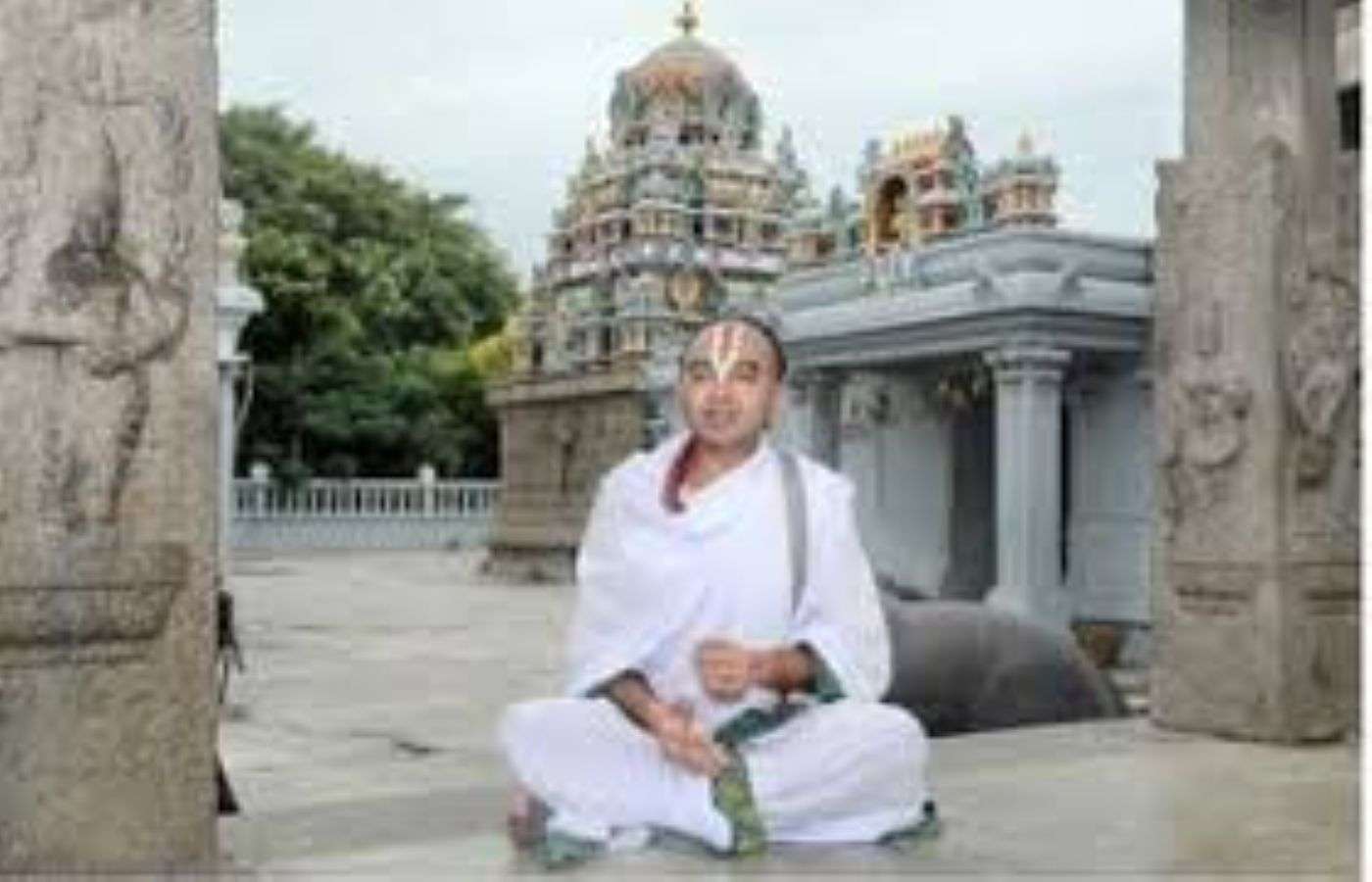
At a time when political rhetoric in Tamil Nadu continues to target Sanatan Dharma with shallow slogans and sweeping accusations, a young Vedic scholar, Velukkudi Krishnan, has delivered what many seasoned intellectuals failed to articulate — a calm, precise, and devastatingly effective rebuttal.
His response to Tamil Nadu Deputy Chief Minister Udhayanidhi Stalin was simple: “Wait for it.”
And what followed was not anger, outrage, or political mudslinging. It was clarity.
In just a few crisp observations, the scholar dismantled the popular attempt to portray Sanatan Dharma merely as a religion, caste system, or social construct. He explained that Sanatan Dharma was never founded by a prophet, never confined to one book, and never restricted to one community. Instead, he described it as the sustaining order of the universe itself — the eternal principle that governs existence.
That explanation matters.
Because modern political discourse often reduces everything to vote banks and ideological binaries. But the young scholar took the debate beyond politics and into the realm of universal truth. He explained that the universe does not function through chaos. It operates through astonishing precision and order.
Galaxies gather matter. Stars are formed through nuclear fusion. Elements like carbon, oxygen, and iron emerge from stars and eventually become the building blocks of human life itself. From atoms and electrons to the rhythm of the human heartbeat, everything follows an inherent order.
The ancient rishis recognized this thousands of years ago.
The Yajur Veda described this sustaining balance as the eternal order that preserves existence. That, the scholar argued, is Sanatan Dharma — not a rigid religion, but the “Law of the Universe.”
Modern physicists may use scientific terminology. Ancient sages used spiritual language. But both point toward the same reality: disorder destroys existence.
If gravity collapses, planets drift into destruction. If nuclear balance fails, stars perish. If ecosystems lose equilibrium, life disappears. Nature itself survives only through harmony and disciplined order.
So when politicians casually declare that Sanatan Dharma must be “eradicated,” the statement sounds less like intellectual rebellion and more like ignorance of what the term actually means.
The scholar’s central point was striking: a human being is merely a speck within the vast cosmos. If that individual believes he can erase or redefine the universal order governing existence, he is not challenging Sanatan Dharma — he is challenging reality itself.
That is why the explanation resonated so deeply across social media and among ordinary people. It was not delivered through hatred or fanaticism. It came through logic, science, philosophy, and composure.
Ironically, the debate also exposes a deeper crisis in Tamil Nadu’s political culture. For decades, ideological battles have been fought by mocking faith rather than understanding it. Complex civilizational ideas have been reduced to slogans designed for applause at political rallies. But slogans collapse when confronted with knowledge.
And this young scholar demonstrated exactly that.
His words served as a reminder that Sanatan Dharma is not merely about rituals or identity politics. It is about balance, continuity, responsibility, and coexistence — principles that sustain not only societies but the universe itself.
One may disagree with traditions. One may criticize social distortions. But dismissing an ancient philosophical framework without understanding its depth only weakens public discourse.
In the end, the scholar did not merely defend Sanatan Dharma. He restored perspective.
And perhaps that is why his quiet “Wait for it” turned out to be far more powerful than all the noise surrounding the controversy.