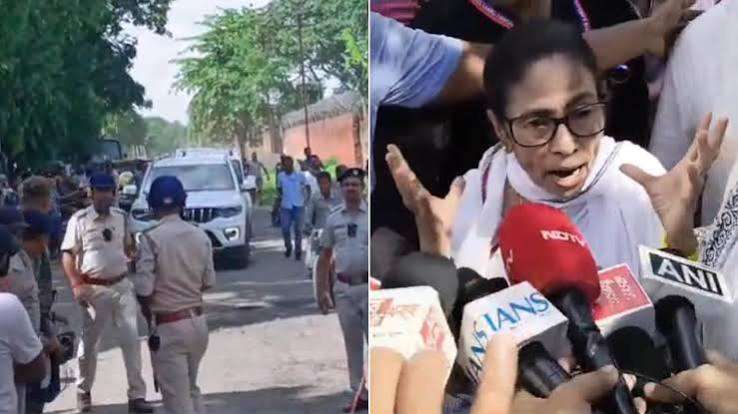
Kolkata: Former West Bengal chief minister Mamata Banerjee on Sunday faced a group of protesters who surrounded her vehicle, raised “chor-chor” slogans and hurled mud and slippers at her car when she went to meet the family of a TMC worker who allegedly died in police custody in North 24 Parganas district.
The confrontation turned Banerjee’s visit into a charged political spectacle, with police forming a cordon around her vehicle as protesters blocked its passage, while the rival camps traded accusations of political provocation, public anger and administrative failure.
“My car has been attacked with stones, shoes and mud. This is nothing but a conspiracy. I had informed the police that I would be coming, but despite that, no security measures were taken,” Banerjee told reporters after reaching the area.
“Forget security. The police are protecting lumpens. Bengal has fallen into the hands of lumpens. We will file a case,” she said.
Banerjee alleged that large bricks were also hurled at her vehicle.
“My head could have been smashed. We could have died here. The police are protecting the BJP,” she said, accusing Chief Minister Suvendu Adhikari, who is also in charge of Home department, of using the police and alleged mafia elements to run the state.
Banerjee also claimed that the deceased worker’s family was being threatened by BJP supporters.
The BJP, however, sought to distance itself from the violence while arguing that the protest reflected local anger against Banerjee.
BJP state president Samik Bhattacharya said the party did not support any attack on the former chief minister’s vehicle and denied the involvement of BJP workers.
“Such an incident, if it has happened, will blacken the face of West Bengal in the future. We condemn the incident and, if such an incident has taken place, the police under Chief Minister Suvendu Adhikari will immediately take action against those responsible,” he said.
But BJP MLA from Bijpur Sudipta Das accused Banerjee of seeking political mileage from the death.
“This is Mamata Banerjee’s old politics. Just as a vulture looks for a carcass, she too looks for a death in West Bengal and tries to find a way to remain in the media. She has become politically irrelevant,” Das said.
“I am with the family as a local and as the MLA. We have been in regular contact with them. The people at whose house this happened are not saying anything. They have faith in us,” he said.
Das said he was ready to provide legal assistance to the family over the alleged custodial death, but accused Banerjee of turning the issue into a political campaign.
The deceased, Birju Keot, husband of former Kanchrapara municipal councillor Jeni Sharma Keot, was arrested by Halisahar police in connection with allegations including extortion. He was produced before a court on Friday and remanded in police custody for five days. His death was reported on Saturday.
His wife has alleged that Keot was beaten inside the lock-up and died as a result of police assault. There was no immediate response from the police to the allegation.
Banerjee’s visit, ostensibly to stand by the bereaved family, thus quickly acquired a wider political significance, bringing into focus the competing narratives that are increasingly defining Bengal’s politics—the BJP’s claim of popular anger against the former ruling establishment and the TMC’s allegation that the new dispensation is using state power and political muscle against its opponents.
TMC spokesperson Krishanu Mitra condemned the alleged pelting of stones and mud at Banerjee’s vehicle as “extremely ugly and condemnable” and linked the incident to the custodial death.
Lok Sabha MP Kalyan Banerjee and Rajya Sabha MP Dola Sen accompanied Mamata to Halisahar.
Kalyan alleged that Adhikari was “running the state through the police” and using alleged mafia elements for political purposes, while Sen accused the administration of failing to protect the former chief minister and her entourage.
The episode also revived memories of recent protests targeting the TMC leadership.
Banerjee faced “chor-chor” slogans outside the Calcutta High Court in June, while her nephew and TMC national general secretary Abhishek Banerjee encountered protests during a visit to Sonarpur the same month, with demonstrators allegedly pelting his convoy with eggs and raising similar slogans.
For the BJP, Sunday’s street protest offered another image of a former 15-year ruling establishment confronting visible public anger after its defeat in the Assembly polls this year.
For Banerjee, the confrontation provided an opportunity to turn the same episode into an indictment of the new BJP government—accusing it of failing to protect a former chief minister and allowing lawlessness and political violence to flourish.
The Halisahar confrontation, therefore, was more than a roadside protest. It brought the state’s increasingly personalised political contest onto the street, with the death of a local TMC worker providing the immediate trigger and the rival claims of “public anger” and “political conspiracy” likely to fuel another flashpoint in Bengal’s post-election politics.