


The sons of Draupadī, burning with youthful ardour and eager to avenge the injuries inflicted upon their kinsmen, poured a tempest of arrows upon the rakshasa Alambusha in support of Bhīmasena. Skilled in sorcery and master of deceptive warfare, the fierce demon resorted to his illusory arts and assailed the Pāṇḍava heroes with relentless fury. With twenty-five shafts he pierced Bhīma; with three he struck Dharmarāja; with five each he wounded the Upapāṇḍavas and Sahadeva; and with another twenty-five arrows he covered Ghaṭotkacha. Exulting in his prowess, he roared like a lion, imagining the Pāṇḍava warriors already subdued.
Ghaṭotkacha, the mighty son of Bhīma, intolerant of the demon’s arrogance, rushed upon Alambusha with irresistible force. He slew his charioteer, cut down his steeds, and shattered his chariot into fragments. Leaping to the earth, Alambusha again filled the sky with shafts, but Ghaṭotkacha, wielding a massive mace, dispelled the demon’s illusions as the rising sun scatters the darkness. Then, with a tremendous blow, he struck his adversary with crushing power.
Alambusha rose into the heavens, seeking refuge in the sky, and Ghaṭotkacha pursued him without hesitation. There they fought in mid-air like two thunderclouds torn by opposing winds, or like mighty eagles contending for prey. Returning to the earth with bodies streaming blood, they grappled hand to hand like enraged tigers. They seized, hurled, struck, and wrestled with every secret art of combat, filling both armies with awe and terror.
At length Alambusha, the brother of the slain Bakāsura, wearied and collapsed upon the ground. Ghaṭotkacha sprang upon his fallen foe, trampling him beneath his feet. He crushed his thighs, shattered his ribs with iron-like fists, and pounded him until life departed from his body. Standing over the slain rākṣasa, Ghaṭotkacha uttered a leonine roar that resounded across the field, proclaiming his terrible might.
The conches and kettledrums of the Pāṇḍava host sounded in joyous triumph, while the hearts of the Kauravas sank in despair. Dharmarāja embraced Ghaṭotkacha and praised his incomparable strength, courage, and devotion.
Then the blind king Dhritarashtra, eager to hear of the next great encounter, addressed Sanjaya: “You have spoken of the mighty Sātyaki, whose prowess rivals that of Yama himself, and of the invincible Dronacharya. When such heroes met in battle, the contest could not have been ordinary. Tell me, O Sanjaya, how that dreadful combat unfolded.”
Sanjaya replied, “As Sātyaki pressed forward, scattering your troops and reducing entire divisions to dust, the venerable Drona, inflamed with wrath, struck him with twenty-five formidable arrows. Sātyaki answered with three razor-edged shafts that momentarily stunned the preceptor. Recovering instantly, Drona pierced him with five arrows, whereupon Sātyaki retaliated with fifty. Drona then wounded him with nine shafts and, with mounting fury, discharged a hundred arrows that tore through Sātyaki’s armour and drenched his body in blood.”
Seeing Sātyaki thus overwhelmed, the Kaurava warriors shouted in triumph. But Dharmarāja and Dhrishtadyumna, perceiving the peril of their ally, cried out, “See how the preceptor torments Sātyaki as a child toys with a captive bird! Let Bhīmasena lead the charge. Surround Drona and relieve our heroic kinsman.”
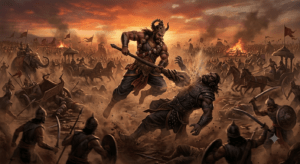
Obeying the command, the Pāṇḍava warriors surged upon Drona from every side. The great preceptor beheld them with a smile, as though welcoming honoured guests, and greeted them with a dazzling shower of arrows. His composure and mastery astonished even the boldest among them.
Sanjaya continued, “O King, before that irresistible assault, twenty-five princes of the Pañchālas and a hundred heroes of the Kekayas were severed and cast to the earth. The survivors, hemmed in by Drona, resembled a herd of elephants trapped in a treacherous mire.”
Amid this confusion, the warriors of the Pāṇḍava army heard the far-reaching blast of Panchajanya. Though the sacred conch of Krishna resounded repeatedly, Dharmarāja could not hear the familiar twang of the Gandiva. Anxiety seized his heart. His voice choked with apprehension as he turned to Satyaki.
“Arjuna has gone alone into the heart of the enemy host. Dust rises in that quarter like storm-clouds, and I hear again and again the blast of Panchajanya, yet not the sound of Gandiva. My heart trembles with foreboding. It may be that the Kauravas, gathered in vast numbers, have surrounded him. You alone, O Sātyaki, possess the courage, skill, and devotion to cut through their ranks and aid him.”
Yudhiṣṭhira continued, “To rescue a friend and ally in the midst of battle is equal in merit to gifting the whole earth to worthy Brāhmaṇas. As Krishna protects us all, so should you protect Arjuna. By this deed you shall earn undying fame. Ashvatthama, Karna, Kripa, and Bhurishrava are terrible warriors, and they have surely encircled him in defence of Jayadratha. My mind warns me that Arjuna stands amid grave peril.”
“While we dwelt in Dwaitavana, Arjuna once told me, ‘With Sātyaki by my side, I can rout the assembled Kauravas.’ You and Krishna are equally dear to him. With your support he undertakes even the most formidable tasks. Therefore go swiftly and gladden his heart. Whether through friendship, kinship, or the sheer force of your arms, save him from danger. If any misfortune should befall Arjuna, what refuge remains for me?”
“You have ever sought our welfare. The strength of your bow is regarded by both friend and foe as a fortress of protection for the Pāṇḍavas. Krishna and Arjuna are your teachers; and I, as the elder of your revered masters, entreat you to honour my request. Penetrate the Kaurava formations, display the full splendour of your archery, rescue Arjuna, and relieve my heart of this consuming anxiety.”
Sātyaki bowed and replied, “O King, your words are just and true. For Arjuna’s sake I do not value my life. When you send me forth with your blessings, how can I hesitate? Before departing to slay Jayadratha, Arjuna said to me, ‘The omens are auspicious; victory shall be ours. I go to fulfil my vow. You must remain and guard Dharmarāja, for his safety is no less important than my success.’”
“He declared that while I stood beside you, you would feel as secure as if he himself were present. Krishna accompanies him, but is not with you. Therefore he entrusted your protection to me. Yet now, commanded by you and compelled by duty, I shall go. May your safety be ensured while I carve a path through the enemy ranks and hasten to the side of my beloved friend.”
Thus spoke the noble Sātyaki, ready to sacrifice his life for loyalty, honour, and the sacred bonds of friendship. And Sanjaya, recounting these events with deep emotion, described to Dhritarashtra how the heroic Yādava prepared to plunge into the ocean of battle in search of Arjuna.

