

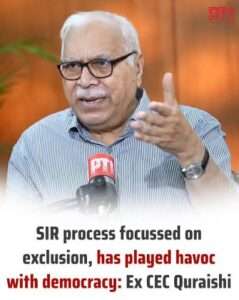
Former Chief Election Commissioner S.Y. Quraishi is perfectly entitled to disagree with the Election Commission of India’s Special Intensive Revision (SIR) exercise. In a democracy, former constitutional functionaries not only enjoy the freedom to express their views but are often expected to contribute to public discourse on institutions they once led. But such criticism must also withstand the same standards of objectivity and factual scrutiny that constitutional authorities are expected to uphold. Quraishi’s alleged remarks in a wire service video interview that the SIR exercise appears to be “more about exclusion than inclusion” raise an obvious question: on what empirical or constitutional basis has he arrived at such a serious conclusion? The allegation is not a mere political comment. When a former Chief Election Commissioner questions the very intent of an electoral exercise undertaken by the Election Commission of India, it naturally carries considerable weight and can influence public perception. Therefore, it deserves closer examination. Has he produced any official data to establish that the exercise is selectively targeting particular sections of society? Has he demonstrated that the process violates constitutional safeguards or the Representation of the People Act? Has he cited instances where eligible citizens have been systematically disenfranchised without remedies being available? If not, then the criticism risks becoming an opinion unsupported by verifiable facts. Ironically, Quraishi himself has publicly acknowledged that his appointment in 2010 was made directly by the government of the day, headed by Prime Minister Dr. Manmohan Singh, under the constitutional scheme that then existed. He also candidly admitted that he would have felt institutionally stronger had there been a broader, bipartisan consultation mechanism involving the Leader of the Opposition. That admission reflected admirable institutional honesty. It also demonstrated his appreciation for processes and procedural legitimacy. The same standard ought to apply when evaluating the present Election Commission’s actions.
If the SIR exercise is unconstitutional or mala fide, the appropriate forum to determine that is the judiciary. Significantly, the Election Commission’s exercise has been subject to judicial scrutiny, and courts have not found sufficient grounds to halt the process merely based on political parties’ allegations of exclusion. In a constitutional democracy, judicial scrutiny matters. Political allegations alone cannot become constitutional truths. There is another important distinction that is often ignored in the public debate. Electoral rolls are not meant to be permanent records immune from revision. Periodic verification is essential to remove duplicates, deceased voters, migrated individuals, and ineligible entries while ensuring that every eligible citizen is included. The objective of electoral integrity necessarily involves both inclusion and verification. One cannot exist without the other. It is also a matter of public record that Bharat faces concerns regarding illegal migration in certain border states. Successive governments and courts have acknowledged this challenge over several decades. Verifying citizenship and electoral eligibility, therefore, cannot automatically be equated with communal or political targeting unless concrete evidence establishes discriminatory implementation. If critics of SIR believe genuine Bharat citizens are being wrongfully excluded, they must present documented cases and seek legal remedies. Constitutional institutions must be challenged through facts, not insinuations. The Election Commission itself must ensure that no eligible citizen is deprived of his or her franchise. Transparency, grievance redressal, and procedural fairness are indispensable. Constructive criticism strengthens institutions when it is grounded in evidence. Former Chief Election Commissioners are custodians of the democratic legacy of this nation. Their words carry weight far beyond partisan politics. If Quraishi believes that the Special Intensive Revision is an exercise in exclusion, he owes the country facts, constitutional arguments and credible evidence—not broad allegations that only fuel political narratives. In matters concerning the sanctity of the electoral rolls and the right to vote, facts must prevail over perceptions. Until proven otherwise, criticism remains opinion, not truth