Ruju Yogi Devata-s
This is an article series. Please read all previous articles before reading this article. The URLs for all previous articles are located in the SPECIAL THOUGHTS section.
It has been explained way earlier in this series that Devata-s are also Jeevaatma-s, but their knowledge and capabilities are far-far superior to us mere mortals. Level 3 is the highest level among all Devata-s/Jeevaatma-s that have ever been through the cycle of birth/death. Therefore, these Devata-s are referred to as Jeevottama Devata-s. Also, as has been explained earlier, Jeevaatma-s can be categorized as Saatvika Jeevaatma-s, Raajasa Jeevaatma-s and Taamasa Jeevaatma-s. Saatvika Jeevaatma-s are Devata-s or Sura-s. Taamasa Jeevaatma-s are Asura-s.
Further, the Jeevaatma-s are categorized into 9 sub-categories as below:
Saatvika-Saatvika, Saatvika-Raajasa, Saatvika-Taamasa
Raajasa-Saatvika, Raajasa-Raajasa, Raajasa-Taamasa
Taamasa-Saatvika, Taamasa-Raajasa, Taamasa-Taamasa
A step further, the above sub-categories of Jeevaatma-s are further sub-categorized into 27 groups as below:
Saatvika-Saatvika-Saatvika, Saatvika-Saatvika-Raajasa, Saatvika-Saatvika-Taamasa
Saatvika-Raajasa-Saatvika, Saatvika-Raajasa-Raajasa, Saatvika-Raajasa-Taamasa
Saatvika-Taamasa-Saatvika, Saatvika-Taamasa-Raajasa, Saatvika-Taamasa-Taamasa
… and so on
And lastly, the above 27 sub-categories are further split into a total of 81 groups as below:
Saatvika-Saatvika-Saatvika-Saatvika
Saatvika-Saatvika-Saatvika-Raajasa
Saatvika-Saatvika-Saatvika-Taamasa
… and so on
The Devata-s in Level 3 are “Saatvika-Saatvika-Saatvika-Saatvika” by their intrinsic nature. This is also a reason why the Devata-s in Level 3 are referred to as Jeevottama Devata-s. Another term used to refer to these Devata-s is Ruju Yogi Devata-s or Ruju Gana Devata-s. The Devata-s in Level 4 are “Saatvika-Saatvika-Saatvika-Raajasa” by their intrinsic nature. And the Devata-s in Level 5 are “Saatvika-Saatvika-Saatvika-Taamasa” by their intrinsic nature.
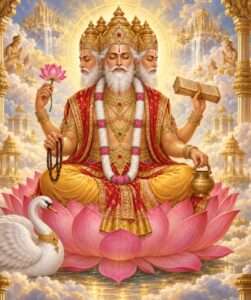
As with the hierarchical level 4, the hierarchical level 3 too has a single queue with 100 seats. The 100th position in Level 3 is referred to by the name “Brahma”. There are a few other names for this position, such as Aja, Chaturmukha, Virinchi, Padma Sambhava, and so on. Further, the 99th position in Level 3 is referred to by the name “Mukhya Praana”, the 98th position is named “Laatavya”, the 97th position is named “Gavya”, the 96th position is named “Vaktavya”… and so on, and the very 1st position is named “Kalki”. All these names have been mentioned in Vaamana Puraana.
Earlier, we had learnt that we have 5 Antah-Karana-s:
- Manas (Mind) – Shiva is the Abhimaani Devata for Manas
- Ahankaara (Awareness of the self) – Again, Shiva is the Abhimaani Devata for Ahankaara
- Buddhi (Intelligence) – Sarasvati is the Abhimaani Devata for Buddhi
- And lastly… Chitta (Memory) and Chetana (super-consciousness) – the Abhimaani Devata-s for Chitta and Chetana are Brahma and Mukhya Praana.
Shreemad Bhaagavata gives an elaborate description of the Srushti (creation) of this Brahmaanda (Universe). The Srushti of Brahmaanda is said to happen in 10 steps as listed below:
- Srushti of Mahat Tattva – The Abhimaani Devata for Mahat Tattva is Brahma. And what is referred to as Mahat Tattva in the Brahmaanda (Macrocosm) is closely related to the Chitta Tattva in the Pindaanda (Microcosm or, in simple terms, our Shareera). And thus, Brahma is also the Abhimaani Devata for our Chitta and also the Chetana.
- Srushti of Ahankaara Tattva – As has been explained already, the Abhimaani Devata for Ahankaara Tattva is Shiva.
- Srushti of Pancha Bhoota-s and Pancha Tanmaatra-s – This happens through Shiva’s Taamasa Ahankaara and has been explained a few times already.
- Srushti of Pancha Jnyaanendriya-s and Pancha Karmendriya-s – This happens through Shiva’s Raajasa Ahankaara. This too has been explained already.
- Srushti of Manas – This happens through Shiva’s Saatvika Ahankaara. This too has been elaborated on earlier.
- Srushti of Ajnyaana – This too happens through Brahma. Ajnyaana is not simply the absence of Jnyaana (knowledge). Ajnyaana is a thing that has its own existence and is the opposite of Jnyaana (correct knowledge). Some have even used the term anti-knowledge to describe Ajnyaana. It is a knowledge that is not resourceful but actually harmful. There are 5 types of Ajnyaanas. They are categorized as Ajnyaana, Moha, Mahaa Moha, Taamisra, and Andha Taamisra. Here is a brief description of these anti-knowledges:
a) Ajnyaana – This is incorrect knowledge. For example, atheism is based on Ajnyaana because it denies the presence of a creator, whereas in reality everything around us has a creator, and that creator is always sentient. Even if something is created by a robot, the robot has a creator. This is the basic cause–and–effect theory. Not accepting this is denying something that is fully rational.
b) Moha – The word Moha has 2 syllables. “Mo” stands for Moksha (liberation from the cycle of brith/death), “Ha” stands for hanana (destruction). One could say Moksha margam hanati iti Moha. A Jeevaatma’s progress towards moksha gets stalled when that Jeevaatma gets obsessed with the creation and forgets the creator. So, anything that amounts to obsession towards the creation can be called Moha. For example, people are always enamoured by the beauty of a woman and forget that what they are seeing is the external body of that woman and that there is a Jeevaatma inside which is subordinate to paramaatma and all the devataas. So, the focus tends to be on what is seen externally and not on what is internal to that woman.
c) Mahaa Moha – Moha going to the next level of fixation can be termed Mahaa Moha. For example, declaring that a woman can go to “Jannat” only through being her man’s object of physical pleasure.
d) Taamisra – Taamisra is Mahaa Moha taking a tamasic turn. For example, the belief in Iran that virgin girls go straight to heaven. For this reason, unwritten law in Iran is that virgin prisoners on death row are assaulted sexually before they are executed.
e) Andha Taamisra – Taamisra going to the extent of mental blindness is Andha Taamisra. For example, a teenage girl in Iran was in a taxi with the windows rolled down. The wind blowing on her face slightly exposed a lock of her hair. The moral police caught her immediately and called her a prostitute. All her appeals against the rule were rejected by all the courts. Her final appeal to the president, Khamenei of Iran, a man in his 70’s, showed no mercy to the innocent teenage girl. She was hanged in public. Before her hanging, she cursed Khamenei, saying that one day women will take out their Hijab and throw it on his coffin. Today the world knows how Khamenei’s end came. Karma returned to him brutally, despite the cowardly president hiding six storeys under the ground in his bunker.
7. Creation of Vanaspathi-s – Now that all essential “ingredients” for the continuation of creation is available, the first type of life comes into being in the form of plants, shrubs, creepers, and trees. These are also called Sthavaraa-s (non-locomotive life). In case of Sthavaraa-s or Vanaspathi-s, the Jeevaatma is in the roots.
8. Creation of all types of Animals – They are broadly categorized as Fishes, Amphibians, Reptiles, Mammals, and Birds. One can see a particular kind of evolution in these five types of animals.
a. Fishes – They are water-bound, and water, as explained earlier, is symbolic of rajasic tendencies. Symbolically, this should tell us a Jeevaatma will initially have a lot of rajasic tendencies. Such fish gets eaten by other bigger fish. Symbolically, a Jeevaatma which doesn’t incline towards sadhana and is always immersed in rajasic tendencies will end up wasting all opportunities.
b. Amphibians – They can live in water and outside of it. Symbolically, amphibians represent those Jeevaatma-s who show a tendency to work their way out of rajasic tendencies.
c. Reptiles – This category of animals almost always move/slide while being fully in contact with the ground. Similarly, a Jeevaatma should learn to always be grounded or humble. Paramaatma will come to a humble person. This is symbolically shown as Vishnu reclining on Shesha.
d. Mammals – This is the category of animals where the females nurse their young through their mammary glands. The milk is symbolic of Vaatsalya and also symbolic of Veda Saara (essence of the Veda-s). This can only come to those who seek the Veda-s with humility.
e. Birds – This category of animals is light and has learnt/acquired the ability to harness the wind and thus sore to great heights and stay there for a long time. And thus, these animals represent those Jeevaatma-s who’ve learnt to harness the Raajasa (wind) and Taamasa (their body weight) to rise to great spiritual elevations.
9. Creation of humans – This is the only species through which a Jeevaatma can really attain Moksha
10. Creation of Asura-s – These are the Taamasik Jeevaatma-s. As everything in the Brahmaanda is originating through Brahma, Asura-s also come into being through him.
Further, Brahma creates the 4 Sana-s (Sanaka, Sanandana, Sanaatana, and Sanat Kumaara), Naarada, Bhrugu, Sapta Rushi-s, Bruhaspati, Daksha Prajaapati. And finally, Brahma creates Swaayambhuva Manu & Shataroopa and advises them to continue with the creation through the union of male and female.
Brahma does not take Avataara on earth. He has earnt that privilege. Taking an Avataara on earth is a burdensome thing which even the Devata-s try to avoid. We see many instances of this all across our scriptures. The current Brahma attained Aparoksha Jnyaana 100 Para Kaala-s ago. The exact duration of 1 Para Kaala has been explained earlier. It is perhaps for this reason that there are no temples built for Chaturmukha Brahma (except for maybe one in Gujarat, a state in the western part of Bhaarat).
Per Shreemad Bhaagavata, the above-mentioned Srushti of Brahmaanda takes about 1/8 of Brahma’s Day. Similarly, our everyday too has a period before sunrise, which is referred to as Braahmi Muhoorta. This time is dedicated to studying the Shaastra-s. As this time pertains to Brahma, who is also the Abhimaani Devata for Chitta (memory), studying anything is said to be better during Braahmi Muhoorta as it leads to higher retention. Whatever we study needs to be retained. What we study but can’t retain becomes of no use to us. For example, a doctor studies all relevant topics about heart surgery… but if he/she is unable to retain what he/she studied while actually performing the surgery, then there is a very high risk of the patient dying. Therefore, the doctor is required to retain all the nuances he learns through his extensive study. This is true to every field we study and like to gain expertise in. Therefore, it is always a better way of life to sleep early and rise early.
Next, let’s continue to ponder the next Devata in Level 3, namely Mukhya Praana.