



Days before Saturday’s protest, the Cockroach Janta Party’s online ecosystem was predicting nothing short of a political earthquake.
Thousands of self-described ‘cockroaches’ were expected to descend upon Delhi’s Jantar Mantar and shake the foundations of the Modi government.
Some enthusiasts spoke of crowds in the thousands. Others hinted at lakhs. Delhi is prepared for a tidal wave. What arrived looked more like a puddle.
By noon, television crews, photographers, YouTubers, vloggers, freelancers, stringers and every variety of journalist identifiable by the word ‘PRESS’ emblazoned across shirts and jackets seemed to be competing with protesters for numerical supremacy.
Around them stood personnel from the Delhi Police, CRPF and SSB, making the security presence appear more impressive than the gathering it was protecting. If social media had promised Abracadabra, the ground reality was pure choomantar.
The protest searching for a purpose
A friend who once worked as a cameraman with NDTV and now freelances happened to be at Jantar Mantar that day. During a WhatsApp video call the other day, he could barely finish a sentence without bursting into laughter at the fiasco it turned out to be.
A favourite moment involved a young protester who appeared somewhat uncertain about the precise reason for his presence. When a reporter thrust a microphone towards him, the youngster demanded the removal of ‘Dharmendra Shah’.
A reasonable demand, perhaps, except that the protest was aimed at Union Education Minister Dharmendra Pradhan.
A movement seeking the resignation of a minister might first settle on the correct minister. But revolutions, like examinations, occasionally suffer from identity confusion.
One stage, many causes
The gathering often resembled a political buffet where everyone brought their favourite grievance.
One group, taking cue from the ‘tukde tukde fang,’ raised the familiar ‘hum leke rahenge azadi’ slogan. Others introduced communal themes into the proceedings. Some highlighted LGBT rights.
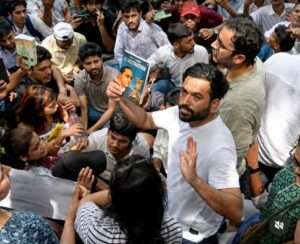
Yet another participant held aloft what he described as the Constitution while passionately defending freedom of speech. When a journalist asked him to show the relevant constitutional provision, he sheepishly declined.
The reason was refreshingly honest. The book in his hand was not the Constitution at all. It was a notebook.
One could not ask for a better metaphor for modern activism. Many seem eager to quote the Constitution. Fewer appear interested in reading it like our LOO (leader of the opposition).
Orwell meets Delhi summer
Delhi’s summer sun showed no mercy. Many of the ordinary cockroaches sat directly on the scorching road, sweating through speeches that were often inaudible beyond the first few rows.
Meanwhile, reports suggested that founder Abhijeet Dipke occasionally retreated to the cool comfort of an air-conditioned car. Spokesman Ashutosh Ranka was reportedly being fanned by supporters.
George Orwell’s spirit must have been smiling. All cockroaches are equal, but some cockroaches are clearly more equal than others.
The curious case of Gen-Z
The protest was marketed as a youth uprising. Which made the guest list rather intriguing. Actor Prakash Raj reportedly wished to attend but could not. Education activist Sonam Wangchuk managed to make it and quickly became one of the day’s principal attractions.
This raises a simple question. When exactly did Prakash Raj and Sonam Wangchuk become Gen-Z? Has the definition changed without public notice? Or does Gen-Z now include anyone capable of appearing at a protest and generating a few additional headlines?
The usual suspects
Perhaps the most revealing aspect of the gathering was the supporting cast. For a movement that portrays itself as a spontaneous uprising of ordinary young Indians, there seemed to be a noticeable presence of familiar Left-oriented student groups.
SFI banners were visible. AISF activists arrived with their daphlis. The slogans followed accordingly.
The atmosphere often resembled a reunion of India’s professional protest industry rather than the birth of a fresh grassroots movement. The revolution may have been new, but the participants looked remarkably familiar.
Trailer or the full feature?
The organisers insist that Saturday’s event was merely a trailer. The real movement, they say, is yet to begin. Fresh deadlines have been issued. New warnings have been delivered. The government has been given another seven days.
Perhaps they are right. Indian politics has a habit of surprising even seasoned observers. But if this was the trailer, the producers may wish to reconsider the screenplay before releasing the full-length feature.
For all the noise, hashtags, and revolutionary rhetoric, the enduring image from Jantar Mantar was not of a government trembling before public anger.
It was of reporters outnumbering protesters. Of demonstrators, uncertain about whom they wanted removed. Of a Constitution that turned out to be a notebook. Of leaders finding refuge in air-conditioned comfort while supporters baked on hot asphalt.
And of a movement promising to capture the imagination of India’s youth while being cheered on by the same old political travelling circus.
The Cockroach Janta Party arrived in Delhi promising a swarm. What it delivered was a scattering. The only thing that truly vanished that afternoon was the hype.
Choomantar. Abracadabra.



The grasshopper and the busy ants … Now we can guess who is who !
May the tribe of resilience and consistent hard working tribe of youth outgrow and enrich themselves.. we in India are living in a comfort zone heaven.. those who are frequent flyers to outside countries and experience of staying are aware of these ! Those who want to return should learn to assimilate rather than questioning or complaining! First of all why do you choose to go abroad? Why you are not happy there ? Why you complain and crib about what is happening in India from there ? What’s the problem? A large country will have something or the other happening in terms of evolving by weeding out maladies as they crop up ! Let’s do it or help in removing the weeds not the base ! Your article is reflective of all the questions above 🫡