India’s defence industry has a problem that is rather less glamorous than missiles, fighter aircraft or drones: there are a lot of orders to deliver, and the industrial system has to find a way of delivering them faster.
Defence production reached a record Rs 1.78 lakh crore in FY2025-26, up 15.6 percent from the previous year, while exports rose to Rs 38,424 crore and private industry contributed about Rs 42,000 crore, or 24 percent, of total production. Those are impressive numbers, but they also raise a more awkward question about whether India’s manufacturing and supply-chain capacity can absorb the acceleration without delivery schedules becoming another strategic problem.
A PwC assessment of the aerospace and defence manufacturing sector had already identified the pressure building underneath the numbers. Among the companies studied, order-book-to-revenue multiples ranged from 1.71x to 6.88x, execution backlogs stretched from two to seven years and some segments could take five to ten years to clear existing orders. The six areas identified for improvement — supply-chain efficiency, operational excellence, planning and governance, faster R&D, workforce productivity and digital integration — would sound perfectly familiar in a construction-equipment boardroom.
And then came Nepal.
The August 26 glacier-collapse disaster along the Nepal-China border sent ice, rock, mud and water through mountain valleys, destroying roads, bridges, hydropower facilities and entire communities. By September 3, more than 1,200 people had been reported dead and more than 4,200 remained missing, while rescue teams were still working around damaged infrastructure and hydropower tunnels. India has also sent specialised personnel to assist with tunnel rescue operations.
The tragedy should not be turned into a defence-industry case study. It does, however, expose a requirement India understands particularly well: when infrastructure disappears in difficult terrain, somebody has to clear the road, move the debris, reach the tunnel, lift the equipment and restore access. Machines become part of the emergency response, while the people who know how to operate, maintain and deploy them become equally important.
For a country with a long Himalayan frontier, expanding border infrastructure and growing disaster-response responsibilities, the distinction between civil engineering capability and strategic capability is therefore not always as neat as a market report might suggest.
The machinery connection
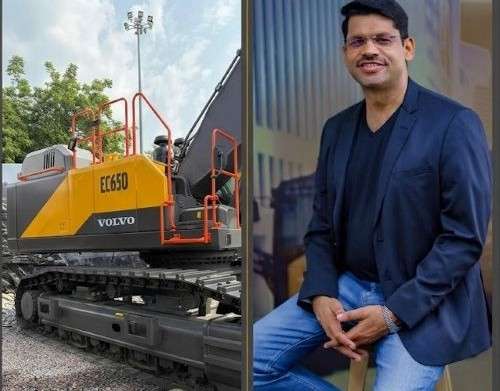
A bulldozer does not become a military machine because it crosses a cantonment gate, but the capability it provides can be useful to military engineers when routes have to be opened, obstacles removed, temporary facilities prepared or damaged ground made usable. Excavators bring similar versatility to trenching, drainage, earthworks, road construction and debris clearance, while motor graders can maintain roads and logistics corridors and wheel loaders and backhoe loaders can keep material moving around engineering sites and temporary installations.
Off-highway trucks add another part of the equation where large quantities of rock, soil or aggregates have to be moved through difficult terrain. Drilling, piling, compaction and concrete equipment can also have a role when roads, protective structures, bridges, bases or other infrastructure have to be built or restored quickly. None of this turns construction equipment into defence hardware, but it does highlight an existing industrial capability that can serve construction, border infrastructure, military engineering and disaster response without requiring every machine to be redesigned for a military role.
JCB India, Tata Hitachi, L&T Construction & Mining Machinery, Caterpillar, Komatsu, SANY, Volvo CE and ACE compete across India’s construction, infrastructure and mining equipment markets, bringing different combinations of machines, manufacturing capability, technology and service support. Their primary businesses remain civilian, and there is no reason for that to change simply because defence spending is rising. What matters is whether particular machines, technologies and engineering capabilities have applications beyond their original markets.
The lifting problem
Cranes make the crossover easier to understand because defence logistics involves an extraordinary amount of heavy equipment that has to be lifted, positioned and transported, sometimes in places where the familiar conveniences of a construction site — prepared ground, good roads and a workshop nearby — have politely disappeared.
Bridges, generators, engineering equipment, containers, specialised vehicles and large components all require lifting systems, and companies such as PALFINGER have been positioning their lifting technologies for applications that include defence alongside construction, utilities and materials handling.
Gainwell provides a more direct example of how the industrial crossover is developing. Through Indocrest Defence Solutions, a Gainwell Group entity, it acquired a controlling stake in Tractors India Limited, or TIL. TIL has a long-established business in cranes and material handling, including pick-and-carry, truck-mounted, rough-terrain and crawler cranes, while also supplying specialised defence equipment.
The more interesting part of that move is not that a crane company has discovered defence. It is that the engineering disciplines behind the products — hydraulics, structural design, controls, fabrication, load management, reliability and field service — can be transferred into another market when there is a genuine requirement.
There is a substantial difference between that and painting every piece of construction equipment in camouflage and calling it strategic. The commercial logic will have to do some of the talking.

Under the bonnet
Some of the most important connections sit inside the machines rather than on their nameplates.
A modern excavator or crane brings together engines, transmissions, hydraulic pumps and valves, cylinders, bearings, filtration, electronic controls, sensors, tyres, specialised steels and precision-machined components, with software and data systems increasingly becoming part of the package. Military vehicles and engineering systems may have very different specifications and qualification requirements, but many depend on the same broad industrial disciplines.
That is where the wider bauma CONEXPO INDIA ecosystem becomes relevant to the defence-execution question. Alongside the machines are suppliers working in power systems, transmissions, hydraulics, automation, filtration, bearings, tyres, electronics, controls, machine tools and precision engineering. Cummins India, ZF and Mann+Hummel are among the companies operating in these areas, while a much larger network of smaller suppliers sits further down the chain.
These companies may never appear in a defence headline, yet they can influence how quickly a major platform reaches its customer. A specialised component that cannot be produced in sufficient volume, a machining process with inadequate capacity or a supplier struggling to meet qualification requirements can hold up an otherwise well-funded programme. The order book may be impressive, but it still depends on factories, suppliers, tooling, people and production capacity doing their jobs at the required speed.
The BEML lesson
BEML provides a useful Indian example of how these capabilities can coexist within one industrial enterprise. Its portfolio spans mining and construction equipment, including bulldozers, excavators, dump trucks, loaders and motor graders, alongside defence products such as high-mobility vehicles, bridge systems, recovery vehicles, mine-ploughing equipment and tank transporters.
Its significance lies less in suggesting that other construction-equipment companies should copy the model and more in demonstrating what can happen when heavy engineering capabilities are deep enough to cross market boundaries. Powertrains, hydraulics, mobility systems, heavy fabrication and manufacturing processes remain useful even when the customer and application change.
Tata Motors, Mahindra & Mahindra and Larsen & Toubro make the wider connection equally interesting. All three have established defence businesses alongside substantial capabilities in commercial vehicles, engineering, manufacturing, infrastructure and other industrial markets. Their defence activities should not be confused with their CE businesses, but the combination illustrates the breadth of industrial capability already available within Indian companies.
The Nepal lesson
The Nepal disaster adds another dimension because defence capability is not confined to combat operations.
When a disaster strikes difficult terrain, military organisations can mobilise specialised manpower, engineering units, helicopters, communications and logistics quickly. Even then, the people doing the work need equipment capable of clearing debris, moving earth, accessing damaged structures and supporting emergency infrastructure.
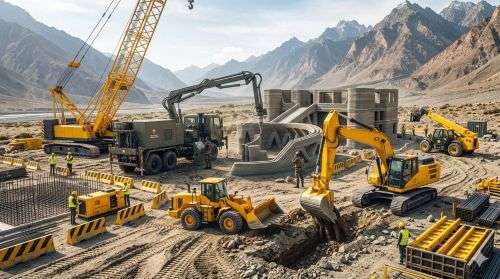
The rescue effort in Nepal has shown how difficult that becomes when roads and bridges have been destroyed and hydropower tunnels are blocked by mud, rock and debris. Heavy machinery and excavators have been part of the effort, alongside helicopters, temporary bridges and specialised rescue teams, while international technical assistance has been brought into the tunnel operations.
For India, the relevance is closer to home. The country has its own Himalayan border areas, difficult mountain infrastructure and a growing requirement to keep roads, bridges, tunnels and logistics corridors functioning in terrain where access can disappear quickly. The equipment used to construct a mountain road may eventually be needed to restore it after a landslide or flood, while engineering capability developed on a civilian project can become valuable when a disaster or military requirement puts the same terrain under pressure.
The requirement, therefore, is larger than defence procurement. It is about national capability.
The competitive reality
There is also a commercial dimension, and it is probably the one that will keep the discussion honest.
JCB, Tata Hitachi, L&T, Caterpillar, Komatsu, SANY, Volvo CE and ACE compete for infrastructure, construction and mining business in a market where customers increasingly demand higher productivity, greater uptime, better financing, digital capability and lower total operating costs. The crane market has its own competitive field, with PALFINGER, TIL and other manufacturers serving different applications.
Nobody needs another market simply because “defence opportunity” looks good in a corporate presentation. A manufacturer is more likely to pursue defence where a particular machine, component or engineering capability has a credible application, qualification requirements can be met and the commercial case works.
That may actually be healthier for the defence ecosystem than a wholesale rush into the sector. An equipment manufacturer might find that a particular excavator configuration, crane system, hydraulic package, powertrain or material-handling solution can be adapted for a defence or disaster-response application without having to build an entirely new military product line.
For the defence establishment, the distinction matters just as much. Proven industrial capability, production discipline and dependable suppliers are more useful than a long list of companies expressing an interest in defence while their factories remain configured for something else.
Where bauma fits
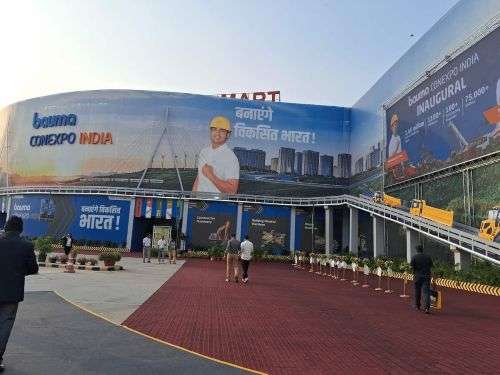
This is where bauma CONEXPO INDIA 2026 can contribute to a national conversation that extends well beyond construction equipment without pretending to be a defence exhibition.
The show brings together machinery manufacturers, component suppliers, technology companies and engineering businesses whose principal customers may be building roads, mines, ports, tunnels and factories. Some participants already have defence businesses, others are exploring the opportunity and many will remain firmly in civilian markets. The useful question is which capabilities already present across that ecosystem can strengthen India’s ability to manufacture, maintain and deploy the equipment required for defence, border infrastructure and disaster response.
That question also connects directly with the execution issues identified by PwC. Supply chains have to become more resilient, factories more productive, planning more disciplined, R&D faster and digital systems better integrated, while suppliers have to scale without quality falling through the floor. These are not abstract defence-sector concerns; they are everyday industrial problems for companies making excavators, cranes, engines, transmissions, hydraulic systems and precision components.
India does not need every excavator manufacturer to become a defence company, every crane to acquire a camouflage paint job or every component supplier to add “strategic” to its corporate presentation. It needs to identify where the capabilities already sitting inside its construction, mining, lifting, mobility and manufacturing ecosystems can contribute, and then create the mechanisms through which those capabilities can be qualified and brought into supply chains where there is a genuine fit.
That is perhaps the more useful way of looking at bauma CONEXPO INDIA 2026. Not as a place where the construction-equipment industry goes looking for a defence market, but as a place where India can take stock of the industrial capacity it has already built, the technologies sitting inside it and the supplier networks that can either accelerate or constrain the next phase of national manufacturing.
When a road disappears, a bridge goes down, a tunnel is blocked or a remote installation has to be built under pressure, the requirement remains fairly basic: machines have to dig, lift, carry, grade, drill and move material, often in conditions in which failure is considerably more expensive than a delayed construction project.
The strategic question for India is whether enough of those machines, components and engineering capabilities are already being made here — and whether the country has organised its industrial system well enough to put them to work when it matters.