There is nothing wrong with questioning the government. In a democracy, scrutiny is not only legitimate but necessary. But when political opposition turns into a reflexive rejection of every piece of good economic news, it ceases to be scrutiny and begins to undermine confidence in the very nation whose governance they aspire to control. The latest lesson comes from a seemingly dry economic statistic: Current Account Deficit, or CAD. Those who routinely cast doubts on Bharat’s growth numbers, projections and economic resilience would do well to understand what CAD actually means before rushing to pronounce judgement on the economy. In simple terms, CAD measures the gap between what a country earns from the rest of the world and what it spends abroad through trade in goods and services, income payments and transfers. A deficit is not automatically bad—developing economies can run CAD while importing capital goods, energy and technology. The real issue is whether the deficit is manageable and whether the country has the financial strength to finance it. That is precisely where Bharat’s transformation becomes visible. Look back at the history. In 1990-91, Bharat entered one of the worst balance-of-payments crises in its history. The CAD had climbed to roughly 3–3.5% of GDP, while foreign-exchange reserves had fallen to extraordinarily low levels. The World Bank records that reserves excluding gold fell below one month of imports and the country was struggling to secure external financing. That was not merely an uncomfortable economic statistic. It was a national vulnerability. Fast-forward to 2012-13. The CAD touched 4.8% of GDP, or $87.8 billion, according to the RBI. The central bank attributed the deterioration principally to a burgeoning trade deficit and weaker net invisible earnings, including a sharp increase in investment-income payments. The contrast with today’s Bharat is striking. The global financial crisis of 2008-09 produced enormous international turmoil, yet Bharat’s CAD was around 2.3% of GDP. During the 2011-13 period, however, it deteriorated sharply, reaching 4.8% in 2012-13.
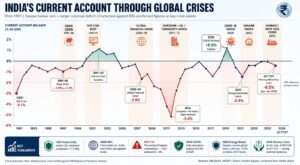
Then came another massive external shock—the Russia-Ukraine war and the accompanying energy-price surge. Bharat’s CAD widened substantially in 2022-23; the first three quarters recorded 2.7% of GDP, with elevated crude prices and stronger domestic demand contributing to the pressure. Now consider 2026. Bharat is confronting another serious external shock, with the West Asia conflict affecting energy prices, trade routes, and commodity markets. Yet preliminary RBI data show that Bharat’s CAD in Q1 FY27 was just $4.2 billion, or 0.5% of GDP, compared with 0.4% in the corresponding quarter a year earlier. The merchandise trade deficit did widen sharply to $86.1 billion, but this was partly cushioned by stronger services receipts of $51.6 billion and higher personal transfer receipts of $42.9 billion. That is the point the doubting minds should not miss. The argument is not that Bharat has conquered every economic vulnerability. It has not. Nor does a 0.5% quarterly CAD mean that Bharat can become complacent. Oil prices, geopolitical disruptions, merchandise imports, capital flows and global demand remain genuine risks. But there is an enormous difference between facing a shock from a position of weakness and absorbing the same shock from a position of strength. And that is what Bharat’s external-sector numbers increasingly demonstrate. Services exports, remittances, foreign investment and accumulated external buffers provide important cushions. Even with a substantially larger merchandise trade deficit in Q1 FY27, the CAD remained only 0.5% of GDP. So, by all means, question the Modi government’s economic policies. Challenge its assumptions. Demand greater transparency. Examine every GDP number. But do not manufacture a crisis merely because the numbers refuse to cooperate with your political narrative. An Opposition that constantly tells Bharatiyas that their economy cannot be trusted eventually risks something far more damaging than losing an argument with the government—it risks eroding confidence in the country’s own economic institutions and achievements. Bharat’s economic story should be debated vigorously. It should not be deliberately diminished. The CAD numbers offer a simple lesson: today’s Bharat may face storms, but it is no longer the economically fragile Bharat that once feared running out of dollars. And that is a fact—not a political slogan.