
For generations, we were taught that Bharat was merely a land repeatedly invaded and populated by successive waves of migrants. Modern genetic science is steadily challenging that simplistic narrative. Increasingly, archaeology, genetics and anthropology are revealing something far more profound—India was not merely a transit point in human history but one of the most important centres in the successful dispersal of modern humans across the globe.
The story begins nearly 70,000 years ago.
After emerging in Africa, modern humans are believed to have crossed the Bab-el-Mandab Strait into the Arabian Peninsula before moving along the southern coastal regions of present-day Iran and entering the Indian subcontinent. Genetic studies place this migration roughly between 75,000 and 55,000 years ago. Scientists call this the “Southern Coastal Route”, which today enjoys the strongest genetic support among models explaining the successful migration of modern humans out of Africa.
The significance of India in this journey cannot be overstated.
Far from being a mere stopover, the Indian subcontinent appears to have served as a major population hub from which humans dispersed further into Eurasia and Oceania. Several ancient maternal lineages represented by mitochondrial DNA (mtDNA) haplogroup M—which constitutes one of the two principal maternal lineages of all non-African populations—have their greatest diversity and antiquity in South Asia. Similarly, important paternal lineages belonging to Y-chromosome haplogroup F and its descendants are deeply rooted in the region.
From India, human populations appear to have branched out in multiple directions.
One stream moved westward approximately 45,000 to 35,000 years ago towards Iran, Central Asia and eventually Europe. Genetic studies have identified ancestral links connecting early Eurasian populations, with some researchers pointing to a discernible genetic trail extending through South Asia into western Eurasia.
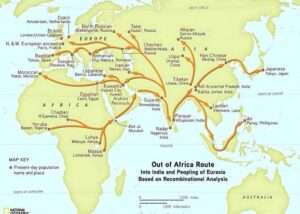
Another movement proceeded eastward between 50,000 and 40,000 years ago towards Southeast Asia, China and eventually Oceania. The descendants of ancient Y-chromosome haplogroups C, D and K are today found among East Asian populations as well as the indigenous peoples of Papua New Guinea and Aboriginal Australians, reflecting these ancient migrations.
Interestingly, an older migration route appears to have met a different fate.
Around 100,000 years ago, modern humans had ventured northwards through the Sinai Peninsula into the Levant region comprising present-day Israel and Jordan before moving towards Anatolia and Eurasia. Archaeological evidence confirms their presence there. However, ancient DNA studies have failed to establish direct genetic continuity between these early Levantine populations and present-day non-African humans.
Scientists now regard this as an early exploratory migration that ultimately became a genetic dead end. The maternal haplogroups M and N—which account for virtually all present-day non-African populations—do not appear among these ancient Levantine remains. Likewise, the genetic signatures that dominate modern Eurasian populations are absent from these early fossils.
This explains why many researchers describe the Levantine migration as a “failed dispersal”, while the Southern Coastal Route represents the successful expansion of modern humans beyond Africa.
The genetic bottleneck experienced by modern humans around 60,000 to 70,000 years ago also aligns remarkably well with the Southern Route model. In simple terms, much of humanity outside Africa today may trace its ancestry to a relatively small population that successfully expanded across the Indian subcontinent before dispersing further across the world.
Science is continually refining our understanding of human origins, and many questions remain open for debate. What is becoming increasingly clear, however, is that India occupies a central place in humanity’s greatest journey. It was neither peripheral nor incidental to the story of our species.
The Indian subcontinent was one of humanity’s great crossroads—a land that not only received some of the earliest modern humans but also helped carry them to the rest of the world.