



Dhṛtarāṣṭra, filled with anxious curiosity, addressed Sañjaya directly and said, “Tell me, how did so many seasoned warriors assail that youthful hero?” Sañjaya replied with composed gravity that Droṇa had arrayed the army in the formidable Padma-vyūha, a circular formation resembling a lotus of many layered petals. In each petal stood kings of varied prowess, while the filaments were guarded by princes of diverse realms. At the heart, in the lotus receptacle, were Karṇa, Duśśāsana, and others, encircling Duryodhana with vigilant care. The most impenetrable portion, the very face of the lotus, was held by Droṇa himself, who stood radiant with pride and austere confidence. The other vital positions were occupied by warriors of renown—Saindhava, Aśvatthāma, Kṛpācārya, Kṛtavarmā, Śakuni, Bhūriśravā, Śala, Śalya, and the sons and kinsmen of Dhṛtarāṣṭra—each firmly prepared for the inevitable clash.
On the opposing side, the Pāṇḍava forces, under the vigorous leadership of Bhīmasena, stood resolute. Alongside him were Sātyaki, Dhṛṣṭadyumna, Kuntibhoja, Chekitāna, Kṣatradharma, Kṣatravarma, Dhṛṣṭaketu, Nakula, Sahadeva, Uttamauja, Śikhaṇḍī, Yudhāmanyu, Ghaṭotkaca, Virāṭa, Drupada, the sons of Draupadī, and the valiant Kekayas and Sṛñjayas. With immense strength and unwavering spirit, they advanced to confront Droṇācārya. The preceptor, beholding the gathered hosts with a calm yet formidable smile, unleashed a relentless shower of arrows. The Pāṇḍavas, astonished by the ferocity of his assault, found themselves gradually yielding ground under the intensity of his resistance.
At that critical juncture, Dharmarāja reflected deeply and resolved that only Abhimanyu possessed the skill to penetrate the Padma-vyūha. Addressing the young warrior with solemn earnestness, he declared, “O Abhimanyu, this intricate formation can be breached only by your father Arjuna, by you, by Kṛṣṇa, and by his son Pradyumna. None among us is equal to this task. Therefore, display your valor and chivalry. Let not your father’s honor be diminished by any failure, nor let our hopes be left unfulfilled. Grant us this triumph by your courage.” Hearing these words, Abhimanyu’s face blossomed like a lotus in full bloom, and with radiant confidence he replied that his father had indeed instructed him in the art of entering such formations. He proclaimed that he would seize this opportunity, break through the enemy ranks, and crush the forces that surrounded him, caring little for the uncertainty of escape.
Dharmarāja assured him that the moment he pierced the formation, they would follow closely and support him in battle. Bhīmasena, with resolute fervor, added that once the breach was made, he, along with Drupada, Sātyaki, and Virāṭa, would surge forward and scatter the enemy hosts with irresistible might. Abhimanyu, glancing at Bhīma with thoughtful curiosity, affirmed his resolve, declaring that he would enter the formation to the very admiration of Droṇācārya himself. He vowed not to fail the trust placed in him, nor to render futile the joy of his parents. With bold assurance, he likened his coming advance to that of a shepherd driving his herd, confident that the world would bear witness to his courage, and that his uncle Kṛṣṇa would take delight in his fearless exploits. Dharmarāja then blessed him, invoking prosperity upon his valor, glory, and noble endeavor.
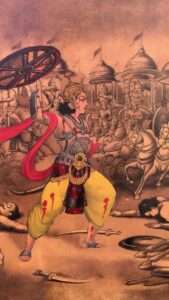
Mounting his chariot, Abhimanyu instructed his charioteer Sumitra to drive straight toward Droṇa. The charioteer, mindful of the dangers, sought to counsel him, reminding the young prince of the unmatched experience and deadly skill of Droṇa and the assembled warriors. He cautioned that Abhimanyu, though brave, had not yet been tempered by many battles, whereas his adversaries were shaped by a lifetime of war. Abhimanyu, however, smiled with serene confidence and replied that even if Indra himself, or Īśvara with all his primal forces, or even Kṛṣṇa and Arjuna together were to oppose him, he would still strive for victory—what then of Droṇācārya and his companions? According to ancient custom, to reject a charioteer’s counsel was considered inauspicious; yet the young hero, undeterred, adhered firmly to his purpose and commanded the advance.
Thus began a fierce and tumultuous battle. Abhimanyu’s chariot surged forward like lightning, its banner fluttering proudly in the wind. With a storm of arrows, he struck at Droṇa and shattered the carefully woven formation. Penetrating the Padma-vyūha, he moved within it with irresistible force—like Mount Mandara churning the ocean, like a raging wildfire devouring dry wood, like Lord Śiva dancing at the end of time. He felled standards, broke bows, shattered royal umbrellas and chariots, and tore through horses, elephants, and soldiers alike. Charioteers fell lifeless, shields and armor scattered, and weapons were reduced to fragments. Streams of blood flowed across the field, while shattered bodies lay strewn as grim testimony to his might.
Sañjaya, recounting the scene, declared to Dhṛtarāṣṭra that Duryodhana, like an elephant approaching a ravenous lion, advanced toward Abhimanyu, pondering desperately how to restrain the overwhelming and mysterious energy of that youthful warrior who now blazed like a force beyond reckoning.

