K.S. Nagarajan
Nations derive their identity not merely from written constitutions, political institutions or geographical boundaries, but also from their civilisational values, cultural traditions and collective conscience. While several countries function without a single codified constitutional document, Bharat’s civilisational foundations go back thousands of years, long before the modern concept of a written Constitution emerged.
Bharat’s ancient wisdom, reflected in the Vedas, Upanishads and Sanatana Dharma, provided an ethical and spiritual framework for society. The eternal sound of Om symbolises this continuity of thought, consciousness and universal harmony. Dharma, truth, compassion, self-restraint and responsibility towards fellow beings were central to this worldview.
Unfortunately, successive foreign invasions and colonial exploitation disrupted much of this civilisational continuity. India’s material prosperity attracted invaders, while the British East India Company employed commercial power, political manipulation and military force to establish colonial control. The freedom struggle subsequently became a contest not merely for political independence but also for the recovery of India’s identity and self-respect.
The contributions of revolutionary nationalists, particularly Netaji Subhas Chandra Bose, remain an important part of this history. His uncompromising approach to independence and his leadership of the Indian National Army represented a powerful alternative in the freedom movement. The ideological differences between Bose and Mahatma Gandhi, including the circumstances surrounding Bose’s resignation from the Congress presidency in 1939, deserve objective historical examination. India’s freedom struggle was never the achievement of one individual or one political philosophy alone.
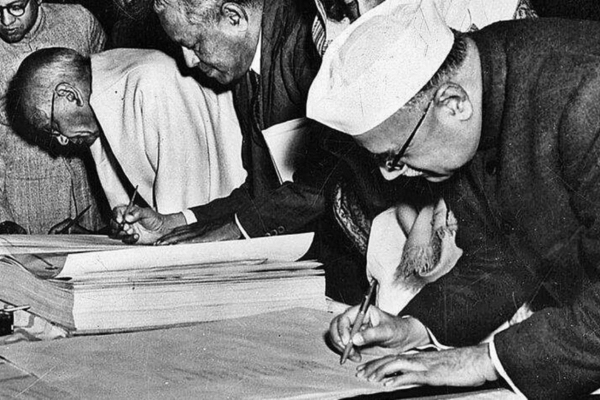
With independence, the people of India gave themselves a written Constitution, among the most comprehensive in the world. Its opening words, “We, the People of India”, are particularly significant. They establish the people as the ultimate source of constitutional authority. Although the President is the constitutional head of the State, the parliamentary system places executive responsibility with the elected government, headed by the Prime Minister and the Council of Ministers.
The Constitution also provides safeguards, checks and balances, and procedures for appointing and removing constitutional authorities. The President ordinarily acts on the aid and advice of the Council of Ministers, subject to constitutionally recognised exceptions. These provisions underline an important principle: power is entrusted to institutions for public service, not for personal or political aggrandisement. As the familiar saying goes, power corrupts, and absolute power corrupts absolutely.
Yet, the written Constitution represents only one dimension of Bharat’s inheritance. Its deeper civilisational philosophy is rooted in Sanatana Dharma and the doctrine of karma. Every action, whether compassionate or cruel, honest or dishonest, has consequences. This principle is not merely about religious observance; it is also a moral framework governing individual conduct.
One may understand karma through a simple analogy. Imagine giving a blind person an ordinary iron plate while falsely claiming that it is gold. The person may not discover the deception, but the conscience of the individual committing it cannot escape the moral consequence. Conversely, offering water to a thirsty creature or helping a helpless person reflects compassion. Both actions reveal the character of the individual.
Ancient Indian spiritual thought explains this interconnectedness through a cosmic framework involving planetary influences, Chitragupta’s accounting of deeds and the consequences of karma. These are spiritual interpretations rather than scientific explanations, but they offer a profound metaphor for the relationship between human conduct and its consequences. In this sense, nobody can escape moral accountability merely because an immediate witness is absent.
The same principle should guide public life. Wealth, authority and political office are temporary responsibilities, not permanent possessions. Every individual arrives in this world without material possessions and eventually departs without carrying accumulated wealth. Greed, vanity, anger and the uncontrolled pursuit of power can therefore undermine both personal character and public institutions.
Bharat’s sovereignty must also be understood beyond territorial boundaries, currency, minerals and economic resources. It rests equally on national confidence, cultural strength, intellectual independence and the trust that the country commands internationally. India’s growing global standing under Prime Minister Narendra Modi has reinforced the importance of strategic autonomy and the confidence to engage with powerful nations on its own terms. Sovereignty is ultimately measured by the ability to protect national interests without surrendering one’s independence.
The formation of the Rashtriya Swayamsevak Sangh in 1925, against the backdrop of social and political upheavals of that period, was another expression of the desire to strengthen Hindu society and national consciousness. Its philosophy and contribution may invite political debate, but disagreements should not prevent an objective examination of its historical role.
Ultimately, Bharat’s greatest strength lies in the harmony between its constitutional democracy and its ancient civilisational wisdom. The Constitution provides the framework for governance; Dharma provides an enduring moral compass for individual and collective conduct.
Political leaders may change, governments may fall and material wealth may disappear. But a civilisation sustained by ethical values, spiritual awareness and a sense of collective responsibility can endure across generations. That, perhaps, is the deeper meaning of Bharat’s sovereignty.