

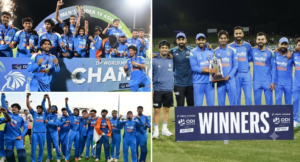
Can there be anything more exhilarating for a cricket enthusiast than witnessing two major Indian cricket triumphs in quick succession? While India’s Under-19 boys lifted the World Cup on Saturday, the senior Indian team touring New Zealand clinched the series 3-1 today. These outstanding achievements have given cricket lovers across the country yet another reason to celebrate, almost like a new Diwali.
What makes these victories particularly satisfying is not merely the silverware but the quality of cricket displayed by the young and established players alike. As a former cricketer and coach, I was particularly impressed by the discipline, determination and composure exhibited by India’s Under-19 boys, especially against traditional rivals Pakistan. Their collective approach, rather than dependence on individual brilliance, demonstrated the importance of teamwork, preparation and mental toughness.
Likewise, India’s disciplined bowling in the decisive ODI against New Zealand was a reminder that matches are not necessarily won by explosive batting alone. Discipline, consistency and the ability to execute plans under pressure remain the cornerstones of successful cricket. These are encouraging signs for Indian cricket. Congratulations, Team Bharat!
There is, however, another important dimension to India’s cricketing success that deserves attention. India is not short of cricketing talent. If anything, the country has an embarrassment of riches. The real challenge is identifying, nurturing and providing the right opportunities to deserving players.
Look at the opportunities available to aspiring cricketers today. The IPL has revolutionised the domestic cricket landscape, providing an unprecedented platform for young talent to rub shoulders with international stars, learn from experienced coaches and showcase their abilities before millions. The exposure and financial incentives have made cricket an attractive career option for youngsters.
Beyond the IPL, there are the Ranji Trophy, Vijay Hazare Trophy, Syed Mushtaq Ali Trophy, age-group competitions, inter-state tournaments and various state-level leagues. The BCCI’s extensive domestic structure offers several routes for talented youngsters to progress. The challenge, therefore, is not the absence of opportunities but ensuring that merit consistently determines who gets them.
Hyderabad offers an interesting example. The performances witnessed in the leagues and other competitions conducted under the Hyderabad Cricket Association (HCA) have been nothing short of astonishing. Triple centuries, numerous double centuries and hundreds have become almost commonplace. Bowling performances, too, have been equally impressive. Frankly, I cannot recall witnessing such a volume of individual performances in recent years.
But this raises an important question: why are more of these consistent performers not finding their way into inter-state competitions and higher-level teams?
One name that immediately comes to mind is Rahul Radeesh, a wicketkeeper-batter whose consistent performances deserve serious consideration. His absence from the South Zone side raises questions about whether performances over an extended period are receiving the attention they deserve.
Of course, selection cannot be based on one big innings or a handful of impressive scores. It must take into account consistency, match situations, quality of opposition, adaptability, fitness and performance across different conditions. But these parameters must be applied transparently and uniformly. A player who repeatedly delivers should not have to depend on personal connections or the goodwill of those occupying positions of authority.
This is where HCA needs to introspect and strengthen its talent-identification mechanism. It would be worthwhile to involve experienced former cricketers and qualified coaches in a structured scouting system. Their responsibility should extend beyond watching a few matches. They should maintain detailed records of promising players, monitor their progress and assess their performances in all four departments of the game — batting, bowling, wicketkeeping and fielding.
Most importantly, talent identification should be a continuous exercise, not an occasional activity undertaken just before team selection. A proper performance database, regular assessment and periodic reviews would help ensure that deserving players are neither overlooked nor lost in the system.
Indian cricket’s success story is built on its enormous talent pool. The IPL has demonstrated that an unknown youngster can emerge as a match-winner when given the right opportunity. Hyderabad and other state associations must take a similar approach at the grassroots and domestic levels.
The message is simple: India does not have a shortage of talented cricketers; it needs a system that recognises talent, rewards consistency and provides equal opportunities. HCA, in particular, has an opportunity to make a beginning. The talent is there. It is up to the administrators and selectors to find it, nurture it and give it the platform it deserves.