Shrikant Rao
Global heavy machinery manufacturers traditionally paired agricultural equipment with construction lines to hedge against industry cycles. The operational logic assumed that public infrastructure spending and commercial building would offset periodic downturns in the farm sector driven by volatile crop prices.
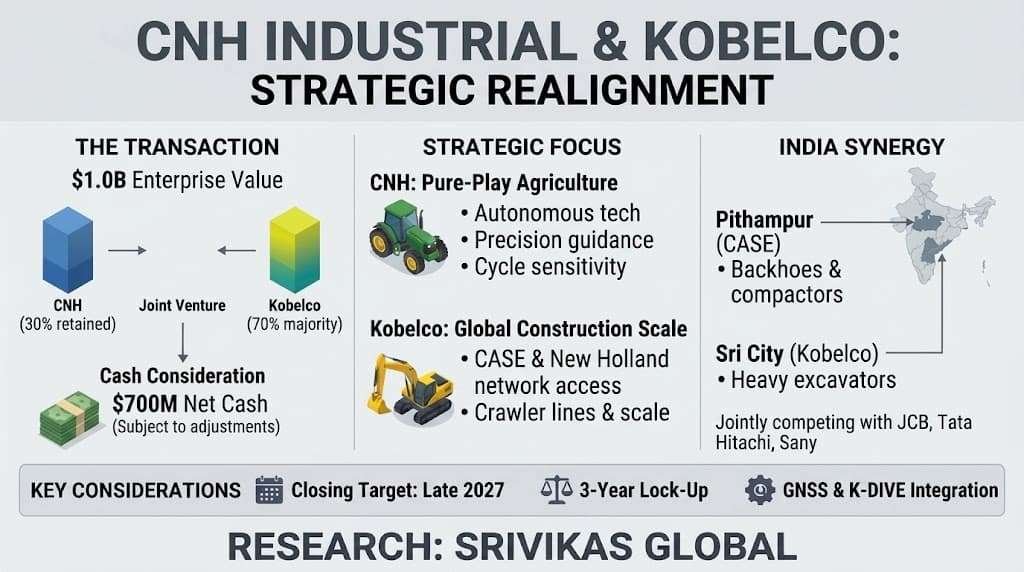
However, that paradigm is shifting. CNH Industrial’s definitive agreement to sell a 70% controlling stake in its construction division to Kobelco Construction Machinery—a subsidiary of Kobe Steel—signals a clear departure from this diversified model. The transaction values the construction business at an enterprise baseline of $1 billion, yielding CNH an expected $700 million in headline cash (subject to customary debt and working-capital adjustments) while leaving the seller with a 30% minority share.
This shift underscores the escalating capital demands of modern off-highway equipment. As digital telemetry, automated guidance, and alternative fuel platforms require increasingly heavy research budgets, manufacturers face a direct trade-off between cross-sector diversification and focused technological investment.
Competitive Landscape
The global machinery sector demands massive scale across distinct operational environments. In agriculture, primary manufacturers like Deere & Company, AGCO Corporation, and CNH are engaged in an expensive development cycle centered on autonomous fieldwork, predictive crop care, and connected farm telemetry, requiring uninterrupted capital expenditure.
Meanwhile, the heavy earthmoving arena remains highly concentrated, led by Caterpillar and Komatsu, alongside global specialists such as Volvo, Hitachi, and Doosan Bobcat. In parallel, Chinese producers like Sany and XCMG have mounted sustained price pressure across emerging-market export corridors.
Because CNH’s construction segment historically represented a modest share of its overall portfolio, defending its market position in both agricultural technology and heavy earthmoving simultaneously proved difficult. Under Gerrit Marx’s multi-year simplification strategy—which included the acquisition of Raven Industries in 2021 and the spin-off of the Iveco Group in 2022—the company opted to concentrate its resources.
Transaction Economics
The deal’s valuation reflects the historical performance gap between CNH’s two divisions. Although the construction unit generated annual revenues between $2.4 billion and $3 billion, its operating margins frequently trailed the agricultural core, hovering in the low single digits and weighing on the parent company’s overall cash conversion.
By deconsolidating these capital-intensive factory operations, CNH expects to expand its consolidated operating margins and ease balance-sheet leverage. The anticipated net cash proceeds are designated to pay down debt, eliminating the recurring manufacturing capital expenditures formerly required to sustain an independent construction footprint.
Crucially, the agreement maintains customer-facing continuity. CNH Capital remains entirely within CNH to write retail equipment financing, leases, and insurance, while agricultural dealers will retain distribution access to construction units built by the newly formed venture.
Governance Alignment
A central factor in the joint venture’s design is the earlier commercial history between the two partners. CNH and Kobelco previously ran a global alliance established in 2002, which was dissolved in late 2012 following disagreements over regional marketing territories and brand autonomy.
The new agreement seeks to avoid past frictions by establishing clear majority governance rather than a mutual marketing compact. Kobelco’s 70% ownership gives it undisputed executive responsibility over manufacturing schedules, engineering development, and product design.
The business will operate via two newly created corporate entities under the leadership of current CNH Construction segment President Humayun Chishti as Chief Executive Officer. This setup offers management and distribution continuity while keeping operating authority settled in Tokyo.
Global Synergies
For Kobelco, the arrangement removes a longstanding bottleneck in international distribution. While the company holds a strong reputation for hydraulic excavator design, lattice-boom crawler cranes, and jobsite remote-operation systems like its K-DIVE platform, its standalone distribution has struggled to break through entrenched dealer channels across North America and Europe.
Through the venture, Kobelco secures access to established CASE Construction and New Holland Construction retail networks across five continents. It also absorbs an established line of compact equipment, wheel loaders, motor graders, and backhoe loaders to round out its core excavator catalog.
Furthermore, Kobelco plans to pair CNH’s global navigation satellite systems and precision automation software with its own digital jobsite tools, alongside building out recurring aftermarket parts and servicing across the operating fleet of CASE and New Holland machines.
Indian Market
India stands out as a crucial operating theater for the new joint venture. Driven by state-funded highway programs, mining demand, and tier-two city expansion, the domestic machinery market remains both fast-growing and price-sensitive.
Locally, CNH manufactures out of Pithampur, Madhya Pradesh, holding an established presence in backhoe loaders, soil compactors, and motor graders. Kobelco Construction Equipment India runs an excavator plant in Sri City, Andhra Pradesh, focused on premium heavy crawler excavators.
The local market features deeply entrenched players. JCB India commands a dominant share in backhoe loaders through an extensive regional parts and service network, while Tata Hitachi, Komatsu, and Sany India maintain major positions in hydraulic earthmoving. Marrying CASE’s localized production base with Kobelco’s excavator engineering gives the venture a more balanced catalog across compact utility machines and heavy infrastructure excavation.
Operational Realities
Translating the strategic logic into durable performance depends on managing clear transition risks. The closing target extends through late 2027 to clear required regulatory hurdles, a multi-quarter window that requires steady hand-offs to avoid talent attrition and dealer hesitation.
The anticipated $700 million in cash consideration remains subject to customary net-debt and working-capital adjustments at settlement, meaning the final cash sum depends directly on inventory levels and channel absorption during the run-up to closing.
Finally, narrowing its corporate profile turns CNH into an agricultural pure play, which clarifies capital allocation but removes the cushion that non-farm equipment historically provided during farm income slumps. Ultimately, the partnership reflects a defined trade-off: CNH concentrates its balance sheet on software-driven agricultural equipment, while Kobelco secures the global scale needed to compete as a full-line heavy equipment builder.