
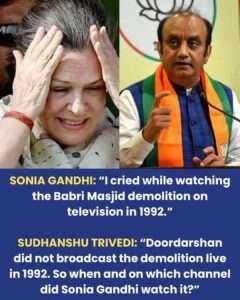
Sonia Gandhi says she cried when she watched the Babri Masjid being demolished on television on December 6, 1992.
It is a moving recollection – except for one rather inconvenient question: what exactly did she watch, on which channel and at what time?
BJP spokesman Sudhanshu Trivedi has asked precisely that question. And it deserves an answer.
The missing telecast
There was no 24-hour Indian news television in 1992. Doordarshan was the national broadcaster. The demolition was filmed, but it was not being beamed live into Indian homes as the structure came down. The footage was subsequently transmitted and broadcast.
So if Sonia Gandhi means that she watched recorded footage or later television coverage, there is no mystery. But if her recollection is that she watched the demolition live as it happened, the claim becomes historically difficult to sustain.
And that is where the word mendacious may seem harsh – but the claim certainly deserves scrutiny. A historical memory cannot acquire the status of fact merely because it is accompanied by tears.
The man behind the camera
There is a rather extraordinary photographic footnote to this story. My friend and former colleague D. Ravinder, a photojournalist, was actually at the disputed site in Ayodhya that day.
He was among the few photographers who managed to get close enough to the kar sevaks to document the actual demolition. Realising the danger, he concealed his camera and continued shooting.
His photographs became the visual record of what happened at the site. They were carried by newspapers and publications across India and around the world, providing some of the most important photographic documentation of that historic moment.
Even the legendary photographer Raghu Rai, who was in Ayodhya with his son that fateful day, captured the extraordinary atmosphere and mood surrounding the events. But getting into the thick of the action at the disputed structure was another matter altogether. That distinction matters.
In an age before smartphones, social media and ubiquitous television cameras, a photograph taken at the right moment could become the evidence.
Ravinder was there with his camera when history was actually unfolding – not sitting before a television screen watching a live feed that did not exist.
Selective tears
Which brings us back to Sonia Gandhi’s tears. There is nothing objectionable about crying over the destruction of a place of worship. The demolition was an embarrassing episode and the perpetrators deserved to face justice. Sonia herself described it in 2010 as a ‘shameful, criminal act’.
But political memory has an unfortunate habit of acquiring cinematic qualities with age. A scene is remembered. The television is switched on. The historic structure comes crashing down on the screen. Tears flow.
Only one problem: Indian television was not showing that scene live. That is why Trivedi’s question is legitimate. Which channel? At what time?
If the answer is recorded footage shown later, say so. Nothing is embarrassing about that. But history should not be given a dramatic makeover merely because a memoir needs an emotional scene.
And then comes the larger question of selective compassion. Babri Masjid deserves tears. So did every innocent victim of communal violence.
Did the same tears flow for the Kashmiri Pandits who were killed, terrorised, raped and driven from their homes? Where was the national moral outrage when an entire community was forced into exile from the Valley?
And what about the victims of the 1984 anti-Sikh massacre, when thousands of innocent people were slaughtered after Indira Gandhi’s assassination? Their suffering too deserves remembrance, grief and justice.
This is not an argument that one tragedy cancels another. It doesn’t. Every innocent Indian killed because of his or her religion deserves our tears.
History needs timestamps
That is precisely why selective remembrance is so disturbing. Compassion cannot be switched on for one tragedy and switched off for another according to political convenience.
Sonia Gandhi’s memoir is titled Belonging: A Journey of Love. Perhaps the real journey of belonging is to recognise every Indian victim of hatred as equally worthy of grief – whether the victim was inside a mosque, a temple, a Sikh home, a Kashmiri Pandit household or anywhere else.
Ravinder’s camera recorded what actually happened at Ayodhya. No political memoir can rewrite what that camera saw. And no amount of retrospective emotion can turn a recorded television report into a live telecast.
Tears may be genuine, memories may be sincere, but history still needs a timestamp.