



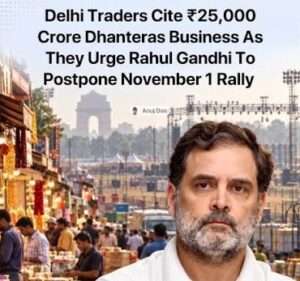
Rahul Gandhi has once again exposed the contradictions at the heart of his politics. When traders in Delhi and elsewhere, facing business losses running into crores amid political agitations, appealed to the Leader of the Opposition to postpone protests in view of the approaching Diwali festival, his response was to ask them to tell the Prime Minister to sack Chief Election Commissioner Gyanesh Kumar. The traders’ immediate concern was their livelihood; Rahul’s answer was another political diversion. The contrast raises an uncomfortable question: does his politics have room for ordinary citizens’ distress when it conflicts with his campaign against the BJP? The comparison becomes even more disturbing when viewed against the Pahalgam massacre, in which Pakistan-sponsored terrorists reportedly singled out tourists based on their religion, killing 26 people in cold blood, with accounts describing their refusal to recite the Kalma as a factor in the killings. Political rhetoric and terrorist violence are not the same, but the tragedy should remind every political leader of the dangers of deepening religious hostility rather than promoting social harmony. The Congress, which imposed the Emergency and resisted judicial verdicts in the past, must explain why it now appears unwilling to let constitutional processes run their course when the Supreme Court is seized of challenges to the Special Intensive Revision (SIR) of electoral rolls and has issued notices to the petitioners. Criticising the Election Commission is legitimate in a democracy; demanding the removal of its chief without establishing the case through due process is another matter. If the Congress has evidence of wrongdoing, it must place it before the appropriate authorities and the courts. Constitutional institutions cannot be expected to secure the party’s approval before discharging their responsibilities. The contradiction becomes more conspicuous when Rahul’s professed sensitivity towards communities is examined. He has spoken of adjusting his programmes to accommodate Christians celebrating Christmas and New Year. Respecting religious festivals is commendable, and every community deserves such consideration. But why does comparable sensitivity appear to recede when traders seek relief during Diwali? Religious harmony cannot mean consideration for one festival and political indifference towards another. Nor can social justice be reduced to electoral arithmetic. The Congress routinely invokes caste representation and seeks to consolidate Dalit and other backward-caste votes by foregrounding social divisions. Yet, the real test of social justice lies in delivering dignity, opportunity and equality, not treating communities as permanent electoral commodities. The Congress has every right to seek Dalit support, but it cannot expect Dalit voters to remain captive to its political legacy. Their electoral choices across states demonstrate that they assess leadership, governance and performance independently. The same applies to Muslim voters, whose preferences cannot be presumed to be permanently controlled by any party. No community belongs to the Congress—or to any other political formation.
For decades, the Congress benefited from an electoral coalition drawing support from sections of minority communities, caste groups and other social constituencies. The BJP’s expansion has disrupted that arrangement, prompting the Congress to intensify its attacks on the BJP and the RSS, often portraying political differences as a struggle against forces it considers inherently divisive. Yet, a party that routinely accuses its opponents of polarisation must answer why its own electoral messaging so frequently revolves around caste identities and community-based calculations. The electorate is not blind to these contradictions. Hindu voters, too, are increasingly willing to look beyond traditional caste loyalties when they believe a broader political alternative offers stronger leadership, national security and governance. The BJP’s electoral advances across several states underline a hard reality for the Congress: it cannot recover lost ground merely by mobilising resentment against its opponents. The forthcoming Assembly elections, including those in Uttar Pradesh, Uttarakhand and Punjab in 2027, will test these competing strategies. Punjab presents a particularly difficult challenge for the Congress. The Aam Aadmi Party displaced it from power, while continuing concerns over drugs, law and order and governance remain central to the political debate. A revival of cooperation between the BJP and the Shiromani Akali Dal could further reshape the contest if the two parties overcome their earlier differences. But electoral calculations alone cannot conceal the larger question confronting Rahul Gandhi. His politics cannot succeed indefinitely by treating every institutional disagreement as a conspiracy, every electoral setback as proof of manipulation and every social community as a vote bank to be mobilised. The Congress must decide whether it wants to govern Bharat or merely obstruct those who do. Its conduct increasingly risks reinforcing the impression that opposition has become an end in itself rather than a means of offering a credible alternative. The party that once dominated national politics cannot reclaim public confidence simply by attacking its rivals, questioning institutions whenever outcomes are unfavourable and invoking social justice selectively. It must demonstrate consistency between its words and actions, respect constitutional processes and show equal sensitivity to the concerns of all citizens. As voters become less willing to accept rhetoric in place of accountability, Rahul Gandhi’s most formidable opponent may not be the BJP. It may be the widening credibility gap between what he preaches and what his politics practises.

