MS Shanker
Student representation is a legitimate democratic demand. But when campus agitation reportedly crosses into separatist rhetoric, intimidation, and disruption of academic life, the constitutional right to protest cannot become a shield for political provocation.
The unfolding protests at Jamia Millia Islamia raise a question that goes well beyond the restoration of a students’ union: are these demonstrations driven primarily by genuine concerns about student representation, or are political interests exploiting campus discontent to advance a larger ideological agenda?
The distinction matters. Democracy protects dissent, and universities must provide space for debate, disagreement and peaceful mobilisation. But no constitutional right grants anyone immunity from disciplinary rules or the consequences of unlawful conduct. A university cannot be converted into a political battleground where academic responsibilities become collateral damage and provocative slogans are passed off as democratic activism.
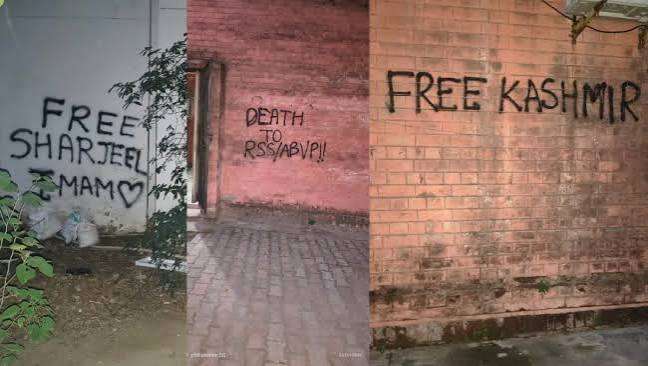
Reports and televised visuals alleging that protesters painted slogans demanding an independent Jammu and Kashmir, called for the release of individuals convicted in connection with the Delhi riots, or raised provocative demands concerning Assam and the strategically sensitive Siliguri Corridor, commonly known as the Chicken’s Neck, warrant serious scrutiny. Such slogans, if accurately reported and presented in their proper context, go far beyond a routine demand for student representation. Calls that appear to advocate the fragmentation of Bharat deserve particular concern, although the precise wording, context and legality of individual statements must be established before conclusions are drawn.
The Constitution is not a licence for separatism
The constitutional argument routinely invoked by student activists cannot end with the words freedom of speech and peaceful assembly. Fundamental rights carry responsibilities, and their exercise is subject to constitutional limitations and lawful restrictions. Equally, criticism of the government, advocacy for unpopular causes and demands for institutional reform cannot automatically be branded anti-national.
That distinction must be maintained if the authorities wish to uphold the rule of law rather than merely win a political argument. Where there is credible evidence of violence, intimidation, vandalism or other unlawful activity, action should follow due process. Where there are only controversial opinions, the response must remain within constitutional boundaries.
The argument that every protest is peaceful simply because its organisers describe it that way is equally unconvincing. Allegations of stone-pelting, clashes with security personnel and disruption of university activities must be investigated on the available evidence. Security personnel are entitled to protection from assault just as students are entitled to lawful protest. Neither side should enjoy immunity from accountability.
The Left’s political predicament
The political dimension of the Jamia agitation cannot be ignored. The CPI and CPM, along with their student-wing networks, have historically used educational institutions as platforms for ideological mobilisation. Their opponents argue that campus activism offers these parties a means of retaining visibility and influence at a time when their electoral strength has diminished considerably.
The Left’s declining political fortunes make this question particularly relevant. The CPI and CPM have a limited presence in Parliament compared with their historical influence, while the CPM’s position in Kerala has come under increasing political pressure. Yet it would be inaccurate to suggest that the Left has disappeared from Bharatiya politics or that every student protest is orchestrated by it. The important question is whether identifiable political organisations are encouraging agitation for their own purposes rather than helping resolve the students’ stated grievances.
If the demand at Jamia is the restoration of the Jamia Millia Islamia Students’ Union (JMISU), inactive since 2006, the university should address it through a transparent, time-bound process. Student representation is not inherently subversive, nor should it be dismissed merely because Left-leaning groups support it.
But neither should a legitimate demand become a convenient vehicle for unrelated political slogans, confrontations or attempts to paralyse an institution. The restoration of a students’ union requires a clear constitution, transparent electoral procedures and safeguards against coercion and violence. If the administration has constituted a committee to prepare a draft constitution, it should communicate a credible timetable and explain the procedural steps still required.
Students must not become political pawns
The reported indefinite hunger strike, which began on October 12, 2026, has intensified the confrontation over student representation, disciplinary action and the administration’s refusal to hold immediate union elections. The protesters have reportedly sought the withdrawal of show-cause notices, penalties and other disciplinary measures, while accusing the authorities of intimidation and excessive force. These competing allegations require independent scrutiny rather than automatic acceptance of either side’s account.
The administration’s reported decision to shift classes online as a precaution against escalating tensions also deserves attention. When a campus cannot conduct its ordinary academic activities because of prolonged demonstrations, tent installations or clashes, the consequences fall on students who may have no interest in the agitation. Their right to education cannot be sacrificed indefinitely to the political ambitions of others.
Nor can concerns about political leaders visiting the campus and potentially influencing the agitation simply be brushed aside. Political participation in public debate is legitimate, but external actors should not be permitted to inflame tensions or exploit young people for partisan objectives.
The government, however, must distinguish between unlawful conduct and lawful dissent. Cutting off university funding merely because students engage in controversial protests would be a disproportionate and potentially damaging response. Public funding supports education, research and institutional development, not the personal convenience of an administration or the political preferences of the government. Any action against an institution must have a lawful basis and follow due process.
Firmness without arbitrariness
Jamia’s administration must enforce discipline consistently, investigate allegations impartially and protect the academic interests of every student. Law-enforcement agencies must act on credible evidence, not political labels. Students, in turn, must understand that a university is a place to prepare for the future, not a staging ground for rhetoric that threatens national unity or intimidates those who disagree.
The CPI and CPM may seek political relevance through student organisations, just as other parties cultivate their own constituencies. That is part of democratic competition. But if any organisation encourages unlawful activity or uses students to promote separatist objectives, it must answer for its actions under the law.
Bharat’s democracy is strong enough to accommodate dissent. It is also entitled to defend its constitutional order against unlawful attempts to undermine it. The answer to campus disorder is neither indiscriminate repression nor endless indulgence. It is transparent procedures, equal enforcement of the law and accountability supported by evidence.
A students’ union can be debated, negotiated and restored through due process. National unity and the right of fellow students to pursue their education cannot be held hostage to political theatre.