Drought-Proofing Bharat by 2047
The Four Waters Concept offers a cost-effective pathway to strengthen water security, protect agriculture and reduce the recurring economic and human costs of drought.
El Niño is not a one-off climate event. Observed for centuries, it will continue to influence weather patterns and pose recurring challenges to agriculture and water security. With climate change potentially intensifying its consequences, Bharat cannot afford to keep responding to every drought with temporary relief measures. The national priority must be to move towards comprehensive drought-proofing by 2047, as an essential component of the vision of Viksit Bharat.
El Niño occurs when surface waters in the central and eastern Pacific Ocean become unusually warm, disrupting weather patterns across the world. Its first recorded occurrence dates to 1578, when fishermen in Peru observed the phenomenon. It typically recurs every two to seven years.
India’s experience demonstrates the consequences. Major drought years, including 1965, 1972, 1982, 1987, 1998, 2009, 2015 and 2023, underline the vulnerability of the southwest monsoon to El Niño-associated disruptions. Consecutive droughts are particularly destructive because they deplete reservoirs, exhaust shallow aquifers and undermine the capacity of rural communities to recover.
The current drought assessment highlights severe stress across Maharashtra, Karnataka, Andhra Pradesh and Telangana. Maharashtra reportedly declared drought in 265 of its 358 talukas, while Karnataka identified 217 of its 240 taluks as drought-hit. Andhra Pradesh declared drought in 388 mandals across 21 districts following a reported 53.4 per cent rainfall deficit between June and August.
Telangana has also faced substantial rainfall deficiencies, particularly during August, with damage to paddy and cotton crops and pressure on reservoir storage. Such conditions expose the limitations of relying on emergency relief after agricultural losses have already occurred.
The experience of 1965–66, 1986–87 and 2014–15 illustrates the danger of successive drought years. A sustainable response must therefore focus on conserving every possible drop of rainwater, replenishing groundwater and improving the capacity of watersheds to withstand prolonged dry spells.
A Proven Alternative
Among the approaches deserving far greater attention is the Four Waters Concept developed by irrigation expert T Hanumantha Rao, who served as an adviser to international institutions, including the United Nations and the World Bank.
In 2000, a Water Conservation Mission was established under the chairmanship of then Andhra Pradesh Chief Minister N Chandrababu Naidu. Its technical committee, chaired by Hanumantha Rao, recommended implementation of the concept in Andhra Pradesh from October 2001.
The model adopts a ridge-to-valley approach, combining ten earthworks and four vegetative measures across a watershed. Implemented in a saturation mode, it seeks to slow runoff, conserve rainwater, prevent soil erosion, recharge groundwater and sustain water availability beyond the monsoon.
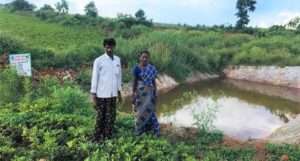
Villages across Telangana and Rayalaseema implemented the concept from 2001, at an initial cost of about Rs 5,000 per acre. Gottigaripalli village in present-day Sangareddy district emerged as a notable example. It reportedly withstood the consecutive droughts of 2014 and 2015 and continued supporting three crops annually, with minimal maintenance.
The model was later implemented in Rajasthan between 2014 and 2018 under Chief Minister Vasundhara Raje at about Rs 8,000 per acre, with similarly encouraging results.
Scale Up the Solution
The concept requires average annual rainfall of approximately 500 mm, subject to local conditions. The states currently facing severe drought stress receive average annual rainfall well above that threshold. An estimated 85–90 per cent of India’s geographical area receives more than 500 mm annually, indicating considerable potential for wider application following site-specific assessment.
Its reported benefits include improved groundwater levels, reduced soil erosion, more persistent streamflow and water availability for multiple crops, including during summer in drought years. By strengthening rural livelihoods, watershed development can also reduce distress migration and the recurring burden of drought-relief expenditure.
At an estimated current cost of Rs 15,000 per acre, the Four Waters Concept merits serious comparison with capital-intensive lift-irrigation and inter-basin water-transfer projects. While it cannot replace every major irrigation project or resolve all inter-state water disputes, it can reduce pressure on large infrastructure by making better use of rainfall where it occurs.
Delivering the Dr Channa Reddy Memorial Lecture in 2016, Hanumantha Rao estimated that implementing the concept across 143.2 million hectares would require Rs 2,14,800 crore, based on the then-estimated rate of Rs 15,000 per hectare. He contrasted this with Telangana’s irrigation budget of approximately Rs 25,000 crore for 2016–17. At updated costs, the nationwide investment is estimated in the supplied material at around Rs 5.50 lakh crore.
The choice before Bharat is whether to continue treating drought as a recurring emergency or invest systematically in preventing its worst consequences. A nationwide watershed-development mission, implemented wherever conditions are suitable, could transform rain-fed agriculture, strengthen groundwater reserves and improve rural resilience.
By 2047, drought-proofing must be more than an aspiration. It must become a measurable national objective, supported by scientific planning, sustained investment and implementation on the ground. (The author is a former Vice-Chairman of the National Disaster Management Authority (NDMA), Secretary of the Dr M. Channa Reddy Memorial Trust, and a senior BJP leader.)