Lakshmanrao Upadhyayula
The sacred hymn attributed to the great sage Vishwamitra, composed in the majestic Triṣṭubh meter of the Ṛgveda, is a profound invocation to the divine Aśvins, the celestial twin deities celebrated as healers, protectors, and swift benefactors of humanity. Their presence in the Vedic tradition symbolizes the harmonious union of divine intelligence and compassionate action, revealing that the cosmos responds to those who approach it with purity, discipline, and unwavering faith. The hymn unfolds as a sacred dialogue between heaven and earth, where every offering, every chant, and every aspiration becomes a bridge connecting human devotion with celestial grace.
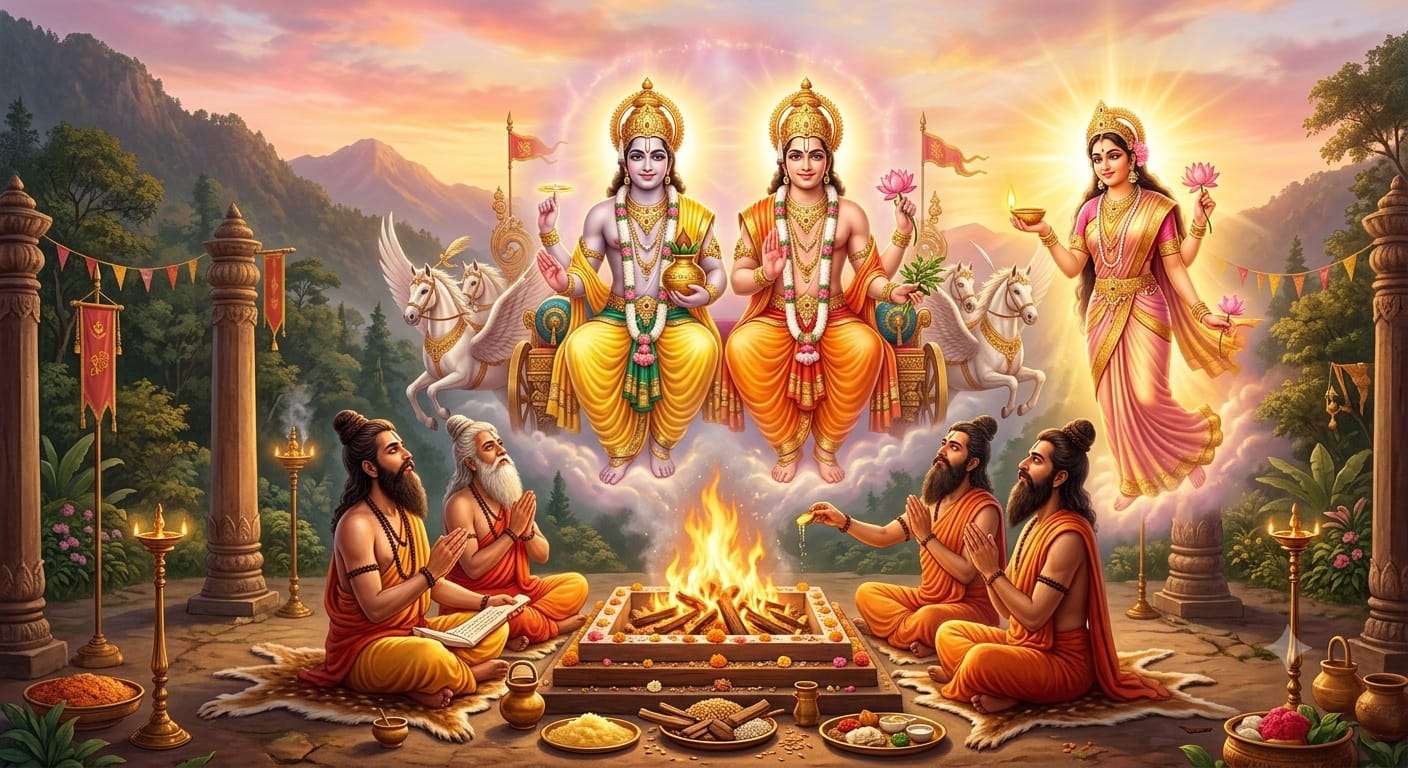
The radiant goddess Uṣā, the divine Dawn, awakens the universe by unveiling all that is precious and life-sustaining. With her arrival, primordial Agni, the eternal sacrificial fire, receives the nourishing and delightful milk drawn as a sacred offering, symbolizing the renewal of life and the continuity of cosmic order. The son of Uṣā, the glorious Sūrya, begins his majestic journey across the heavens, illuminating all realms with divine brilliance. As daylight adorns the world with its auspicious radiance, the hymns dedicated to the Aśvins arise even before the full splendor of the Sun, declaring that divine wisdom awakens before visible light and that spiritual consciousness precedes material perception.
The sage earnestly invites the Aśvins to mount their wondrous chariot, adorned with perfectly fashioned wheels and drawn by swift, well-yoked celestial horses. This divine vehicle is called to descend upon the sacred precincts of the expansive yajña, where the holy fires burn with unwavering brilliance. Just as loving parents guide and protect their children, the sacrificial rite rises toward the heavens with reverence and purpose, carrying the prayers of humanity. The worshippers implore the divine twins to crush every serpent-like force of ignorance, hostility, and deception that seeks to hinder righteousness, replacing fear with courage and darkness with enlightened understanding.
Sacred oblations are lovingly offered as expressions of gratitude and surrender. The Aśvins, renowned for their flawless chariot and incomparable swiftness, are invited to listen attentively to the hymns resounding through the sacrificial arena. These Vedic mantras are recited with precise pronunciation, rhythmic cadence, and profound devotion, for the sages understood that the power of sacred sound rests not only in meaning but also in its perfect vibration. The ancient seers preserved these hymns with extraordinary care, recognizing that fidelity to sacred knowledge safeguards both spiritual integrity and the enduring heritage of the Vedic tradition.
The worshippers beseech the Aśvins to understand the sincerity of their prayers and to journey with their divine horses toward the consecrated yajña. The invocation is offered in friendship and reverence, reflecting the intimate relationship between the deities and devoted seekers. As Sūrya rises following the appearance of Uṣā, the hymn urges the divine twins to arrive without delay, allowing their splendor to overcome every hostile influence and every force opposed to truth. Their celestial path symbolizes the invisible channels through which divine grace continually descends into the world.
The assembled priests chant these sacred hymns with unwavering concentration, proclaiming the glory of the Aśvins as destroyers of hostile powers and protectors of righteousness. Before them stand the pure vessels filled with carefully prepared Soma, arranged according to sacred ritual and offered with faultless devotion. Their companionship with humanity is celebrated as ancient, benevolent, and ever desirable. The hymn recalls their enduring relationship with the descendants of the venerable Jahnu lineage, emphasizing that divine friendship is strengthened through remembrance, gratitude, and faithful worship. As the Soma fills their hearts with delight, the devotees pray that the same divine joy may overflow into their own lives through blessings of health, wisdom, prosperity, and inner peace.
The hymn further extols the eternal youthfulness, unfailing truthfulness, and inexhaustible power of the Aśvins. They are praised as bestowers of auspicious fruits whose compassion never diminishes and whose delight in Soma reflects the bliss of divine communion. Accompanied by the hosts of Vāyu, the life-giving principle of movement and breath, they are invited to partake of the sacred Soma during the evening worship, completing the daily cycle of devotion. This union of Agni, Vāyu, Soma, Uṣā, and Sūrya illustrates the remarkable scientific temperament of the Vedic seers, who perceived the interconnected rhythms of light, energy, atmosphere, nourishment, and consciousness as expressions of one harmonious cosmic order governed by Ṛta, the eternal law of the universe.
The pure oblations offered by skilled and faultless priests ascend toward the celestial realms through disciplined ritual and inspired recitation. Their mastery of the Ṛgvedic hymns reflects generations of careful preservation, where precision of sound, intention, and action combine to create a living bridge between humanity and the divine. The rain-bearing chariot of the Aśvins is poetically described as moving between heaven and earth, revealing the Vedic understanding that divine blessings descend through the natural cycles of the cosmos, sustaining all forms of life and affirming the inseparable relationship between spiritual devotion and ecological harmony.
Finally, the hymn presents the delicious Soma, blended with sweet and invigorating essence, as the supreme offering to the divine twins. They are invited to drink this sacred elixir and graciously visit the homes of their devotees again and again, bringing healing, prosperity, and enduring protection. The purifier of Soma signifies the continual refinement of both ritual and human consciousness, reminding every seeker that true worship purifies the heart before it transforms the world. Thus, the hymn of Sage Vishwamitra stands as an everlasting testimony that the harmony of sacred knowledge, disciplined worship, scientific observation, and unwavering devotion leads humanity toward divine companionship, righteous living, and the eternal light of cosmic truth.