


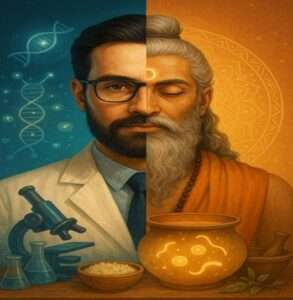
The topic evokes strong reactions across different sections of our society because it lies at the intersection of religion, cultural identity, national pride, education, and scientific credibility. Whenever exaggerated claims that the Vedas describe ancient aircraft, nuclear weapons, internet, plastic surgery, stem-cell technology, relativity or quantum physics are endorsed by politicians, senior officials, academicians, and scientists in elite institutions, it becomes a topic of intense public discussion. Unfortunately, such discussions end up as contests pitching Vedas against the recent discoveries in modern science, as if the credibility of one depends on discrediting the other.
Bharat’s unusually rich and sustained traditions of philosophical inquiry, debate and commentary allow people to value both the spiritual and philosophical significance as well as the contributions to mathematics, astronomy, medicine and metallurgy in the Vedic literature. But it should not force to endorse the claims that cannot be historically, archeologically or scientifically substantiated. I, therefore, suggest that instead of scoring points over each other, our response should be based on pride without exaggeration, scepticism without contempt, and historical scholarship without ideological pressure.
Having said that, let me start with a single Sanskrit mantra from the Annapūrṇa Upanishad (1.40), Prapathaka (chapter) 1, Mantra (verse) 40, to set the tone of this article. कोऽहं कथमिदं किं वा कथं मरणजन्मनी । विचारयान्तरे वेत्थं महत्तत्फलमेष्यसि ॥ १.४० ॥ In English, “Ko’ham? Katham idaṃ kiṃ vā? Kathaṃ maraṇa-janmanī? Vicāraya antare; vetthaṃ mahat tat-phalam eṣyasi”. This translates to “Who am I? how came I into being? What is it? How came death & birth? Thus, inquire within yourself; great will be the benefit you will derive from such inquiry”.
This verse reflects the inspired and contemplative vision of our ancient Rishis about the universe and humanity. Their primary focus is on spiritual questions rather than systematically investigating the material world, as done in modern science. They considered the physical world as impermanent and ultimately illusory, like a mirage or phantasmagoria. This clearly indicates that the Vedas were never composed as scientific textbooks or manuals; rather, they are treatises of the metaphysical world. In this sense, I feel that the Vedas in general and the Upanishads in particular can harmonise with science with whatever modern science proves or discovers in this physical world. Let me elaborate my point with an example on “Consciousness” as given in the Upanishads and perceived by famous scientists. Chandogya Upanishad teaches about Space, which is identified with Brahman, the Immensity, poorly translated as “God”. According to Chandogya (3.14.1), Sarvam khalvidam Brahmā – everything is Brahman and Prajñānam brahmā – Brahman is consciousness (Aitareya-Upanishad 3.1.4). Further, in the Chandogya Upanishad (6.11), Tat tvam asi – you too are a moiety of Brahman and not separate from IT; therefore, your individual consciousness is a modality of cosmic consciousness. Brihadaranyaka Upanishad (1.4.10): Aham brahmāsmi, Ayam ātma brahma – I am Brahman and this Self (soul) is Brahman.
The circular Vedic logic is that the entire Cosmos is Space that is Brahman identified with Consciousness. So, both Space and Consciousness are identifiers of Brahman. In short, the matter in the Universe arises from consciousness, which is the substrate of everything. Now look at what our famous scientists said about “Consciousness”. Max Planck said, “Consciousness, I regard as fundamental. I regard matter as derived from consciousness. Everything we talk about, everything we regard as existing, postulates consciousness. We cannot get behind consciousness”. He did not say that Quantum physics proved that consciousness creates matter; what he meant was, whatever we know about “matter” is known through conscious experience. Therefore, consciousness cannot simply be treated as something we can explain away as a secondary phenomenon without addressing the fact that all our knowledge of the physical world is mediated by consciousness. Planck’s statement has an obvious resemblance to certain philosophical positions in Vedanta, particularly in Advaita, where consciousness is treated as fundamental, and the apparent material world is understood in relation to Brahman.
Let me come to Albert Einstein. His name is often associated with his admiration for the Vedas and the Bhagavad Gita, especially his frequently quoted phrase, “When I read the Bhagavad Gita and reflect on how God created the universe, everything else seems superfluous”. This quote lacks firm documentary authentication; although he reflected deeply on spirituality and the nature of the cosmos and there is no reliable evidence that he regarded Vedic texts as the source of relativity or modern physics.
I can go on and on but will stop with Erwin Schrödinger and Werner Heisenberg. A passage frequently attributed to Schrödinger reads: “The unity and continuity of Vedanta are reflected in the unity and continuity of wave mechanics. This is entirely consistent with the Vedanta concept of All in One” and “The multiplicity is only apparent. In truth, there is only one mind.” These statements reflect Schrödinger’s philosophical interpretation of Vedanta. They do not mean that the Upanishads supplied the mathematics of wave mechanics or that quantum mechanics was directly derived from them. His scientific papers on wave mechanics do not present Vedanta as a physical theory or cite it as an experimental source.
Similarly, the quote, “Quantum theory will not look ridiculous to people who have read Vedanta, attributed to Heisenberg. Though the source of this statement could not be verified, his interest in Indian philosophy is well known. Quantum mechanics challenges the classical assumption that physical properties always exist in definite form independent of measurement. This encouraged comparisons with Vedic thought that questions the rigid separation between the observer and the observed. But Heisenberg did not ever claim that the Upanishads had discovered quantum mechanics, nor did he use Vedanta as a substitute for mathematical physics.
In my opinion, these are analogies, not equivalences, and as such Quantum entanglement, superposition, and wave functions are precise physical concepts supported by experiments. They should not be treated as scientific confirmations of Brahman or Atman. Conversely, the philosophical value of the Upanishads does not depend on their being retroactively converted into physics.
I suggest that instead of searching for modern scientific achievements in the Vedas, we should highlight Bharat’s impressive intellectual history without exaggeration. Our ancient scholars made foundational contributions to the decimal place-value system and zero, while later scholars developed important ideas in algebra, arithmetic, and trigonometry. The global history of mathematics acknowledges the substantial contribution of our mathematicians over many centuries. Aryabhata discussed the rotation of the Earth and produced important astronomical calculations; Brahmagupta made major contributions to mathematics and astronomy. The same applies to medicine where traditions associated with Charaka and Sushruta contain important knowledge of diagnosis, pharmacology, surgery and medical practice. Our ancient metallurgical achievements also deserve independent recognition. The iron pillar of Delhi, high-quality steel traditions and ancient metalworking practices demonstrate considerable technical skill.
A full thesis could be written on Bharat’s ancient achievements, but I will elaborate on one example and stop with the derivation of the value of Pi (π), which has always fascinated me. π is the constant ratio of a circle’s circumference to its diameter. A verse associated with the Kerala school of mathematics and attributed to Mādhava of Saṅgamagrāma encodes a remarkably accurate value of π using the Bhūta-saṃkhyā system, in which words represent numbers through objects or concepts traditionally associated with particular numerical values. The verse reads: “Vibudha-netra-gajāhi-hutāśana; tri-guṇa-veda-bha-vāraṇa-bāhavaḥ.” Here, vibudha represents 33 (gods), netra 2 (eyes), gaja 8 (elephants), ahi 8 (snakes), hutāśana 3 (fires), tri 3, guṇa 3, veda 4, bha 27 (nakṣatras or lunar mansions), vāraṇa 8 (elephants), and bāhu 2 (arms). Following the Bhūta-saṃkhyā convention, in which the numerical values are read in reverse order, these words encode the number 2,827,433,388,233. This number represents the circumference of a circle whose diameter is specified in the second verse.
In the second verse, Nava-nikharva-mitevṛtta-vistare;paridhi-mānamidaṃjagadurbudhāḥ, the phrase nava-nikharva gives the diameter: nava means 9 and nikharva represents 1011. Therefore, the diameter is 9×1011 = 900,000,000,000. The verse states that the circumference of a circle with this diameter is 2,827,433,388,233, a number encoded through the Bhūta-saṃkhyā words in the preceding verse and read from right to left. Thus, the value of is calculated as 2,827,433,388,233 divided by 900,000,000,000 = 3.1415926535922. The value is correct to 11 decimal places. Isn’t it amazing!
Final word: I always wonder–the unity that today’s science is seeking in “Theory of Everything (ToE), a hypothetical, all-encompassing framework in physics that mathematically unites all fundamental forces and particles in the universe, is something possible only in the realm of philosophy. Modern physics stands on two highly successful yet fundamentally incompatible pillars: i) Albert Einstein General Relativity that describes the macrocosmic world of large-scale structures like planets, galaxies, and gravity as a smooth, continuous curvature of spacetime and ii) Quantum Mechanics that governs the microscopic world of atoms and subatomic particles, using probabilistic models and discrete packets of energy.
These two systems clash when applied to extreme environments where both immense mass and tiny scale exist simultaneously, like inside a Black Hole or at the exact moment of the Big Bang. A Theory of Everything aims to bridge this gap through a single set of equations, often referred to as Quantum Gravity. Is Quantum Gravity a bridge between Vedic knowledge and modern science?
I will leave the readers with a teasing thought. Why a Doctor of Philosophy (Ph.D.) degree is awarded even if somebody’s thesis is in mathematics, physics, chemistry, geology, geophysics, biology, astronomy, etc.?


A Thought-Provoking Synthesis of Vedic Wisdom and Modern Science
Dr. R. K. Chadha deserves sincere appreciation for this insightful and intellectually balanced article. His scientific discernment and spiritual sensitivity illuminate how modern science and Vedic philosophy can enrich human understanding without diminishing each other. The distinction between empirical evidence and metaphysical inquiry is particularly commendable, as is his recognition of India’s remarkable contributions to mathematics, astronomy, medicine, and metallurgy. By advocating pride without exaggeration and scepticism without contempt, the author upholds the true spirit of rational inquiry. This is a commendable contribution towards harmonising scientific knowledge with spiritual wisdom and inspiring a deeper exploration of consciousness, existence, and the mysteries of the universe.
Your article, “Vedic Knowledge vs Modern Science: What’s the Difference?”, deserves sincere appreciation for choosing a unique and intellectually significant subject that calls for a balanced understanding of India’s ancient wisdom and the achievements of modern scientific inquiry. Dr. R. K. Chadha approaches this sensitive subject with commendable intellectual responsibility, recognising that cultural pride need not depend on exaggerated claims and that scientific scepticism need not diminish the philosophical and spiritual richness of our heritage.
The article’s greatest strength lies in its recognition that Vedic philosophy and modern science address different, though sometimes overlapping, dimensions of human understanding. The Upanishads invite us to contemplate consciousness, the nature of the Self, existence and the ultimate reality, whereas modern science investigates the physical universe through observation, experimentation, mathematical modelling and reproducible evidence. Their relationship need not be defined by competition. Ancient philosophy can deepen our reflection on the meaning of existence, while science can progressively explain the mechanisms and laws governing the natural world.
The discussion of consciousness is particularly thought-provoking because it touches one of the most profound questions at the intersection of philosophy, neuroscience and fundamental physics. Concepts such as Aham Brahmasmi and Tat Tvam Asi express a philosophical vision of unity between the individual Self and ultimate reality. Their resemblance to certain interpretations of modern physics is intellectually stimulating, but resemblance must not be mistaken for scientific proof. Quantum mechanics does not establish that consciousness creates the material universe, just as the philosophical profundity of Vedanta does not depend on such a claim. The author’s distinction between analogy and equivalence is therefore both scientifically sound and philosophically mature.
Equally commendable is the article’s effort to recognise India’s historical contributions to mathematics, astronomy, medicine and metallurgy without attributing every modern discovery to ancient scriptures. The achievements of scholars such as Aryabhata, Brahmagupta and Madhava deserve recognition through historical research, mathematical verification and an understanding of their original intellectual context. Such an approach gives our heritage a stronger foundation than unsupported claims of technological discoveries thousands of years ahead of their time. Genuine historical achievement requires no exaggeration to command respect.
From a scientific perspective, the article also opens an important avenue for further exploration: the distinction between knowledge derived from philosophical contemplation and knowledge established through empirical investigation. Scientific theories remain open to testing, revision and refinement, while metaphysical propositions may concern questions that cannot always be resolved through experiments alone. Both forms of inquiry can encourage intellectual humility, provided their respective methods and limitations are clearly understood. A deeper examination of this distinction would make the article even more valuable to readers seeking a rigorous understanding of both traditions.
The concluding reflection on a possible Theory of Everything is especially stimulating. Modern physics continues to seek a consistent framework connecting quantum mechanics with general relativity, and this unresolved challenge reminds us how much remains unknown about the universe. Philosophical ideas of unity may inspire meaningful reflection on this quest, but they cannot substitute for the mathematical and experimental evidence required to establish a physical theory. The true meeting point between ancient wisdom and modern science may therefore lie less in claiming that one anticipated the other and more in their shared capacity to awaken curiosity about reality.
Overall, I congratulate Dr. R. K. Chadha for presenting a subject of considerable intellectual, cultural and spiritual importance with an admirable commitment to reason, historical perspective and respectful inquiry. The article encourages readers to appreciate the depth of Indian philosophical traditions without compromising scientific standards, and to embrace modern discoveries without dismissing the wisdom of earlier generations. Its central message is timely and constructive: we can take pride in our ancient heritage, remain faithful to scientific evidence, and continue searching for truth without allowing either tradition or modernity to become an obstacle to open-minded inquiry. This is a commendable contribution to a debate that deserves less confrontation, greater scholarship and a more enlightened dialogue between knowledge, reason and spirituality.
overwhelmed by going through the article by Dr.Chadda. My humble suggestion is that he should be presenting popular talks in Schools and Colleges to inculcate the meaning of spirituality and Vedic Science . I am a strong believer of Vedic science and I wholeheartedly compliment him for his wonderful article..
Very clearly without any prejudice Dr Chaddha presented the topic. His overall comprhension is highly appreciable.
Congratulations to the author for bringing out a very interesting article on various developments in Vedic wisdom versus modern science. A very knowledgeable one, and interests one to read. He is one in all. Hats off.