New Delhi: While India’s green economy can support more than a crore jobs by 2035, key challenges, such as women’s lower access to technical education, limited green skilling and a lack of finance and policy related to the green workforce, continue to persist, according to a new report.
The report says to build a green workforce at scale, India needs to revise the National Policy for Skill Development and Entrepreneurship, 2015, to integrate green jobs as a core focus and establish a National Green Jobs and Skilling Mission as the implementation mechanism.
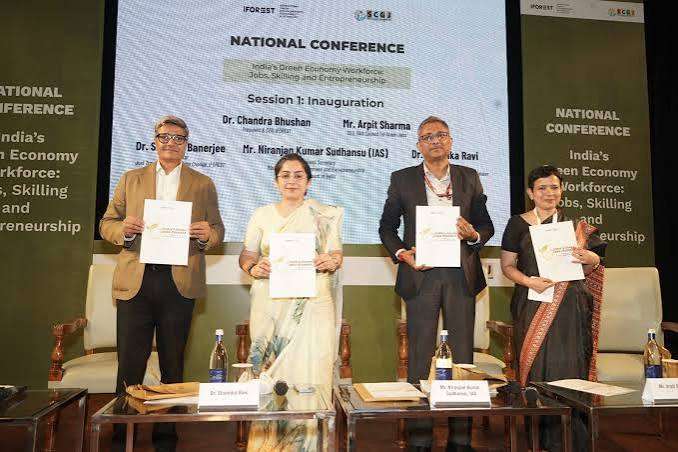
The report — “India’s Green Jobs Moment: Pathways to Build a Future-Ready Workforce” — was released on Wednesday by iFOREST, a Delhi-based environmental research organisation.
During the launch of the report, Shamika Ravi, member of the Economic Advisory Council to the Prime Minister, said, “Today, the biggest constraint to the growth of every business is finding skilled manpower. We have degrees, but we do not have skills, and the market is now saying it will reward only skill.”
The analysis highlights that technical education in India’s labour market is a key gap — only about 4.5 per cent of the working-age population reported having technical education in 2025. The situation is worse for women — only 3.1 per cent of working-age women had technical education in 2025.
“This gap merits attention because recognised certification, unlike informal or experience-based learning, makes workers’ competencies visible and portable across employers and sectors. That matters increasingly as demand shifts towards new occupations,” the report said.
Moreover, dedicated green skilling remains small in scale. That is because sector-specific programmes, such as the National Green Hydrogen Mission and the Jal Urja Mitra Skill Development Programme (small hydro), have trained about 81,000 technicians so far, with solar accounting for a large majority.
This is an issue because direct employment in key green sectors (renewable energy, green hydrogen, electric vehicle manufacturing and charging infrastructure, and formal recycling) is projected to reach about 35 lakh by 2030 and more than 54 lakh by 2035, up from about 14.5 lakh in 2026, according to the report.
“This implies about 4.5 lakh additional jobs a year, while dedicated green programmes have trained about 81,000 technicians in total so far. Even if only a modest share requires specialised training, demand will exceed current output several times over, besides the reskilling needs of existing workers,” the report said.
Public financing is yet another problem. The Union Budget 2026-27 allocated Rs 9,540.5 crore to major Ministry of Skill Development and Entrepreneurship (MSDE) schemes, up by about two-thirds from Rs 5,749.9 crore in 2025-26.
The increase, however, is concentrated in PM-SETU — aiming to transform industrial training institutes (ITIs) — the share of which has gone up from 52 per cent to 64 per cent.
For the Skill India programme, which funds the PMKVY — the flagship scheme for skill certification — the National Apprenticeship Promotion Scheme (NAPS) and the Jan Shikshan Sansthan, the allocation has increased by only about 4 per cent.
“India has the institutions, the policy momentum and the demographic advantage to build a trained, future-ready green workforce at scale. The priority now is to connect these capabilities to emerging demand,” Chandra Bhushan, the president and CEO of iFOREST, said in a statement.