



Bharat has witnessed protests, mass movements and fierce political agitations throughout its democratic journey. That is neither unusual nor undemocratic. The right to dissent, assemble and protest is intrinsic to a vibrant democracy. But there is a fundamental line that cannot be crossed: the street cannot become a substitute for Parliament, and agitation cannot become an alternative to constitutional governance.
This distinction assumes particular importance at a time when the politics of the Congress-led Opposition increasingly appears to be moving from Sansad to Sadak—from debate and persuasion inside constitutional institutions to pressure politics outside them.
If the emerging political argument is indeed that decisions can no longer be secured through parliamentary debate, electoral persuasion and judicial remedies, but must instead be forced through street mobilisation, then it is not merely an aggressive opposition strategy. It raises a much larger question about the very meaning of constitutional democracy.
Bharat is not unfamiliar with dissent. The freedom movement itself witnessed methods of civil disobedience, mass mobilisation and resistance to an alien government. Bhagat Singh engaged deeply with revolutionary and anarchist thought, while Mahatma Gandhi’s ideas of Swaraj and decentralisation carried a powerful critique of concentrated authority.
But independent Bharat made a conscious choice. It did not replace colonial rule with permanent street rule. It created a Constitution, an elected Parliament, an independent judiciary, constitutional bodies and periodic elections through which political power would be won, exercised and, when necessary, peacefully transferred.
Dr B.R. Ambedkar’s warning about the “grammar of anarchy” remains remarkably relevant. He cautioned that once constitutional methods were available, resorting to extra-constitutional methods could become the grammar of anarchy. His warning was not against protest itself. It was against making agitation a substitute for institutions.
That distinction appears to be getting blurred today.
Farm laws were opposed through prolonged agitation. The CAA and NRC debates produced enormous street mobilisation. Now the Election Commission’s Special Intensive Revision is being projected by sections of the Opposition as another battlefield. Opposition to a government decision is legitimate. Questioning an Election Commission exercise is legitimate. Taking the matter to court is legitimate. Raising the issue in Parliament is legitimate.
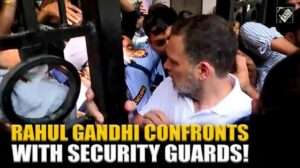
But attempting to delegitimise every constitutional process unless it conforms to one’s political preference is something altogether different.
There is another uncomfortable reality for the Congress and its allies: elections are ultimately decided by voters, not agitators. If an Opposition believes that a policy is wrong, its strongest weapon is not an indefinite blockade of roads or disruption of institutions. It is the ability to convince the electorate that an alternative deserves power. Recent results in Tripura and Assam underline this democratic reality. In Tripura’s Village Committee elections, Congress and its allies, including the Left parties that were once politically dominant, were decisively rejected by the electorate, with the ruling NDA alliance winning 4,320 of the 4,597 seats.
Similarly, in Assam’s Silchar Municipal Corporation polls, the BJP is set for a sweeping victory, maintaining strong leads across almost all of the 40 contested wards. The BJP had already won two wards unopposed before counting began. The message from both states is unmistakable: political legitimacy ultimately comes from the ballot box, not from the ability to mobilise crowds on the streets.
The proposition that political decisions should increasingly be made on the Sadak rather than through Sansad therefore deserves serious scrutiny. Streets can express anger. They can draw attention to grievances. They can compel governments to listen. But they cannot legislate. They cannot frame constitutional amendments. They cannot pass budgets. They cannot conduct a vote of confidence. They cannot replace the Election Commission, Parliament or the judiciary. In a constitutional democracy, protest has a legitimate place—but it cannot become a parallel source of sovereign authority.
And this is where Rahul Gandhi and the Congress need introspection. After three consecutive Lok Sabha defeats since 2014, the answer cannot simply be to intensify confrontation with institutions or to portray every constitutional process as suspect. Nor can a political relaunch depend on permanently keeping supporters mobilised on the streets.
A democracy certainly needs a strong Opposition. In fact, Bharat needs an Opposition capable of questioning the government intelligently, exposing genuine failures and presenting credible alternatives. But an Opposition becomes institutionally dangerous when defeating the government politically is replaced by weakening the institutions through which governments are elected and governed.
The Constitution—not Parliament alone, not the government, not the Opposition and certainly not the street—is supreme. Parliament derives its authority from the Constitution. So does the executive. So do constitutional bodies. The judiciary too operates within the constitutional framework.
That is precisely why democratic disagreement must ultimately return to constitutional pathways.
Bharat today aspires to be a $5-trillion-plus economy, a major defence exporter and a consequential global power. Such a nation cannot afford a political culture in which every disagreement becomes a street confrontation and every institutional decision is accepted only when politically convenient.
Protest, yes. Dissent, absolutely. Accountability, unquestionably. But anarchy, never.
The street may influence Parliament. It may awaken public opinion. It may force a government to reconsider.
But in a constitutional democracy, the street cannot become Parliament.


