



The Aichi-Nagoya Asian Games were expected to be another opportunity for Bharat to consolidate its emergence as a serious sporting power in Asia. Instead, the campaign has raised uncomfortable questions. Whatever the final tally when the Games conclude on Sunday, the contrast with Hangzhou 2023 is too stark to be brushed aside as a statistical fluctuation.
At Hangzhou, Bharat produced its best-ever Asian Games performance—107 medals comprising 28 gold, 38 silver and 40 bronze—and finished fourth. This time, the country entered the final phase with 67 medals, including 11 gold, 23 silver and 33 bronze. Cricket, hockey and a few other events could still add to the tally, but a finish in the region of 70–72 medals would represent a substantial fall from Hangzhou.
That should concern the Sports Ministry, national federations and, more importantly, the sporting ecosystem as a whole.
To be fair, the comparison is not entirely like-for-like. The Aichi-Nagoya programme has dropped or altered several events in which Bharat had traditionally collected medals. That inevitably affects the overall numbers. Shooting, athletics, squash, archery and some team events contributed significantly to the 2023 haul, and the absence or alteration of medal opportunities in certain disciplines has made repeating 107 medals considerably more difficult.
But that explains only part of the story. It cannot explain everything.
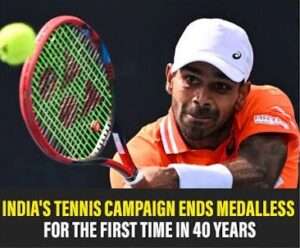
The more worrying issue is the conversion of opportunity into medals—particularly gold. A country aspiring to become a sporting power cannot remain excessively dependent on a handful of established stars or on disciplines that happen to offer a large number of medals in a particular edition of a multi-sport event.
The Hangzhou performance created expectations of a deeper sporting bench. Aichi-Nagoya has exposed how fragile that depth may still be.
Several reigning champions and medal winners have failed to reproduce their previous performances. In disciplines where Bharat had demonstrated considerable promise, the progression from promising youngster to consistent international medal contender appears uneven. The problem is not necessarily a shortage of talent. It is whether the system is capable of identifying, developing, protecting and continuously upgrading that talent.
This is where the real questions begin.
Bharat has invested substantially more in sport over the past decade, and the results in Olympics, Asian Games and other international competitions have undeniably improved. Yet the sporting pyramid remains narrower than it should be. Grassroots identification, school and university competition, coaching quality, sports science, nutrition, injury management and competition exposure need to function as one continuous pipeline rather than as disconnected schemes.
There is another uncomfortable reality. Too often, sporting systems become event-driven—intense preparation before an Olympics or Asian Games, followed by a gradual loss of momentum. A genuinely successful sporting nation needs an assembly line of talent, not an occasional assembly of champions.
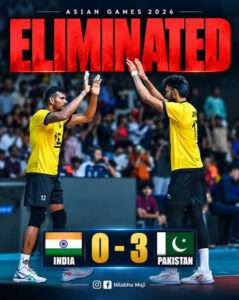
The federations too must introspect. Selection disputes, administrative battles, inadequate domestic competition and inconsistent development structures can consume attention that should instead be directed towards athletes. A medal at a major Games is the visible end-product of years of invisible preparation. If that preparation is weak, no amount of last-minute funding can compensate.
The objective now should not be to explain away the reduced tally. Nor should a single disappointing Games erase the genuine progress made by Bharat in recent years.
The right response is to treat Aichi-Nagoya as a warning.
If Bharat wants to move beyond being a country capable of producing occasional champions and become a sustained sporting power, the benchmark cannot simply be the number of medals won at one Games. The benchmark must be whether every successive generation is producing more finalists, more podium contenders and more champions across more disciplines.
Hangzhou demonstrated what Bharat can achieve when several sporting streams come together. Aichi-Nagoya, whatever the final tally, has reminded us how much more needs to be done before that performance becomes the norm rather than the high-water mark.
The Sports Ministry and federations should not wait for the next Asian Games to begin that introspection. The next medal tally is being built today.

