



There is a difference between exposing genuine weaknesses in Bharat’s education system and constructing an exaggerated narrative around them. The latest portrayal by The Economist, with its description of Bharat’s education system as a “misery machine” and its suggestion that young people are being driven towards rebellion, appears to cross that line.
The problem is not that Bharat’s education system should be above criticism. It should not. Learning outcomes remain uneven, coaching has become a parallel industry, degrees do not always translate into appropriate employment, and examination systems require greater transparency and public confidence. These are real challenges. They deserve serious scrutiny and urgent reform.
But when a vast and extraordinarily complex education system is reduced to a phrase such as “misery machine”, the question must be asked: is this analysis—or narrative construction?
The mirror needs to be shown.
For decades, Bharat inherited an education architecture shaped substantially by colonial priorities. The challenge before the country today is not merely to expand that inherited system, but to build an education model that combines modern science and technology with its own civilisational knowledge, languages, culture and intellectual traditions.
That is precisely the direction articulated by the National Education Policy 2020. The policy explicitly speaks of Bharat’s rich knowledge traditions, Bharatiya languages, multidisciplinary learning and the need to connect education with the country’s cultural and social realities. It also stresses equity, inclusion, critical thinking, scientific temper and employability.
One may disagree with aspects of its implementation. One may question its pace or execution. But to portray the attempt itself as evidence of educational decline would be intellectually lazy.
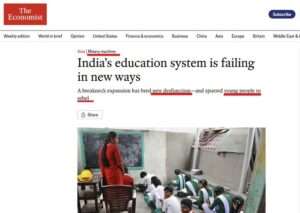
The numbers tell another part of the story.
Higher-education enrolment increased from 3.42 crore in 2014–15 to nearly 4.46 crore in 2022–23. Female enrolment rose substantially during the same period, while enrolment among Scheduled Castes and Scheduled Tribes also recorded significant increases. The number of colleges registered with AISHE rose from 39,050 in 2017–18 to 45,473 in 2021–22.
These figures do not prove that everything is working. They prove something equally important: Bharat has been undertaking an enormous expansion of educational access.
And expansion on this scale inevitably produces contradictions.
More students mean greater pressure on classrooms. More graduates expose the mismatch between degrees and jobs. Competitive examinations create demand for coaching. Rapid expansion produces uneven quality. Infrastructure gaps become more visible precisely because more young people are entering the system.
Those are problems of a rapidly expanding system—not necessarily evidence of a civilisation in educational collapse.
This is where framing matters.
Show a leaking school roof, a crowded classroom, an examination irregularity or a coaching-centre tragedy and the image is powerful. Amplify it through political controversy and television debates, and it becomes a national narrative. Package it for an international audience and suddenly an individual failure can appear to represent an entire country’s education system.
That is how narratives acquire a life of their own.
The danger is that genuine reform issues then disappear behind a sweeping verdict.
Bharat does not need foreign media to pretend that its educational problems do not exist. Nor should Bharat dismiss uncomfortable criticism merely because it comes from abroad. What it should demand is proportion, context and intellectual honesty.
If coaching dependence is a problem, examine why it exists. If examinations lack credibility, reform them. If graduates face employment challenges, redesign curricula and strengthen industry linkages. If school learning outcomes remain inadequate, invest in teachers and foundational learning.
But do not convert every weakness into a civilisational indictment.
The Economist and other Western commentators are perfectly entitled to scrutinise Bharat. Bharat, equally, is entitled to scrutinise the assumptions behind that scrutiny.
The real story is neither a miracle nor a “misery machine”. It is a huge, diverse education system undergoing a difficult transition—expanding access, attempting structural reform and simultaneously confronting old and new problems.
That story may be less dramatic than a sensational headline.
But it is closer to reality.
And perhaps that is precisely why the mirror needs to be held up.

