


There is something wonderfully democratic about entitlement. It does not care whether you are sitting in the White House or waiting outside the gates of 7, Lok Kalyan Marg.
It can make a person believe that the world’s highest honours – or the country’s highest office – are simply overdue.
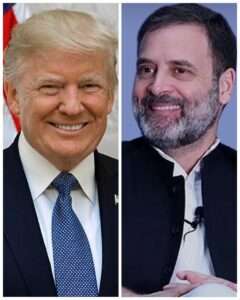
Donald Trump appears convinced that the Nobel Peace Prize is one such overdue honour. And in Bharat, Rahul Gandhi’s political journey sometimes gives the impression that the PM’s chair is another.
‘I deserved it more than anybody’
Trump has never been particularly shy about his disappointment at not receiving the Nobel Peace Prize. In July, he went considerably further, saying he should have won it ‘more than anybody’ and claiming that he had settled eight wars.
Now Canadian Prime Minister Mark Carney has become the subject of Nobel speculation after building an international profile by standing up to Trump over tariffs, sovereignty and Canada’s place in the world.
There is no evidence that Carney is actually on the Nobel Committee’s shortlist. The current buzz is largely speculation from prediction markets and admirers. But the irony is delicious: the man who believes he deserves the prize is watching another leader attract attention precisely for resisting him. We can almost imagine the Trumpian question: ‘But what about me?’
And then there is our hereditary claimant
India has a similar, though constitutionally rather more complicated, version of the entitlement syndrome.
Rahul Gandhi is the latest political heir of a family that produced three prime ministers – Jawaharlal Nehru, Indira Gandhi and Rajiv Gandhi.
That is an extraordinary political legacy. But it is a legacy, not a letter of appointment. India is a republic, not the Kingdom of Nehru-Gandhi.
The PM’s chair is not supposed to work like an ancestral property: Three generations have occupied it, so kindly keep it ready for the fourth.
Of course, Rahul Gandhi has every constitutional right to aspire to the office. His supporters have every right to campaign for him. Indeed, Telangana Chief Minister A Revanth Reddy has recently called for Rahul Gandhi to become prime minister.
But wanting the job, campaigning for the job and being democratically entrusted with the job are three different things. That distinction seems to get blurred rather easily in dynastic politics.
When Trump supplies the ammunition
The more troubling question is not Rahul Gandhi’s family background. It is what he says about the country he aspires to lead.
In July 2025, Trump described Bharat and Russia as having ‘dead economies’ during a tariff confrontation with India.
Rahul Gandhi did not merely criticise the government’s economic policies. He endorsed Trump’s description.
‘Yes, he is right,’ he said, adding that ‘everybody knows’ the Indian economy is dead and that he was glad Trump had ‘stated a fact’.
There is nothing wrong with an Opposition leader demolishing the government’s economic record. That is precisely what it is supposed to do.
But there is a difference between saying ‘the government has mishandled the economy’ and agreeing with a foreign leader’s sweeping declaration that India’s economy is dead. Especially when the speaker is positioning himself as a potential prime minister.
Imagine someone applying for the captaincy of a cricket team while repeatedly announcing that the team is finished – and borrowing the opposing captain’s words to make the point.
The maturity test
A prime minister does not merely inherit a surname, a party organisation or a political constituency. The office demands judgement about when to attack one’s government and when one’s country’s national interest must take precedence.
Rahul Gandhi is perfectly entitled to oppose Narendra Modi. He is perfectly entitled to challenge every economic policy of the government. He is perfectly entitled to seek the prime minister’s office.
But the country is equally entitled to ask whether someone who so readily amplifies a foreign leader’s disparaging description of Bharat’s economy demonstrates the political maturity expected of a future prime minister.
And that brings us back to Trump. Both men appear to have an uncomplicated relationship with entitlement.
One seems to think: I have settled enough wars, therefore give me the Nobel. The other comes from a family that gave Bharat three prime ministers, so perhaps the next turn should naturally come his way.
There is, however, one small problem with both propositions. The Nobel Committee does not work for Trump. And Bharat does not work for the Gandhi family. The first prize is decided by a committee. The second is decided by voters.
Neither is a family heirloom. Neither can be claimed merely because one believes it is one’s turn. Democracy, rather inconveniently, still insists on earning the prize.

