



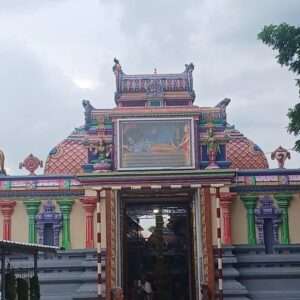
Sri Thrinethra Dasa Bhuja Veera Anjaneyar Temple is situated at Ananthamangalam village near Tirukkadaiyur in Mayiladuthurai district, Tamil Nadu. The temple is associated with the Sri Rajagopalaswamy Temple and is one of the rare shrines where Lord Hanuman is worshipped in the extraordinary form of three eyes and ten arms. The quiet village setting and the unique form of Anjaneyar make this a fascinating and lesser-known Hanuman shrine of Tamil Nadu.
The temple is traditionally associated with the Vijayanagara period. Sources describing the shrine state that a Vijayanagara chieftain who governed the region built a temple for this unique form of Hanuman. The larger Rajagopalaswamy temple complex is also traditionally regarded as several centuries old.
The principal deity is Sri Thrinethra Dasa Bhuja Veera Anjaneyar — Hanuman with three eyes and ten arms. His five right hands hold the Sudarshana Chakra, Trishula, Ankusha, arrow and Maththaksham, while the five left hands hold the Shankha, Padma, Pasha, Kodanda bow and Navaneetha. A third eye adorns his forehead and a quiver of arrows is seen behind him. The idol is described as a Panchaloha image and is about four and a half feet tall.
The Anjaneyar shrine stands in the peaceful surroundings of Ananthamangalam, close to the Sri Rajagopalaswamy Temple. The shrine faces north, while the main Rajagopalaswamy Temple faces east. In front of the Anjaneyar shrine is the sacred temple tank known as Hanumath Theertham. Within the Rajagopalaswamy temple complex is another rare form of Hanuman, the four-armed Trinethra Anjaneyar, making the sacred complex especially unusual.
The temple’s tradition is closely connected with the Vijayanagara period and with the worship of Hanuman among the rulers and commanders of that era. The shrine’s importance, however, rests principally on its extraordinary iconography. Unlike the familiar standing or seated forms of Anjaneyar, the deity here is portrayed with three eyes and ten arms, bearing the weapons and attributes traditionally associated with several gods.
The temple continues to be administered as part of the religious heritage of the region, and special worship is performed on important days, particularly Amavasya and Saturdays.
According to the Sthala Purana of Ananthamangalam, the story begins after the great war in Lanka.
Sri Rama had defeated Ravana and rescued Sita. He was returning to Ayodhya with Sita, Lakshmana, and Hanuman, eager to reach Ayodhya in time for his return. On the way, they stayed at the hermitage of Sage Bharadwaja.
At that time, Sage Narada came to meet Sri Rama. Narada told Rama that although Ravana had been defeated, two powerful asuras named Raktha Bindu and Raktha Rakshasa were still performing severe penance beneath the sea. If their penance was completed, they would acquire extraordinary powers and could become a threat to the world.
Sri Rama was deeply concerned. He could not delay his journey to Ayodhya because Bharata had vowed to give up his life if Rama did not return within the promised period. Lakshmana could not be sent either, as he had to accompany Rama.
Hanuman then came forward and offered to undertake the task.
The gods, pleased with Hanuman’s devotion and courage, blessed him with their divine weapons. Lord Vishnu gave him the Shankha and Sudarshana Chakra. Lord Brahma gave him the Ankusha and other divine weapons. Goddess Lakshmi gave him the Padma, while other deities bestowed their own weapons and powers. Sri Rama gave Hanuman his Kodanda bow and arrows along with Navaneetha.
Finally, Lord Shiva appeared and bestowed upon Hanuman his third eye and Trishula. With these divine weapons and the blessings of the gods, Hanuman assumed a magnificent and formidable form with three eyes and ten arms.
In this extraordinary form, he confronted the two asuras and destroyed them. Having accomplished the task given to him by Rama, Hanuman continued his journey towards Ayodhya.
According to the temple tradition, when Hanuman reached this beautiful place, he was filled with joy at having successfully completed his Lord’s command. He stayed here in a state of Ananda, or divine happiness.
Because Hanuman experienced this great joy at the place, it came to be known as Anandamangalam. Over time, the name is said to have evolved into Ananthamangalam.
The unique form of Hanuman seen here is therefore remembered as the form he assumed after receiving the divine weapons and the third eye of Lord Shiva. His three eyes represent his extraordinary divine power, while his ten arms hold the weapons bestowed upon him by the gods.
This beautiful legend gives Ananthamangalam a special connection with the Ramayana and explains why the temple preserves one of the most unusual forms of Hanuman worship in Tamil Nadu.
Amavasya is an important occasion at the temple, when special Thirumanjanam and worship are performed for Anjaneyar. Saturdays are also considered especially significant, with devotees offering traditional prayers and Vada Malai. Special observances are held on other auspicious days associated with Hanuman worship.


