



The latest American tariff threat may sound dramatic. It should not, however, be mistaken for an economic apocalypse for Bharat. The US House of Representatives has now passed legislation that could empower President Donald Trump to impose tariffs of up to 100 per cent on countries purchasing Russian oil, including Bharat and China. The measure still requires the next steps before such a tariff can actually be imposed. New Delhi has already made its position clear: its energy security and economic interests cannot be compromised. That is precisely the perspective in which Bharatiya citizens should view the issue. A 100 per cent tariff would undoubtedly hurt exporters selling into the American market. Textiles, engineering goods, gems and jewellery, chemicals and other export-oriented sectors could face severe competitive pressure if such a measure were actually implemented. Nor should anyone pretend that Bharat would be completely insulated from the consequences. But there is a world of difference between economic pain and economic surrender. The temptation to press the panic button must therefore be resisted. Bharat is not an economy whose entire growth trajectory depends upon Washington’s goodwill. Its market of more than 1.4 billion people, expanding domestic consumption, services economy, manufacturing ambitions, infrastructure investment and increasingly diversified global partnerships provide economic depth that did not exist a decade ago. The International Monetary Fund, as recently as September 15, described Bharat as a key driver of global growth and the world’s fastest-growing major economy, citing its strong fundamentals and policy framework. That does not mean tariffs are irrelevant. It means they must be put in perspective. Consider energy. Bharat imports roughly 88 per cent of its crude-oil requirement, according to government data. That dependence makes affordable and reliable energy a national economic necessity, not a bargaining chip to be surrendered to another country’s geopolitical calculations. At the quoted crude price of $131.19 a barrel, one barrel contains roughly 159 litres. Depending on the prevailing rupee-dollar exchange rate, freight, insurance and other landing expenses, the crude component alone can translate into a substantial rupee cost per litre. Refining, transportation, marketing and taxation then determine the final pump price.
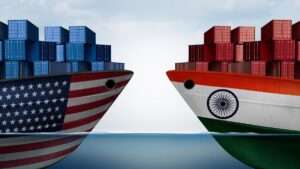
The important point is that the crude price is only one component of what Bharatiya consumers ultimately pay. Indeed, PPAC put Delhi petrol at ₹102.12 and diesel at ₹95.20 on September 16. So why should Bharat be expected to abandon a commercially advantageous source of energy simply because Washington disapproves of it? The answer cannot be found in panic. Nor does this mean Bharat should pick a fight with America. Quite the contrary. Negotiations should continue. Trade should continue. Strategic cooperation should continue. American investment and technology remain important to Bharat, just as Bharat’s enormous consumer market, skilled workforce and expanding economy matter to American companies. But partnership cannot mean subordination. There is another fact worth remembering. Washington itself had only recently announced a Bharat-US interim trade framework under which the US reciprocal tariff on Bharat goods was set at 18 per cent, while both sides committed themselves to broader trade negotiations. The possibility of a sudden escalation to 100 per cent therefore demonstrates how quickly trade policy can become an instrument of geopolitical pressure. Bharat’s response must consequently be neither belligerence nor submission—but economic resilience. If America chooses to make Bharatiya goods more expensive for American consumers, American businesses and consumers will also have to consider alternative suppliers and higher costs. Trade is not a one-way street. Bharat should diversify markets, accelerate domestic manufacturing, strengthen consumption, expand exports to Europe, Africa, West Asia and the Indo-Pacific, deepen supply-chain partnerships and continue reducing vulnerabilities in energy and critical imports. That is how a major economy responds to pressure. Not by trembling. Not by surrendering its national interest. And certainly not by allowing another country’s tariff policy to dictate the trajectory of 1.4 billion people’s economic aspirations. Trump may possess the power to impose tariffs. He does not possess the power to determine Bharat’s destiny. Bharat’s growth story is larger than any single American tariff.

