



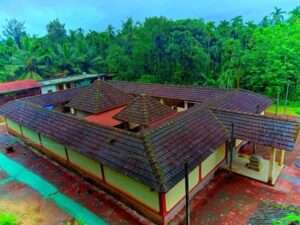
Sri Mahavishnu Temple at Nidvala in Aivatoklu village of Sullia Taluk, Dakshina Kannada, is an ancient and revered Vaishnava shrine dedicated to Lord Mahavishnu in his Chaturbhuja, or four-armed, form. The temple is closely associated with the history and traditions of Tulunadu and is believed to have been established around the 14th–15th century under the patronage of the Enmuru Ballala kings.
The temple is believed to have a history of around 600 years. Its sacred tradition, however, is associated with an even earlier period. According to temple tradition, the Mahavishnu idol is connected with the 12th-century Hoysala king Bittideva, better known as Vishnuvardhana.
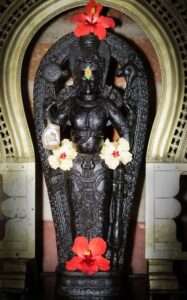
The presiding deity is Sri Mahavishnu in Chaturbhuja form. The Lord is worshipped as the protector and sustainer of devotees, and prayers are offered for prosperity, good health, family welfare and the removal of obstacles.
The temple follows the traditional architectural and religious traditions of Tulunadu. The original temple structure deteriorated over the centuries and underwent restoration at different periods. The temple is now undergoing a major reconstruction, with traditional rituals and the sacred character of the shrine being preserved. An important feature of the present reconstruction is the planned west-facing orientation of the deity, based on guidance received through an Ashtamangala Prashna.
The history of Nidvala Mahavishnu Temple is closely connected with the Enmuru Ballala rulers. According to temple tradition, the sacred Mahavishnu idol was commissioned during the reign of Hoysala King Bittideva, or Vishnuvardhana, and was later brought to Nidvala and consecrated by the Ballala rulers. The shrine subsequently became an important place of worship in the region.
The sacred story of Nidvala Mahavishnu Temple is closely connected with Koti and Chennaya, the legendary twin heroes of Tulunadu. According to local tradition, the brothers were devoted to Sri Mahavishnu and would seek the Lord’s blessings before undertaking important journeys and activities. The temple tradition further holds that they received the Lord’s prasada before setting out on their final journey.
Over the years, the original temple structure gradually deteriorated and eventually reached a condition described as Ajirnavasthe. As a result, the sacred idol was temporarily moved to nearby Chukkadi. However, devotees continued to believe that Nidvala was the Lord’s original and rightful abode.
In 1929, an Ashtamangala Prashna was conducted to determine the wishes of the deity and the future of the temple. According to temple tradition, the consultation indicated that Sri Mahavishnu should be brought back and re-established at Nidvala. It was believed that restoring the deity to the original sacred place was necessary for the welfare of the region. Following this, the temple was renovated and the deity was once again established at Nidvala.
In recent times, another Ashtamangala Prashna was conducted before undertaking the present reconstruction. One of the important directions was that the deity should be re-consecrated facing west. This westward orientation is traditionally associated with the Ballala king’s palace and the sacred traditions connected with Koti and Chennaya.
The temple observes traditional worship and special ceremonies dedicated to Sri Mahavishnu. The present reconstruction is also associated with Brahmakalashotsava and the re-consecration of the deity, with devotees and the local community

