



Hindi Diwas, celebrated every year on September 14th, is an important occasion linked to our constitutional history, linguistic diversity, and cultural memory. On September 14th, 1949, the Constituent Assembly adopted Hindi, written in the Devanagari script, as the official language of the Union. Following the enactment of the Constitution, this decision was incorporated into Article 343. Hindi Diwas is celebrated on September 14th to commemorate this historic event.
But Hindi Diwas shouldn’t simply be about giving speeches on the importance of Hindi, reciting poems, and completing formalities by organizing Hindi weeks or fortnights in government offices. The real question is how much Hindi has become the language of our lives, education, administration, justice, science, technology, and employment. If Hindi’s recognition is limited to ceremonies and announcements, then Hindi Diwas offers us more of an opportunity for introspection than celebration.
First, it is important to clearly understand that Hindi is not the national language of India, but rather the official language of the Union. According to Article 343 of the Constitution, the official language of the Union is Hindi, with its script in Devanagari. In a multilingual country like India, this distinction is not merely a matter of constitutional terminology but also a question of our democratic sensibility. India’s identity is shaped by its linguistic diversity. Tamil, Telugu, Kannada, Malayalam, Bengali, Assamese, Marathi, Gujarati, Punjabi, Oriya, Urdu, Kashmiri, Maithili, and many other Indian languages express the memories, experiences, and cultural heritage of society. Therefore, Hindi should develop not in opposition to these languages, but through dialogue and cooperation with them.
While Hindi has the opportunity to become a language of communication between India’s diverse regions, it also carries with it a responsibility. Hindi should be a bridge of communication, not a medium of dominance. The expansion of any language is natural and acceptable only when it is imbued with respect, sensitivity, and a sense of inclusion.
On Hindi Diwas, schools, universities, and government institutions host programs such as essay writing, speeches, debates, poetry recitations, quizzes, and prize distribution. These events have their own importance and generate enthusiasm for the language, but the true development of Hindi begins after these events are over. It is time to elevate Hindi from a language of celebrations to a language of experimentation and knowledge.
Even today, the influence of English is clearly visible on government websites, research materials, and many official documents. Hindi-medium students in higher education face a shortage of quality textbooks and innovative research materials. While Hindi content is available in fields such as science, medicine, law, management, and information technology, its quantity, quality, and up-to-dateness need to be further strengthened.
Translation alone will not be enough to make Hindi the language of knowledge. Original writing, modern vocabulary, the involvement of subject experts, and quality editing are also essential. A difficult and mechanical translation of an English book does not bring students closer to Hindi. Knowledge will only become accessible to the public when its language is simple, natural, and relevant to the subject.
The connection between language and education is profound. A child has a better opportunity to understand complex subjects in the language they think and experience. Despite this, the question of language education in India is often linked to concerns about social status and employment. Knowledge of English is crucial in today’s global and employment-oriented environment, but this should not mean that education in Hindi or other Indian languages is considered inferior.
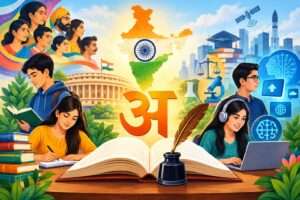
Hindi-medium students often face a dual challenge. On the one hand, they lack access to adequate and quality study materials in their own language, and on the other, they face additional difficulties in higher education and competitive examinations due to English vocabulary. This cannot be addressed by eliminating any one language, but by developing a robust multilingual education system. Schools and universities should develop high-quality content in Hindi on science, social sciences, law, economics, and technology. Students should also have ample opportunities to conduct research, create digital content, engage in journalism, and express new ideas in Hindi. Hindi must become not just a language of examinations, but a language of thought and innovation.
The digital age has also opened up new possibilities for Hindi. With the expansion of the internet and smartphones, Hindi content has grown rapidly on news portals, video platforms, podcasts, blogs, and social media. Millions of people read news, watch entertainment content, and use digital services in Hindi. This represents a major opportunity for Hindi. However, digital Hindi also faces challenges. The trend of writing Hindi in Roman script is increasing. This enables quick communication, but there is a risk of weakening the habit of Devanagari writing. The spread of linguistic errors, incomplete information, and sensational expressions on social media is also a matter of concern.
In the current era of artificial intelligence, making Hindi technologically capable has become even more essential. Better translation software, speech recognition systems, digital dictionaries, e-libraries, and online courses must be developed in Hindi. Without investment in language technology, Hindi may remain merely a consumer of content in the digital future. Institutional efforts are necessary to make it a language of creation, knowledge, and innovation.
The future of Hindi will be determined more by the preferences and usage of young people than by government mandates. Young people will only read and write in Hindi when they see ample opportunities for modern subjects, employment, and expression. Therefore, instead of limiting Hindi to past glories, it must become a vibrant language of the present.
Hindi literature, journalism, and cinema must address contemporary issues such as unemployment, the climate crisis, gender inequality, migration, digital privacy, mental health, and changing family relationships. The language, experiences, and anxieties of the new generation must be reflected in various forms of expression. A language that fails to reflect the problems of its time may gradually become formalized and distanced from life.
Today, Hindi offers numerous opportunities in blogging, freelance journalism, screenwriting, advertising, translation, podcasts, and online education. Institutional support for these areas can connect Hindi with the creative economy and employment.
Concrete policy initiatives are also necessary for the development of Hindi. The use of simple and clear Hindi should be encouraged in government services and judicial processes. Quality content for higher education and technical subjects should be prepared in Hindi. Translators, editors, and subject matter experts should receive better opportunities and respect. The study and use of all Indian languages, including Hindi, should be encouraged. Government websites and public services should be made multilingual and user-friendly, while developing simple, modern, and standardized Hindi for digital platforms. Fundamental research, journalism, and literary experiments in Hindi also need financial and institutional support.
In 2026, Hindi Day and the Sixth All India Official Language Conference are being held on September 14. Instead of limiting such an occasion to discussions of administrative use, it should be used as a platform for reflection on the broader social, educational, and technological future of Hindi.
The biggest message of Hindi Diwas is that respect for a language is demonstrated not just by sentiment, but by behavior and institutional policies. Instead of pitting Hindi against English, it must be integrated with the support of Indian languages, modern knowledge, and digital technology. Hindi doesn’t need to be saved; it needs to evolve with the times. It will remain vibrant and effective only when it combines the clarity of science, the sensitivity of literature, the boldness of journalism, and the speed of technology.
Therefore, on Hindi Diwas, our resolution should not be merely to speak Hindi, but to think in Hindi, conduct research, create knowledge, and create new opportunities. Hindi should move beyond being a language of celebrations and become the language of life, education, knowledge, and employment—this will be the true significance of Hindi Diwas.

