



Mantras 1 and 2 talk of the quality required for a true seeker and the Guru. The six students were well established in the lower apara vidya, saguna upasana. They approached the Guru with faggots in hand for para vidya, nirguna upasana. A student should have the quality of questioning the knowledge at the intellectual level, devotion at the mental level, and service at the physical level.
The Guru tells the students to wait for a year and ask their questions. They had to practise austerity tapas at the mental level, celibacy (brahmacharya) at the physical level, and shraddha faith at the intellectual level.
Shraddha is the unflinching commitment till you reach the goal in spite of the obstacles that come your way. Hence, it is considered as an intellectual quality. The mind should not allow any distractions. It’s the intellect that can control and keep the mind in its place. Shraddha is directly proportionate to your intellectual strength. If your goal is to reach Brahman, then you will pursue it till your last breath, even if it is not achieved in this janma-birth.
Mantra 1.3
अथ कबन्धी कात्यायन उपेत्य पप्रच्छ ।
भगवन् कुते ह वा इमाः प्रजाः प्रजायन्त इति ॥ १.३॥
atha kabandhī kātyāyana upetya papraccha.
bhagavan kute ha vā imāḥ prajāḥ prajāyanta iti .. 1.3..
Then, Katyayana Kabandhi approached (him) and asked: “Revered Master, whence are these creatures born?”
The students had waited for one year and tuned in their receptacles through the three qualities of tapas, brahmacharya and shraddha. The student Katyayana Kabandhi asks the master the cause for the pluralistic phenomenon that he sees in the world.
Q: Who can ask the cause for creation?
A: A person who is in the midst and caught up in the experience cannot observe the experience. Only when you are objective and become the observer, you are not caught up in the happenings of life. Only a person who steps back can check the cause of happenings around him. So, to ask the question for the pluralistic phenomenon, you must not be caught up. You can examine and question the very cause of it. One who is caught up in the creation cannot ask the very source of creation.
Mantra 1.4
तस्मै स होवाच प्रजाकामो वै प्रजापतिः स तपोऽतप्यत
स तपस्तप्त्वा स मिथुनमुत्पादयते । रयिं च प्राणं
चेत्येतौ मे बहुधा प्रजाः करिष्यत इति ॥ १.४॥
tasmai sa hovāca prajākāmo vai prajāpatiḥ sa tapo’tapyata
sa tapastaptvā sa mithunamutpādayate . rayiṃ ca prāṇaṃ
cetyetau me bahudhā prajāḥ kariṣyata iti .. 1.4..
To him he said, “Prajapati – the Lord of creatures desirous of progeny performed penance and he created a pair — matter and prana, that they would produce creatures in many.
Prajapati is the creator and he created a pair – matter and prana (energy). In general, we say God created the world. A true enquirer, a Vedantin will not be satisfied with mere theory that a creator did penance and created the world. God is an unknown factor.
Vedantic philosophy does not accept that the world started at a particular time. Everything in the world is measured by time, space, and causation. Time is eternal, space is all-pervading, and causation is infinite. If we say the world started at a particular time, there is a fallacy. We are creating the world before its existence. Time is measured between two intervals or experiences. Time is born only at the second experience. Therefore, the unit of time is called a second. When we say the world is born at a particular time, we are contradicting the very measuring tool of the world i.e., time.
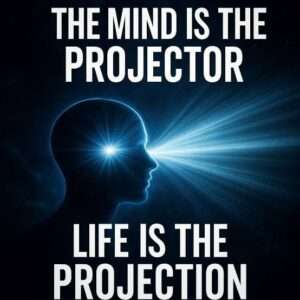
The philosophical standpoint for creation is that the world exists only when the mind is projecting and backing it. Waking and dream worlds exist only because of the mind. In deep sleep, the mind folds back into nothingness, so there is no mind and no world. When the mind wakes up, the world of plurality also wakes up.
Prabhava is creation, and Pralaya is dissolution. Subjective pralaya is when the mind has gone into a deep-sleep state, and when the mind wakes up, it is the subjective prabhava. Micro level refers to the individual. The individual’s world appears only when the mind backs it. The world does not exist in deep-sleep when the mind is not available.

When a criminal or a saint goes to sleep, both wake up as a criminal and a saint, respectively. When the criminal when he goes to sleep, he wakes up compelled by the desires with which he slept. It is because of his vasanas and desires with which he slept that he wakes up as the same person. A saint, having slept with noble and divine thoughts, his vasanas make him wake up as a saint. So the world of saint or criminal is defined by the thoughts they entertain. The world is defined purely by your thoughts. So, the masters say, ‘The world is a projection of your mind.’ I appear as a criminal or saint because of the thoughts one’s mind projects. It is what you perceive the world to be.
The world we are living is nothing but a picture created by the mind with the reel of thoughts. Each one of us experiences different worlds because of the different reels that are running in each one’s mind like a projector. When we change the reel, the projection changes. The mind is a continuous flow of thoughts that gives solidity to the world. We can draw a comparison of the mind to the projection in a theatre.
Elements in a projector are the screen, projector equipment, reel, bulb in the projector, and a person controlling the entire projection. All combined, there is a beautiful movie to watch.
The comparison is:
The reel is the mind and its thoughts.
The projector is the physical body, the individual.
The screen is the world of experiences. The screen is white before the projection of the reel. In the same way, the world is neutral.
The person controlling the projector equipment is the intellect.
The bulb, or the light in the projector, is Consciousness. Light has nothing to do with the reel that is being played on the screen. Without the light, there cannot be any projection. Similarly, the Consciousness has nothing to do with the thoughts of the mind. As the mind, so is the world. The mind, like a reel, continuously has thoughts.
The intellect must have complete mastery over the thoughts. The moment the intellect has no control, then your life is at the mercy of whatever the mind entertains.
The subjective creation and dissolution is the pralaya and prabhava of the world. The world begins when our mind wakes up and dissolves when we go into deep sleep, where the mind ends. At the absolute level, when the mind is annihilated, there is no more world.
When the reel changes, the movie changes. Similarly, change the thought and the entire world changes for you.
At the macro level, the cosmic creation of the world prabhava is known as Hiranyagarbha or Prajapati. Half the hemisphere is awake prabhava, and the other half is deep-sleep pralaya. So, the prabhava and pralaya is also happening at the macro level.

