



At the time of independence, India faced the challenge not only of securing permanent political independence but also of building a nation that maintained national unity despite the extraordinary diversity of languages, cultures, traditions, and regional identities. The provincial boundaries inherited from British rule served administrative convenience and colonial interests. They did not adequately take into account the linguistic and cultural identities of many regions. Therefore, after independence, the demand for reorganizing states on a linguistic basis naturally arose.
Although the national leadership was initially apprehensive about linguistic states, the tragedy of Partition was still fresh, and there was a fear that if states were formed on the basis of language, regional identities might overshadow national identity. However, the hallmark of Indian democracy has been that, rather than suppressing these aspirations, it chose to accommodate them constitutionally and democratically. Time has proven that respecting linguistic identity does not pose a threat to India’s unity, but rather can become a foundation for its strength.
The political acceptance of linguistic identity began to emerge even before independence. The Indian National Congress reorganized its provincial organizations along linguistic lines. This was intended to better communicate with the public in their language and socio-cultural contexts. However, after independence and Partition, circumstances changed. The national leadership was not in favor of any immediate major regional reorganization.
The Dhar Commission, formed in 1948, did not immediately recommend the reorganization of states on a linguistic basis. Subsequently, the JVP Committee, consisting of Jawaharlal Nehru, Vallabhbhai Patel, and Pattabhi Sitaramayya, also recommended in 1949 that national unity, administrative stability, and the security of the newly formed nation be prioritized. This caution was understandable at the time, as the country was undergoing a period of political transition and social instability.
But public aspirations could not be postponed indefinitely. The demand for a separate state for the Telugu-speaking people of the Andhra region grew stronger. Potti Sriramulu’s 1952 fast unto death and his death gave a decisive turn to this movement. After widespread public pressure, Andhra State was formed in 1953. This event was not limited to the creation of just one state; it also fueled the demand for linguistically based states in other parts of the country.
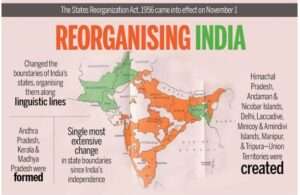
The government then attempted to find a comprehensive and institutional solution to the problem. The States Reorganization Commission, formed in 1953 and chaired by Fazal Ali, considered linguistic and cultural aspirations as well as administrative, economic, and geographical feasibility. Based on the Commission’s recommendations, the States Reorganization Act and the Seventh Amendment to the Constitution were enacted in 1956. This resulted in a major change in the administrative map of India, leading to the creation of 14 states and six union territories.
The greatest contribution of linguistic states was that they reduced the conflict between regional identity and national identity. When a community gained an administrative identity consistent with its language, culture, and local aspirations, feelings of alienation were weakened. People gained confidence that the Indian Union respected their distinct identity rather than eradicating it.
Another important benefit of linguistic reorganization was seen at the administrative level. The availability of governance and public services in the mother tongue or regional language reduced the distance between the state and the citizen. Democracy is effective only when citizens understand the language and processes of governance. Administration in regional languages facilitated the participation of ordinary citizens.
This system also broadened democratic representation. Local language-speaking political leadership was given the opportunity to emerge at the state level. This brought politics closer to public concerns, and the problems of different regions became part of the national discourse. Linguistic states also demonstrated that diverse regional identities can coexist with national unity within a federal system.
The reorganization of India did not end in 1956. Further changes to state boundaries occurred in response to changing political and social circumstances. The creation of Maharashtra and Gujarat in 1960, and the creation of Haryana in 1966 with the reorganization of Punjab, are significant examples. This demonstrated that the Indian Union is not a static and unchanging administrative structure, but rather an adaptable system adapting to democratic aspirations.
However, the success of linguistic states does not mean that all challenges related to linguistic identity have been eliminated. Tendencies such as linguistic majoritarianism, neglect of minority languages, and a sense of regional superiority can pose challenges to federal harmony. Therefore, along with preserving linguistic identity, it is also essential to protect the rights of linguistic minorities.
Today, the need is to ensure that regional aspirations are heard through constitutional and democratic means. Considering any regional identity anti-national is as unfair as placing regional identity above national identity. The true strength of Indian federalism lies in the balance between cultural identity and national unity.
Linguistic reorganization is a unique achievement of India’s nation-building. It taught the important lesson that unity cannot be achieved by suppressing diversity. By integrating linguistic diversity into the constitutional framework, India demonstrated that unity is strengthened not by imposing uniformity but by respectfully accommodating diversity. This flexible federalism remains a crucial foundation for India’s democratic stability and national unity even today.

